
AxessPoint: Oracle—Investment-grade rating, high-yield reality

By Nick Agoglia | 29 July 2026
Text
Oracle (ORCL) was downgraded to BBB- by S&P in early July, from BBB to one notch above high-yield. Its 30-year bonds have widened 150 bps since September, when it raised $18bn of debt for AI infrastructure. ORCL now trades wide to many BB names after raising another $25bn in February. But does it truly trade like a high-yield bond? By many metrics compared to peers, ORCL 30-year bonds have gone from near-first to near-last, becoming more high-yield by the day:
Its spreads are now wide of BB names: +25 bps to CHTR, +100 bps to VTRS, and +150 bps to many low BBB peers.
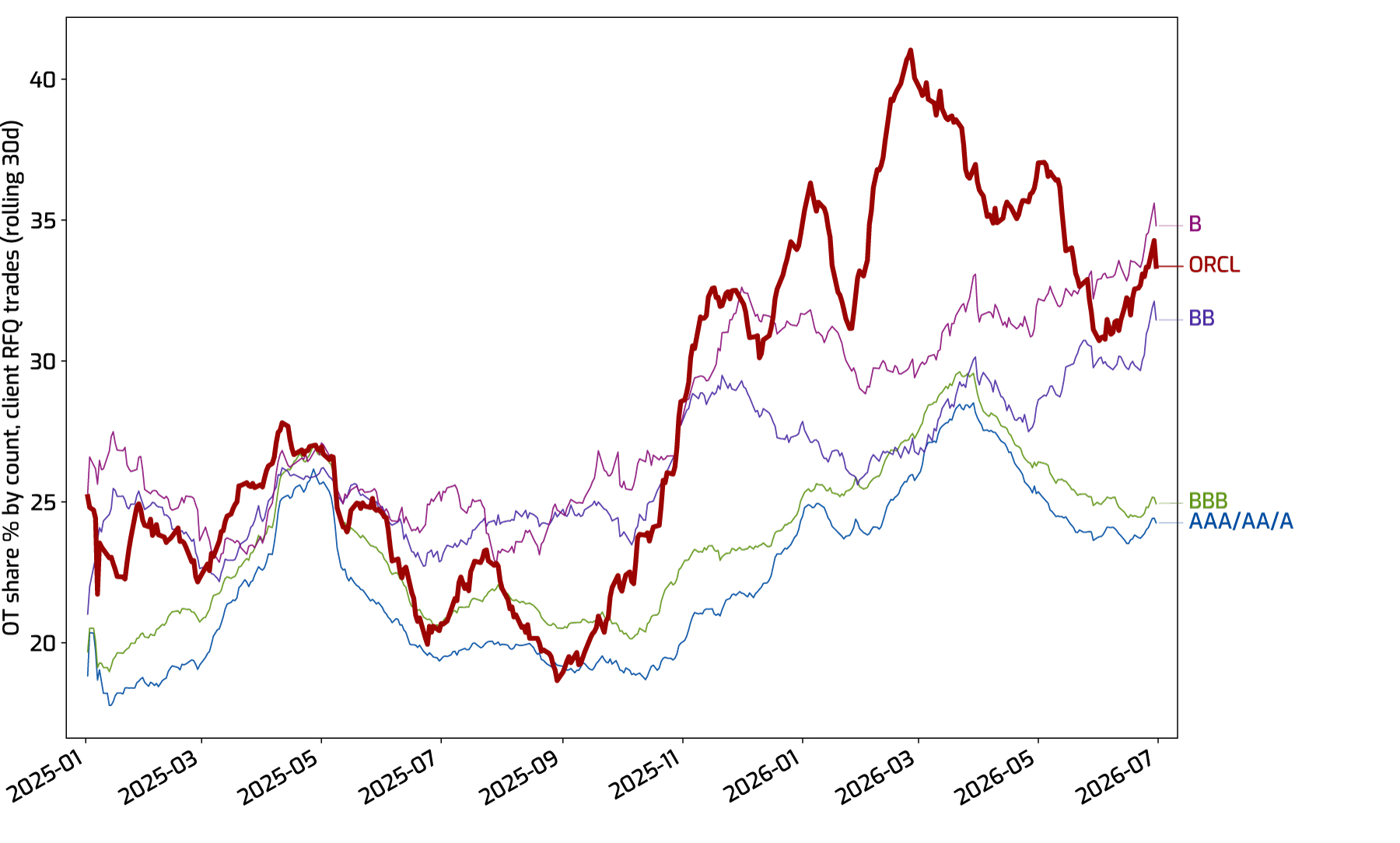
The share of client RFQ trades won by an Open Trading® response is up from 20% to 30-40%, a share typically seen during periods of high volatility or in BB and single B bonds.
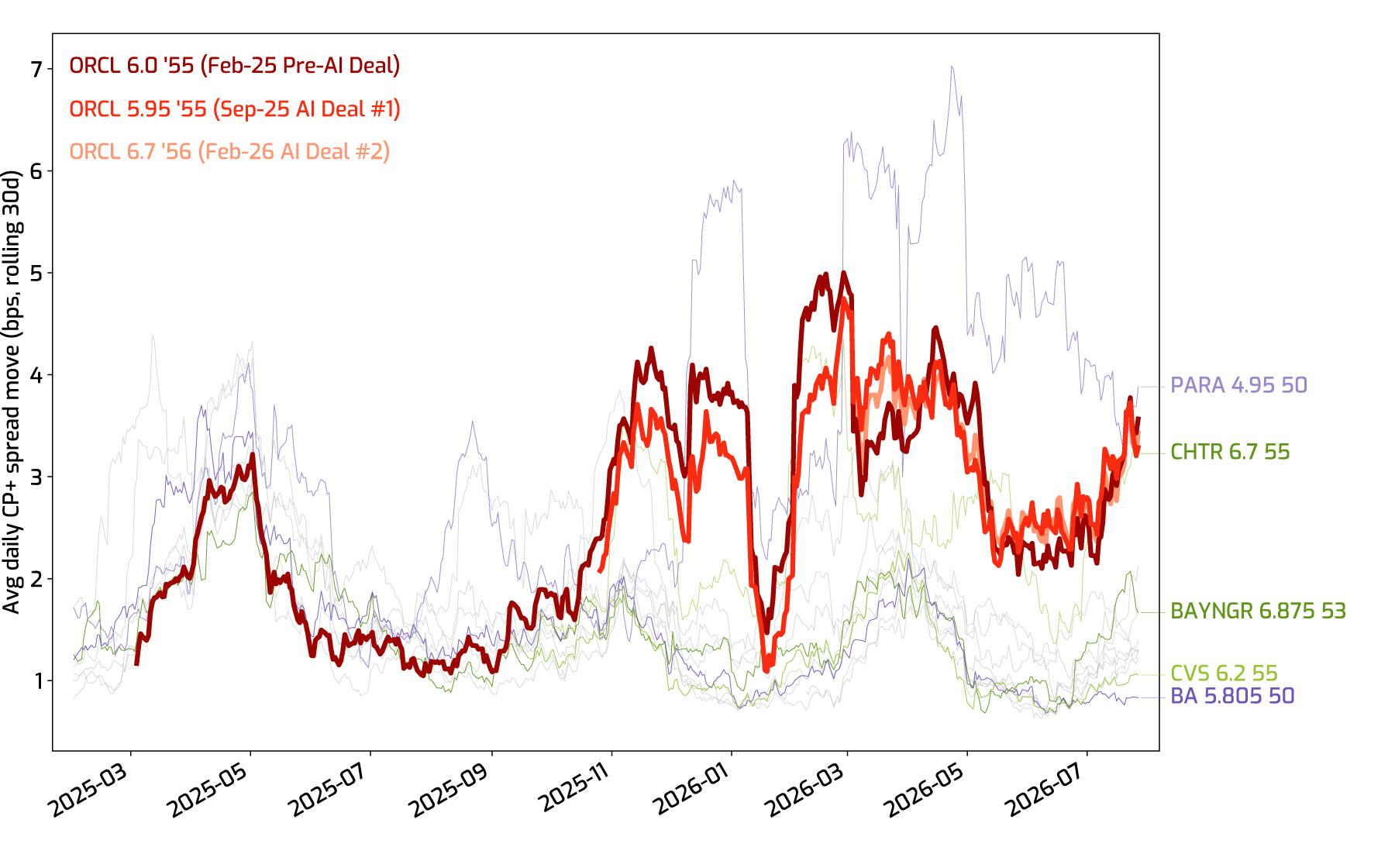
It now moves 3 bps a day on average, in line with PARA and up from only 1 bp for much of 2025.
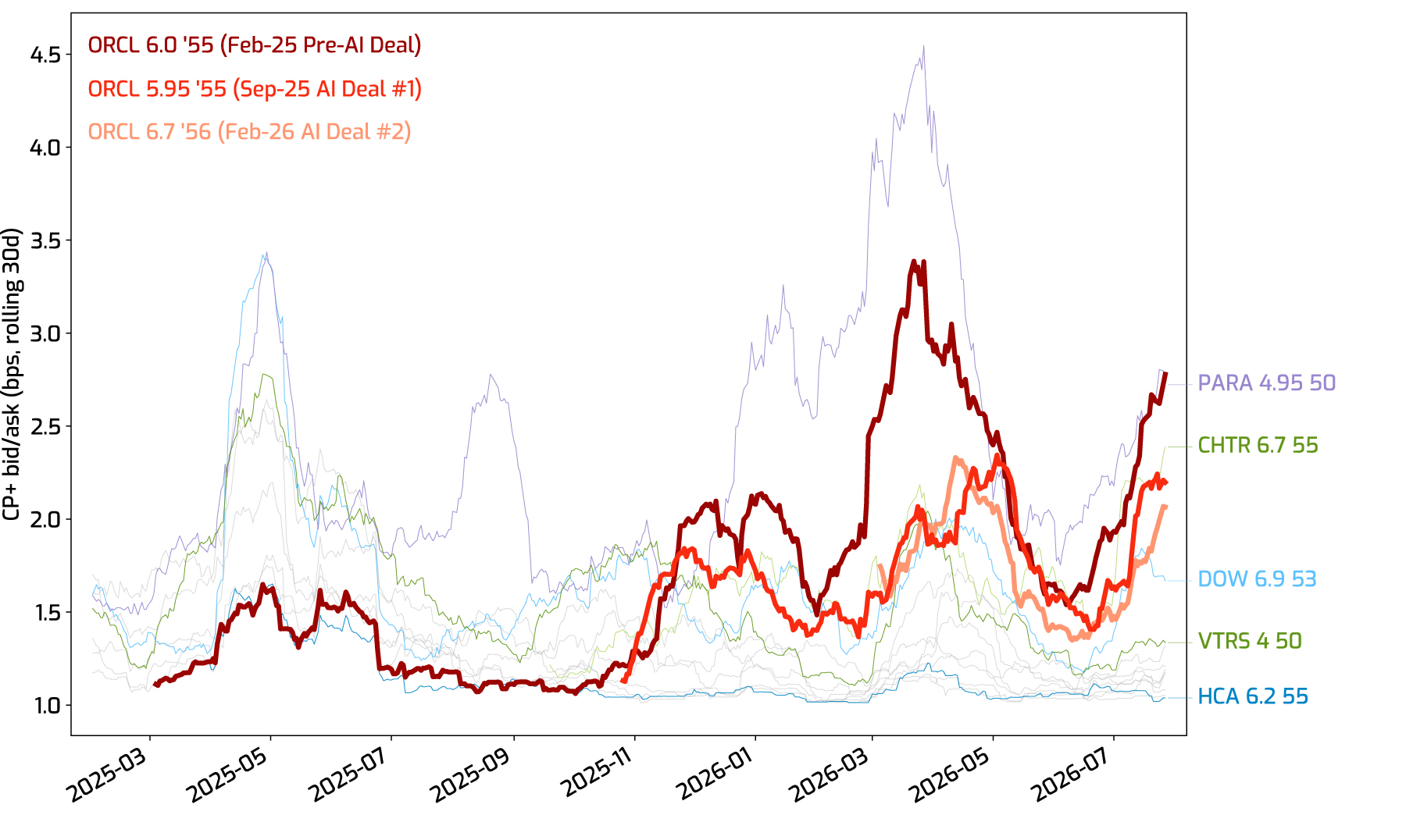
Its more seasoned 30-year bond has a bid-ask of almost 3 bps, while its BBB peers are all under 1.5 bps.
Below we look at its three newest 30-year bonds: two issued as part of the hyper-scaling deals in February 2026 and September 2025, and one issued just before in February 2025. We compare them to many liquid 30-year benchmarks: high profile BB names like CHTR and PARA, tech BBB names that were (once) its peers like AVGO and INTC, and finally non-tech BBB names also in the news or highly liquid like BA, CVS, and HCA.
1. Spread
Except for PARA 4.95 ’50, ORCL trades wide to both BB 30-year bonds of comparable size. At +275, ORCL trades 25 bps wider than CHTR and 100 bps wider than VTRS, both liquid BB 30-years with over $1bn outstanding. As recently as summer 2025, ORCL at +125 traded tighter than almost all the bonds shown below.
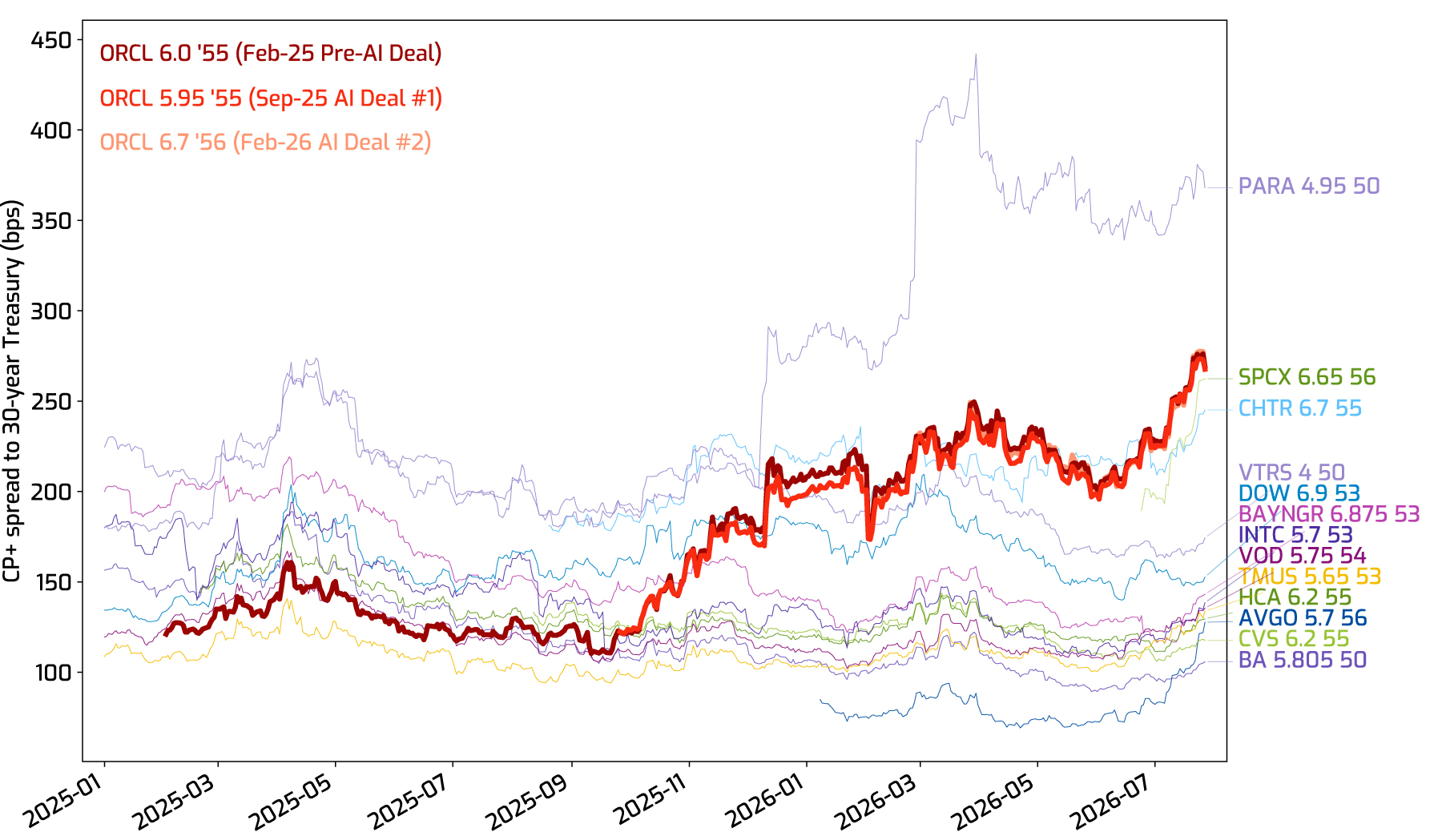
*Data as of July 28th, 2026
2. Price change since Jan 1st 2025
The shift is particularly evident in ORCL’s price change. We compare ORCL to its peers for all 30-year senior bonds of at least $750mm deal size. Like an index, we start on Jan 1, 2025 and weigh each issuer’s daily price changes by amount outstanding. ORCL long bonds have deteriorated over 20% in price terms, worse than PARA and all its BBB peers.
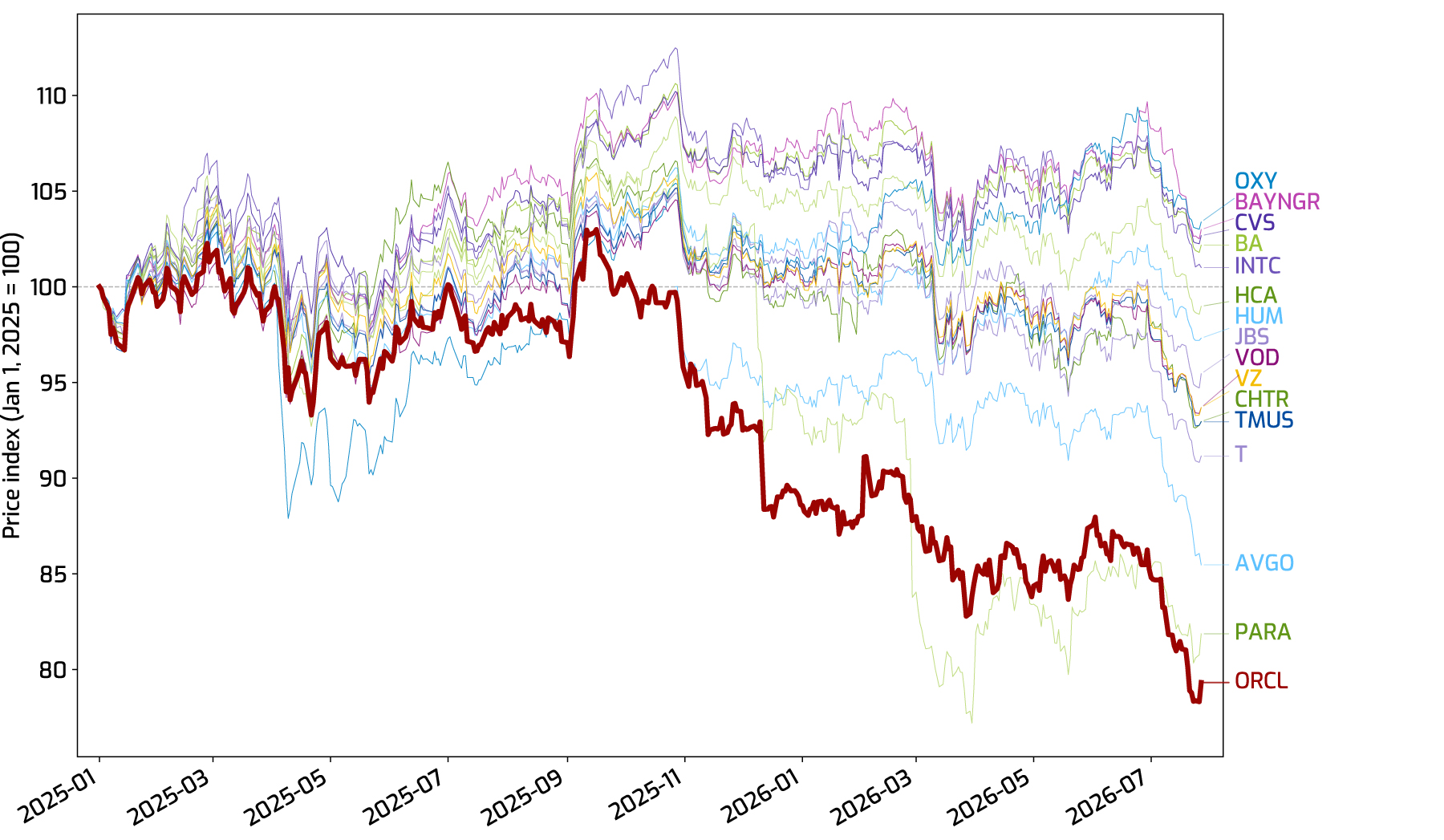
*For illustrative purposes, clean price only – does not include coupons and accrued interest.
3. Open Trading share of trades
The share of client RFQ trades won by an Open Trading response typically rises with higher volatility and lower credit quality. For stressed credits and volatile markets, the value of the MarketAxess OT network rises to fill in liquidity gaps. ORCL's share by count doubled from 20% just before its first AI deal in September 2025, to 40% by the time of its second deal in February. An OT response wins a third of trades in ORCL currently, more in line with BB and even single B buckets, and above the 25% typically seen for investment grade.
4. CP+™ bid-ask spread
The bid-ask on ORCL's older pre-AI issue has converged with PARA 4.95 '50 to almost 3 bps. Its Sep '25 deal has a bid-ask comparable to CHTR 6.7 '55. Its most recent issue has a bid-ask of 2 bps, while more seasoned BBB peers all have a bid-ask near 1.5 bps and some as tight as 1 bp.
5. Average daily spread change
ORCL’s spreads to treasury now move 3 bps a day on average, in line with PARA 4.95 '50 and CHTR 6.7 '55 recently. Before its massive AI issuance, it used to trade +/- 1 bp per day, like most of its BBB peers still do.
Conclusion
While Oracle may still carry an investment-grade rating, its 30-year bonds are increasingly trading with high-yield characteristics. Wider spreads, steeper price deterioration, higher daily spread volatility and a rising Open Trading share all point to liquidity characteristics more commonly associated with BB credit than investment-grade peers. The market appears to be repricing Oracle’s AI-driven debt buildout in real time, with liquidity dynamics and trading behavior suggesting that investors are already treating Oracle as high-yield risk.