
Blockbusting Part 2 | Examining market impact of client inquiries

By Gio Accurso, Grant Lowensohn | 28 September 2023
Text
Highlights and objectives
-
We aim to examine the price impact of client-initiated inquiries on the market, during a period of extreme volatility, to examine what drives information leakage.
-
When trading large EUR IG blocks on MarketAxess in March 2023 , traders managed to minimize market disruption. Moreover, post-trade analysis showed no adverse spread impact from their block trading activity.
-
Instead, market impact was driven more by prevailing market conditions than the number of dealers that saw a given order.
-
Sending an inquiry to Open Trading on MarketAxess did not lead to more post-trade spread movement – as such, the additional access to liquidity that Open Trading provides outweighs the potential information leakage.
Methodology
-
We limit our study to client-initiated inquiries on the MarketAxess platform within the EUR IG segment during March 2023, a month which exhibited high levels of volatility thereby offering a unique opportunity to examine post-trade market impact of all inquiries.
-
We approximate market impact by computing the average percentage change in CP+™ levels in spread terms – for a given bond and side (e.g. bid, offer) – between time of inquiry submission and 5, 10, 15, 30, 60 and 120-minute intervals.
-
To standardize the percentage changes, we normalize by the CP+ bid/ask spread at the corresponding time interval.
-
Lastly, we remove instances of extreme outliers in spread movements that were likely the result of incorrect benchmarks and/or yield calculation irregularities.
Effects of block trading on market impact
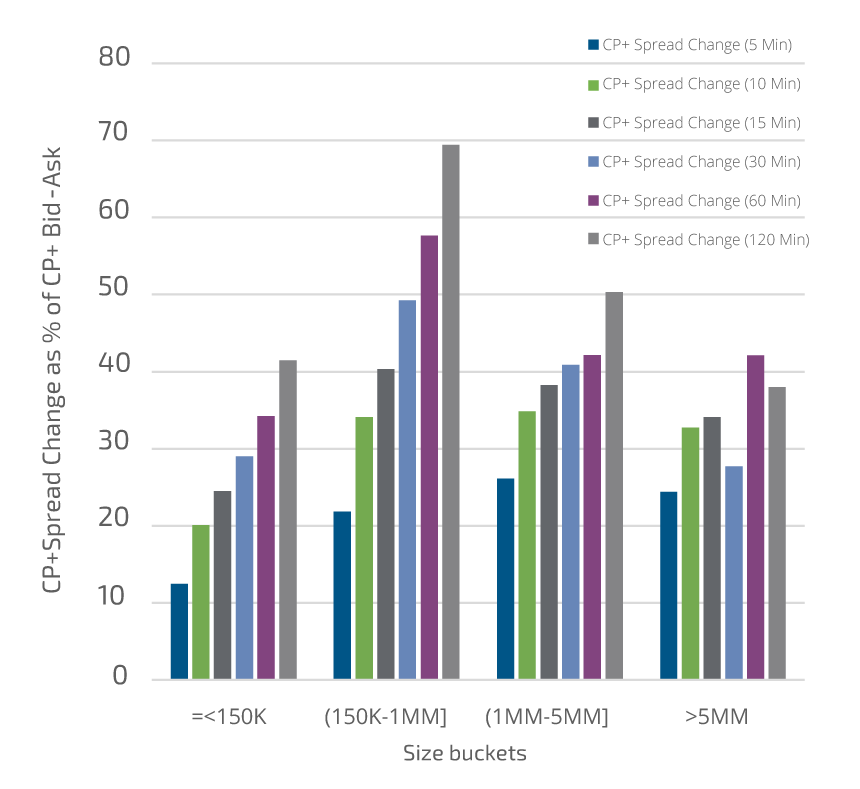
Generally, one would expect larger trade sizes to have greater market impact – the larger the trade, the higher the likelihood for slippage and post-trade movements. Figure 1 explores the effect of trading larger sizes on post-trade spread movements. For the EUR IG segment during March 2023, size does not correlate with market impact as we do not see percentage changes in CP+ movements increasing for larger size buckets.
As such, the analysis shows that trading larger, EUR IG blocks on the MarketAxess platform did not contribute to material, adverse post-trade movements.
Trade size vs. market impact
Effects of order direction on market impact
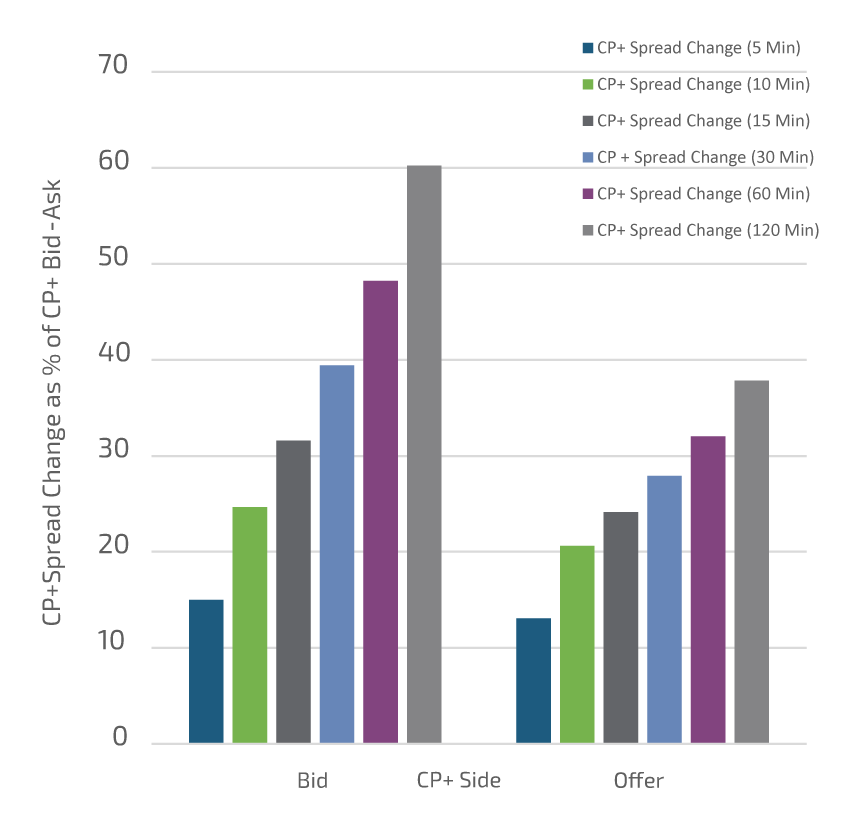
In times of high market volatility, we expect to see an imbalance of trade orders in one direction and pricing movements to match. Figure 2 explores the effect of direction on market impact in both spread terms. CP+ movements ranged from 1.2-1.5x greater on the bid than offer side. Given that percent changes were normalized by the underlying CP+ bid/ask spreads, this suggests that the primary driver of spread movement was market beta.
Order direction vs. market impact
Liquidity analysis
Conventional reasoning would expect a positive relationship between the number of counterparties privy to an order and market impact; however, trends from March 2023 provide an alternate picture. In Figure 3, we assess the combined effects of the number of dealers invited to respond and whether an inquiry was sent to Open Trading - ultimately, we do not see a measurable difference in post-trade movement across all four scenarios.
Furthermore, both the average number of responses to an inquiry sent to Open Trading (1.73) and the penetration rate (27.11%) for March 2023 were in line with monthly figures from both before and after the period of study. The relative parity in CP+ movements further supports the thesis that the market volatility in March was not due to limited liquidity provisions but rather a market-wide selling off triggered by uncertainty in the bank/financials sectors.
Number of dealers invited + Open Trading vs market impact

Summary
The objective of our study was to examine the effects of client-initiated inquiries on the market, via their price impact, during a period of extreme volatility, to examine what drives information leakage. Specifically, does trading blocks electronically during periods of high market beta lead to greater CP+ movements? Our conclusions are two-fold: (1) regardless of order direction and block size, trading electronically did not lead to excess market impact in the EUR IG segment and (2) market beta, rather than the manner in which a client trades, is the primary driver for post-trade movements. Accordingly, our analysis of the EUR IG segment during March 2023 reflects that trading electronically – irrespective of size and direction – did not lead to material market impact.