
Europe’s bond transparency regimes put data in the spotlight

By Geoff Morton | 1 July 2025
Text
It’s no secret that the launch of the US Trade Reporting and Compliance Engine (TRACE) over twenty years ago was a great leap forward for bond markets. Now, UK and European markets are catching up, with regulators set to roll out their latest takes on post-trade transparency. For financial institutions, this is an opportunity to assess the emerging transparency landscape and ensure their data strategies are optimised as the trading environment evolves.
The centrepiece of UK (FCA) and EU (ESMA) transparency efforts is a complete overhaul of the rules governing when transactional data, currently being collected by Approved Publication Arrangements (APAs), can be made available publicly1. This promises a clearer view of market dynamics—an estimated 80-90 percent of corporate bond trades are expected to be published in real time—but also presents challenges for interpretation. While the two frameworks are similar, the differences mean that the price and volume information for the same bond trade could be transmitted to the market at different times, dependent on the reporting entity (Figure 1). While ESMA is broadly more transparent—with maximum deferral times of four weeks compared to the FCA’s three months—there is still no shortage of complexity. A total of 68 different deferral scenarios have been devised for corporate and sovereign bonds across both regimes2.
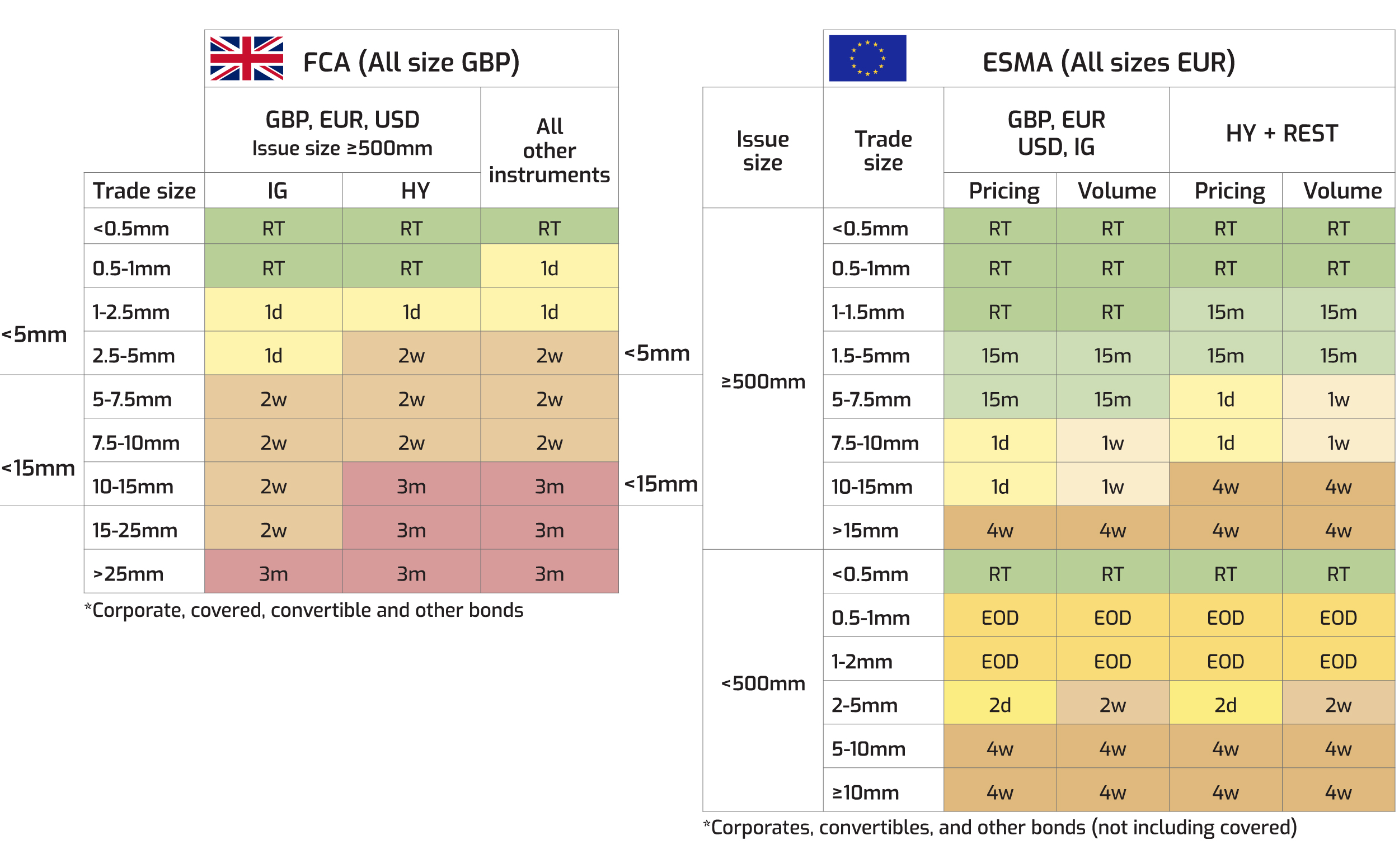
Figure 1: A comparison of deferral times for corporate bonds under the new transparency regimes. The trade size boundaries are defined to help with comparison.
1An APA is a regulated entity that publishes trade reports on behalf of an investment firm.
2See Table 8 of FCA Policy Statement PS24/14 and tables on pages 45, 46, 49, 50, and 52 in MiFIR review Final Report ESMA74-2134169708-7775.
The introduction of Consolidated Tape Providers (CTPs) for each regulatory regime will go some way to mitigating this complexity, by reducing the number of data sources. This will change from 18 different APAs and dozens of other reporting mechanism to two consolidated feeds. However, market participants will still need not only to assess how best to consume the new datasets available (as well as understand the complexities of the reported data they provide) but also how valuable they are to their organization.
As the leading provider of data to EU and global fixed income markets over the last decade, we’re used to advising clients on how best to determine that value. We know that 3 key factors affect decisions on data consumption and use—quality, coverage and timeliness. In the paragraphs that follow, we take a look at these criteria, examining them in the context of TraX®, our unique source of executed global fixed income data.
Taking the lead on data quality
A comprehensive focus on market transparency means market participants will be required to pay much closer attention to data quality; we know this as a consequence of our continued development of TraX. The breadth and historical scale of the data set—containing 85% of the European and sizeable proportions of the APAC, CEEMEA and other fixed income markets—has provided us with extensive opportunities to continually refine and test its data-cleansing algorithms. Similarly, our users’ pursuit of ever-higher levels of real-time transparency, combined with the robust community of buy- and sell-side clients consuming the data, has helped provide the feedback needed to optimise the testing—and hence the quality.
As a simple comparison, we recently applied these techniques to a population of fixed income trades published by the top 10 APAs and found that almost 40 percent were not usable as-is, requiring extra processing (Figure 2).
Percentage of Clean Trades in the Top 10 APA's
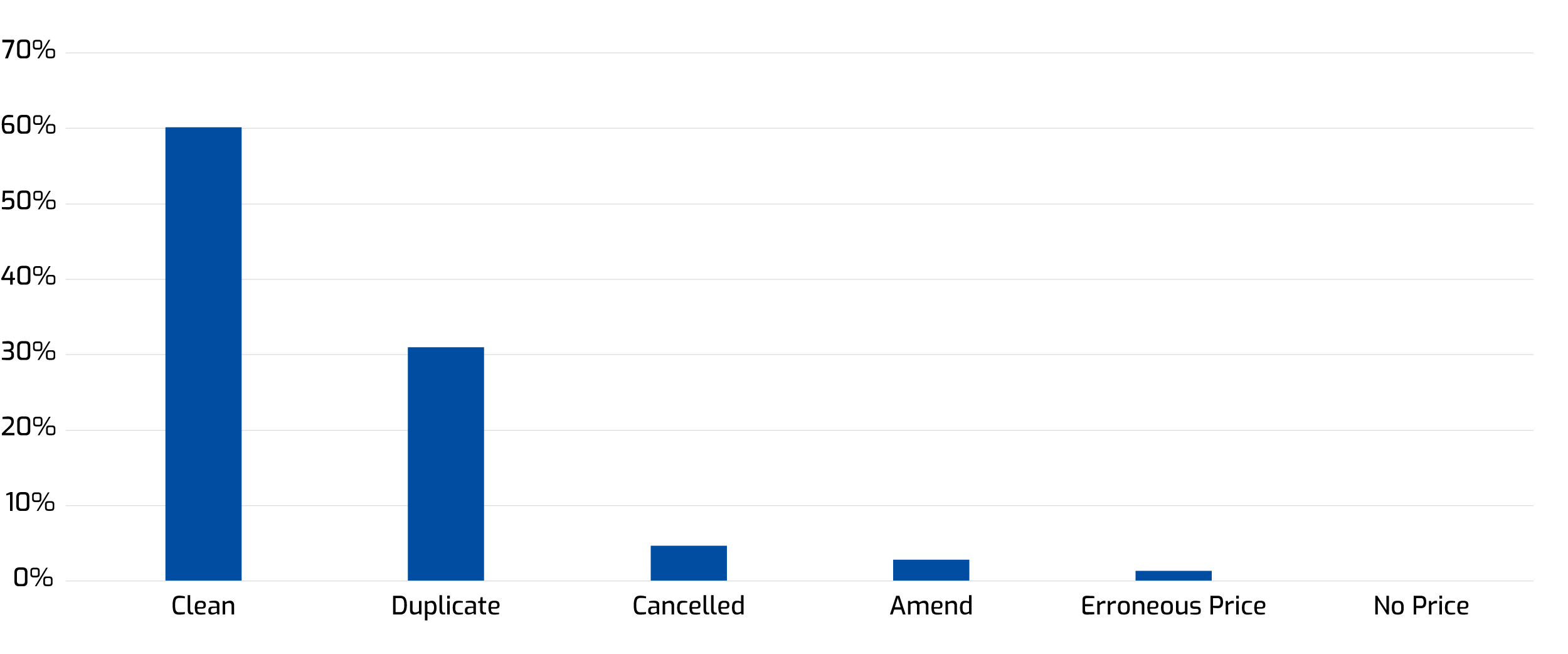
Figure 2: Output from TraX proprietary data-cleansing algorithms on trade data published by the top 10 APAs, covering all fixed income market activity in Q1 2025.
As UK and European trading desks formulate their data strategies, they will need to consider how to balance the potential of regulatory offerings against the work needed to ensure data quality and integrity. With upstream challenges likely to persist, institutions should consider solutions that offer a track record of producing clean, actionable data tailored to market needs.
Getting the most out of coverage
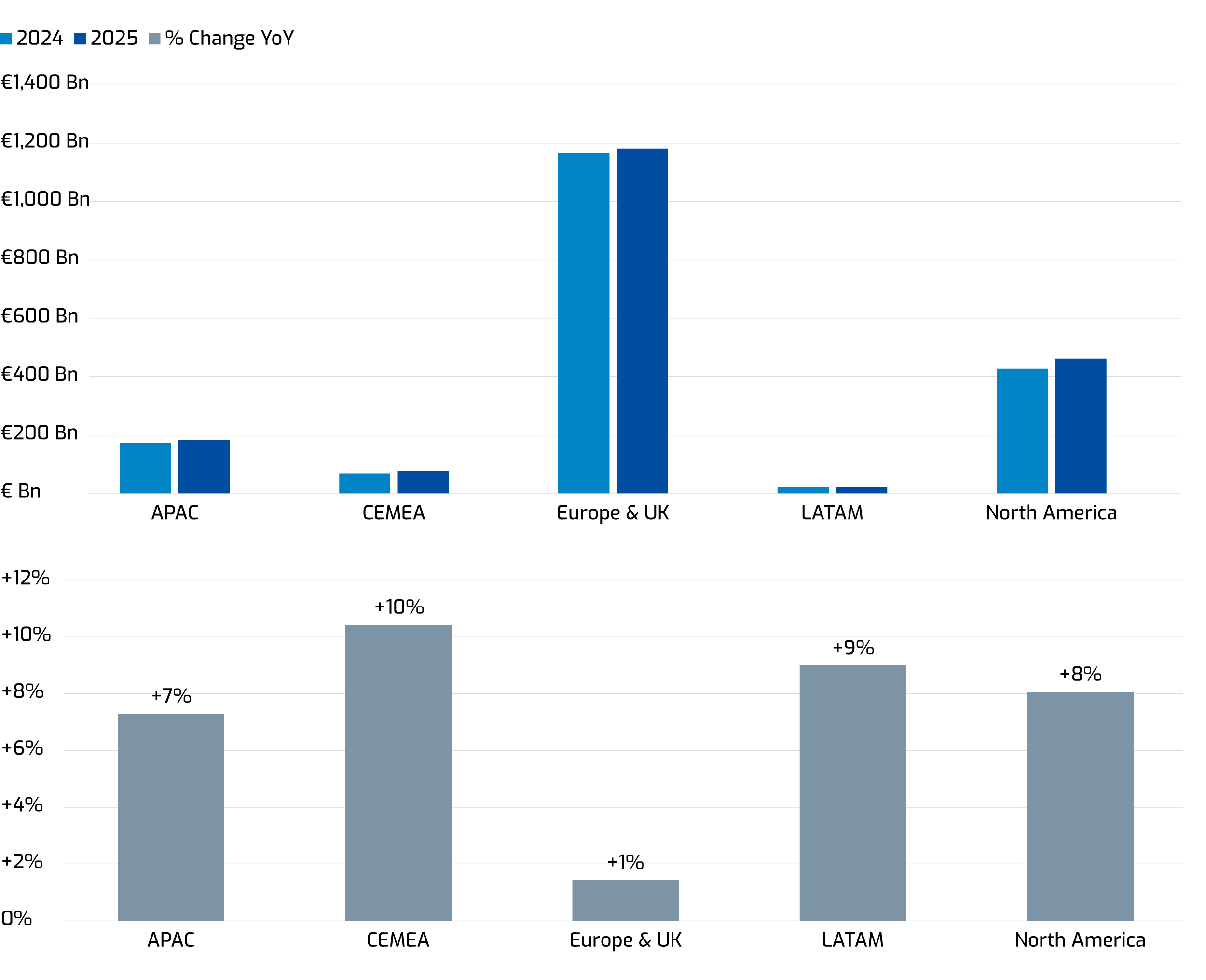
In today’s globalised markets, the deeper and broader the datasets, the more valuable they are. Multiple interconnected markets and trading strategies require a holistic, global view of transaction data. That plays to our strengths as a global trading platform: Our enriched TRACE offering covers the US market, and when combined with the TraX product suite, that completes the global picture. The combined dataset is inclusive of contributions received around the clock, across markets in Europe, APAC, the Americas and beyond (Figure 3).
Corporates by issuer region Q1 2025 v 2024
Sovereigns by issuer region Q1 2025 v 2024
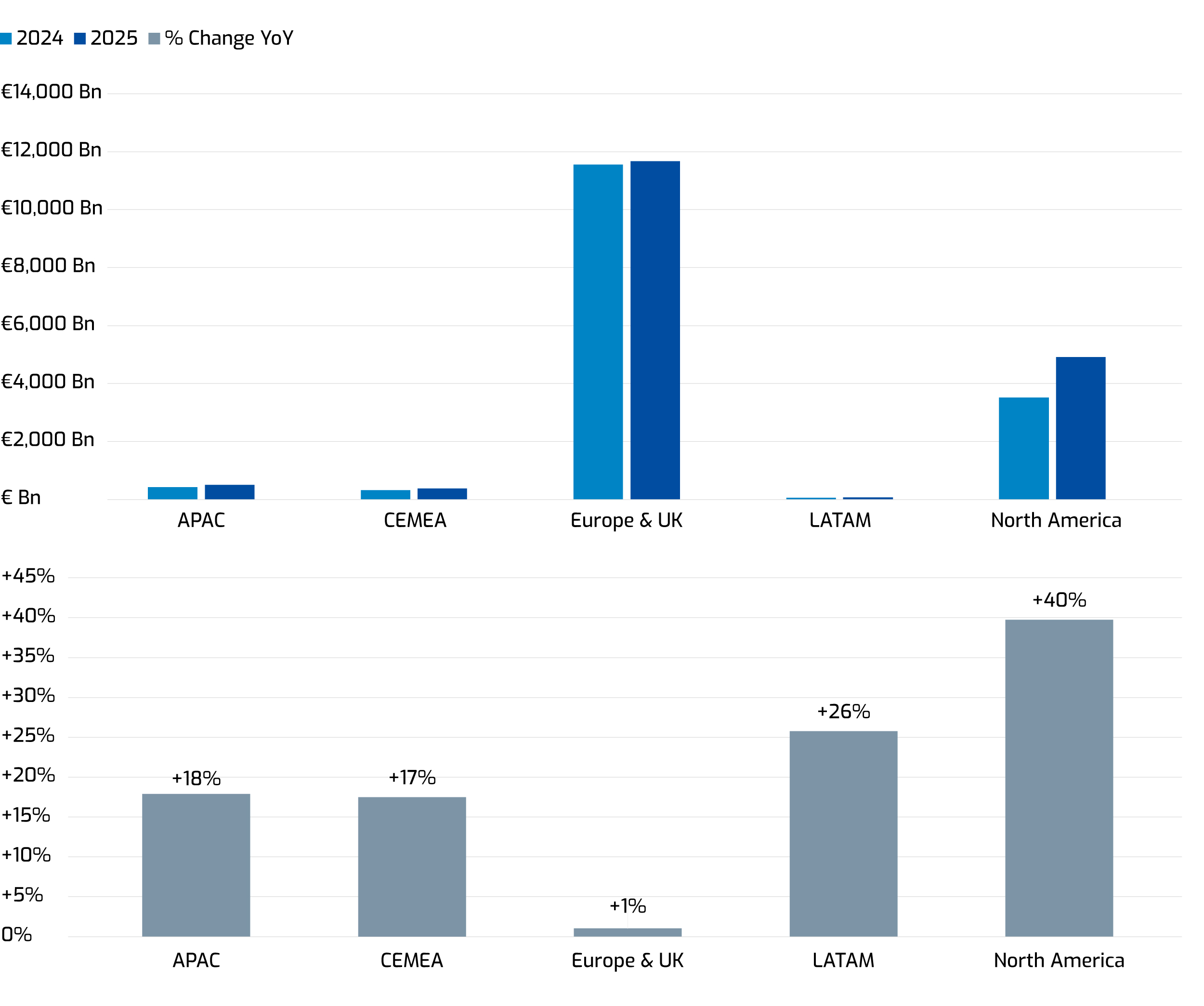
Figure 3: Total volumes collected by the TraX data set in Q1 2025 compared with 2024 across corporate and sovereign bonds.
TraX data is available through a number of live and end-of-day data products. Axess All Prints, our real-time transacted price service and most akin to a TRACE-like offering, publishes daily price prints on over 50,000 executed trades across over 13,000 unique instruments. It has expanded its coverage more than three-fold since launching in 2022, and the team has remained focused on continuously improving the offering. The most recent update to Axess All Prints added clean, real-time pricing for sterling corporates and EM local markets as well as trade direction on every print, increasing average daily trade count coverage by ~15%.
We believe the overlay of the new transparency rules will super-charge the relevancy of our products, allowing for a level of detail on the underlying transactions not previously achievable, all within the regulatory framework. And, with TraX’s contributor-led model, the ability to evolve the product-set in concert with the markets will only further help users to cut through the noise and get precise insights on both primary and secondary markets.
Case Study 1: TraX data to see the full picture
Consider two illustrations:
In March 2025, as German Bunds moved sharply following news on the country’s fiscal policy, secondary trading volumes spiked as market prices fell. At the time, clients using our TraX Volume data were able to filter out primary market volumes to focus on secondary market trends, as well as understand the client-buy skew in long-term securities.
In the UK, a continuing news story about the fate of Thames Water linked to controversies over its environmental record and financial viability dominated headlines. TraX users were able to view historical and real-time bond market reactions to these events, not just the total trading volume but also the direction of those flows.
Global, clean, and timely data offers clients a competitive advantage in complex and volatile markets, underscoring the need for a complete data set.
The importance of timeliness
Just as important as what data is available is when it is available. In the both the EU and the UK, regulators have imposed deferral periods for many bond trades. Indeed, some larger trades on less liquid bonds will have to wait to be reported to the market for as long as three months3. TraX, by contrast, receives data directly from (primarily) the dealer community, allowing for a real-time decision on not just when, but how the information should be transmitted4.
3Maximum deferral time under the FCA regime is 3 months, whereas under ESMA it is 4 weeks. Broadly speaking EU reported transactions will be available before the equivalent FCA reported transactions. Deferrals are the responsibility of the transaction reporter.
4TraX receives over 95% of trades in real-time or close to it.
One widely used TraX product is Axess All®, our intra-day trade tape, that provides aggregated & anonymised volume and pricing information for the most actively traded bonds on a 15-minute delay. This innovative approach to transparency means that users can get a more complete view of the actual market dynamics—without the potentially market-moving consequences of publishing the full economics of the most impactful trades.
Once again, our approach allows for the continual refinement and adapts to the evolving needs of market participants. In a world in which information is at a premium, speedier publication can offer market participants a clear advantage.
In summary
As electronic trading continues to expand globally and the regulatory backdrop evolves, the relative performance of different data solutions will feature high on decision makers’ agendas. Their task in the coming months will be to identify products that do the best job of enhancing their trading strategies. In that context, key considerations will include levels of data quality, coverage and timeliness, as well as the presence of value-adds such as extra data fields and customised market intelligence.
We believe TraX and its various derived products offer the best of all worlds—quality, coverage and timeliness in easily-to-consume and ready-packaged solutions designed to meet multiple and various use cases for the data, from front to back office.
Learn more by visiting our product pages:
TraX®