
Fed-day dynamics in a post-forward guidance era

By Nick Agoglia | 8 July 2026
Text
Introduction
At its last meeting, the Federal Reserve announced a meaningful change to its communication strategy: the removal of forward guidance. For over two decades, forward guidance helped markets form a view on the likely path of interest rates before the decision hit. With that guidance now pulled back, the market may need to place more weight on the 2:00 pm decision itself and on the trading conditions that follow.
There is no clean “before” and “after” for a world without forward guidance; the policy pre-dates even the creation of TRACE. The closest recent proxy for a volatile Fed is the 2022–23 hiking cycle, when meeting outcomes were far less certain, and the market absorbed larger policy surprises. We compare that period with the calmer, better-telegraphed post-hiking regime of 2024–26, using MarketAxess data to examine how US high grade and high yield activity behaves around the 2:00 pm decision and 2:30 pm press conference.
Highlights:
Inquiry activity always dips leading up to the 2:00 pm release. In the 2022–23 hiking era, it returns immediately in the 2:00–2:30 pm release window. In recent years, it peaks after 3:00 pm when the rate decision has less surprise and more focus is placed on the press conference comments around forward guidance.
Response quality has improved significantly in 2024–26. Execution costs have barely increased compared to a normal Wednesday – a return to a volatile Fed without forward guidance could see them rise again.
Quantity of responses remains consistent in both eras with only a slight dip during the release window
The share of trades won by an Open Trading® response has increased in recent years, and remained consistent compared to a normal Wednesday even during the volatile 2022–23 hiking cycle.
Inquiry activity dips before the print, its return varies in each era
We first looked at how MarketAxess platform activity in US credit behaves in the minutes around a Fed decision under both regimes. We focus on client-initiated Request-For-Quote (RFQ) and Portfolio Trading activity in US high grade and high yield credit. Ahead of the print, notional inquired dips in each era, especially compared to a normal Wednesday in the same period. After the print, activity comes back, but the path back depends on how much uncertainty went into the print or the comments after.
In the 2022–23 hiking cycle, inquiry rises in the half hour after a very volatile release (2:00–2:30 pm) and remains at the same levels the rest of the trading day. In recent years, activity also increases after the 2:00 pm release, but it keeps rising into the 2:30 pm press conference until it finally peaks after 3:00 pm. These releases had well-telegraphed guidance and an expected rate outcome, shifting more focus to Powell’s comments in the presser, where more clarification around forward guidance is delivered.
Fed-day inquiry notional under each era
A lull ahead of the 2 pm statement compared to normal Wednesdays, then different post-decision behavior
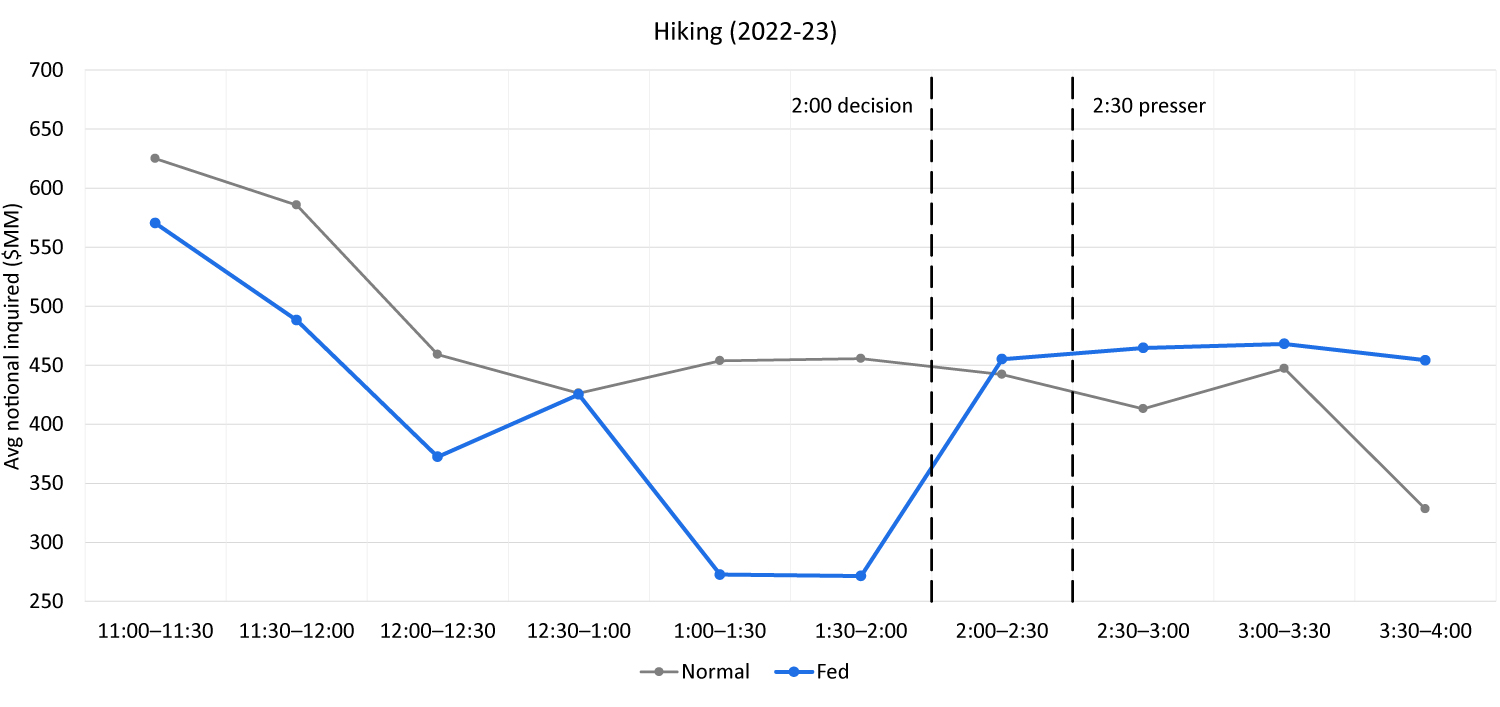
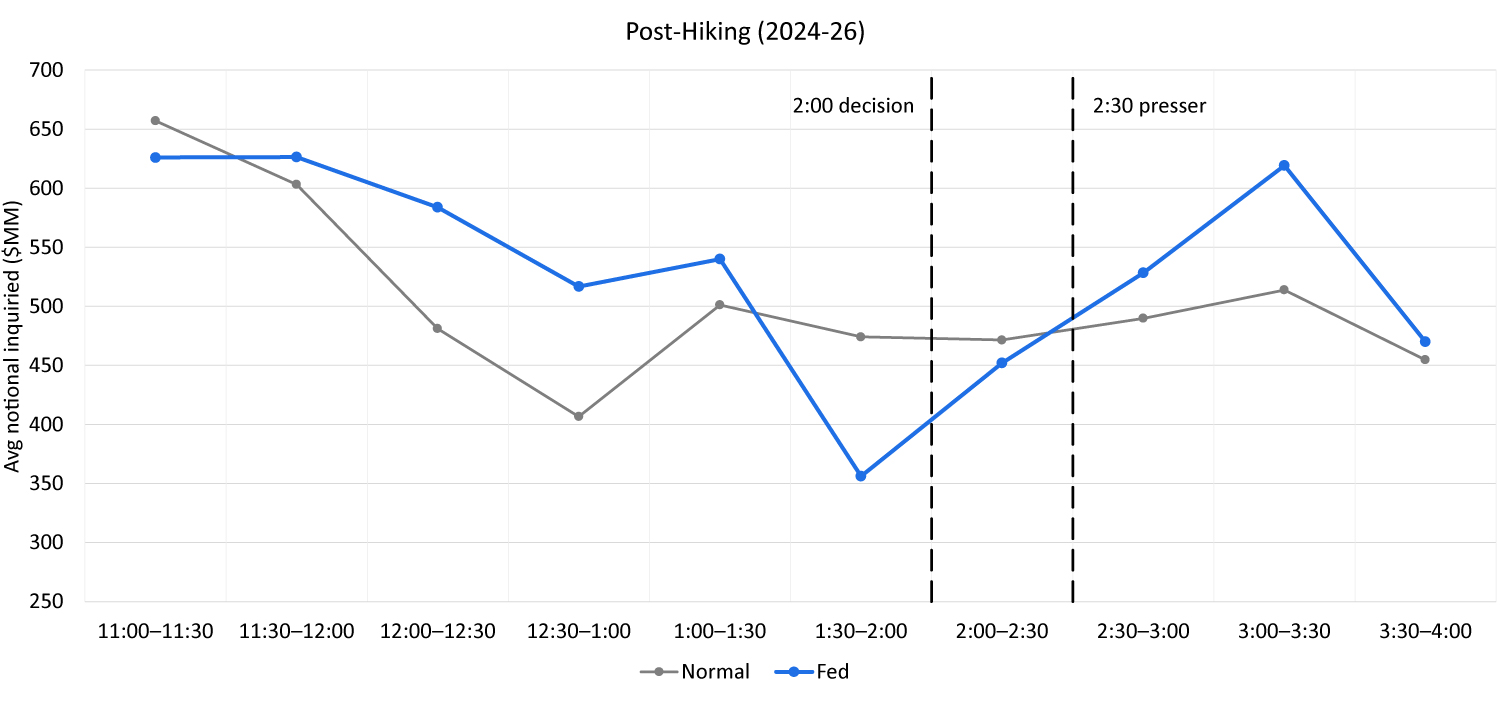
Takeaway: The market will wait for the print regardless of the Fed regime. When the re-engagement arrives and for how long will increasingly depend on the uncertainty of the 2:00 pm rate decision in a post-forward guidance world.
Execution quality improves in recent, less volatile meetings
When Fed meetings concentrate risk in a small window, it’s expected that transaction costs will rise. They do, but only marginally in recent years. We measure the median of US high grade spread trades against the corresponding CP+™ side at the time of the inquiry. A positive value means the client traded better than the CP+ side (the offer on a buy trade and bid on a sell trade).
On a normal Wednesday in both eras, clients execute a few tenths of a basis point better than the CP+ side all afternoon long. In aggregate, dealers and liquidity providers are consistently improving their responses versus where CP+ estimates they should be.
On Fed release days in the 2022-23 hiking cycle, dealers still improve upon CP+ by 0.1 to 0.4 basis points leading into the release. For just 30 minutes immediately following the release, this flips to not even 0.2 bps worse, and fully recovers by the time of the press conference in the hour following 2:30 pm.
In the post-hiking regime, the rise in transaction costs is a fraction of that. Median execution remains a few tenths of a basis point better than the CP+ side early in the afternoon, then hovers right at the CP+ side before the release, and dips not even a tenth of a basis point worse immediately after the 2:00 pm release. Compared to a normal Wednesday, there is less than a 0.2 bp difference in transaction costs during the entire afternoon.
Execution vs corresponding CP+ side
US High Grade (spread)—median client RFQ trades vs CP+ side
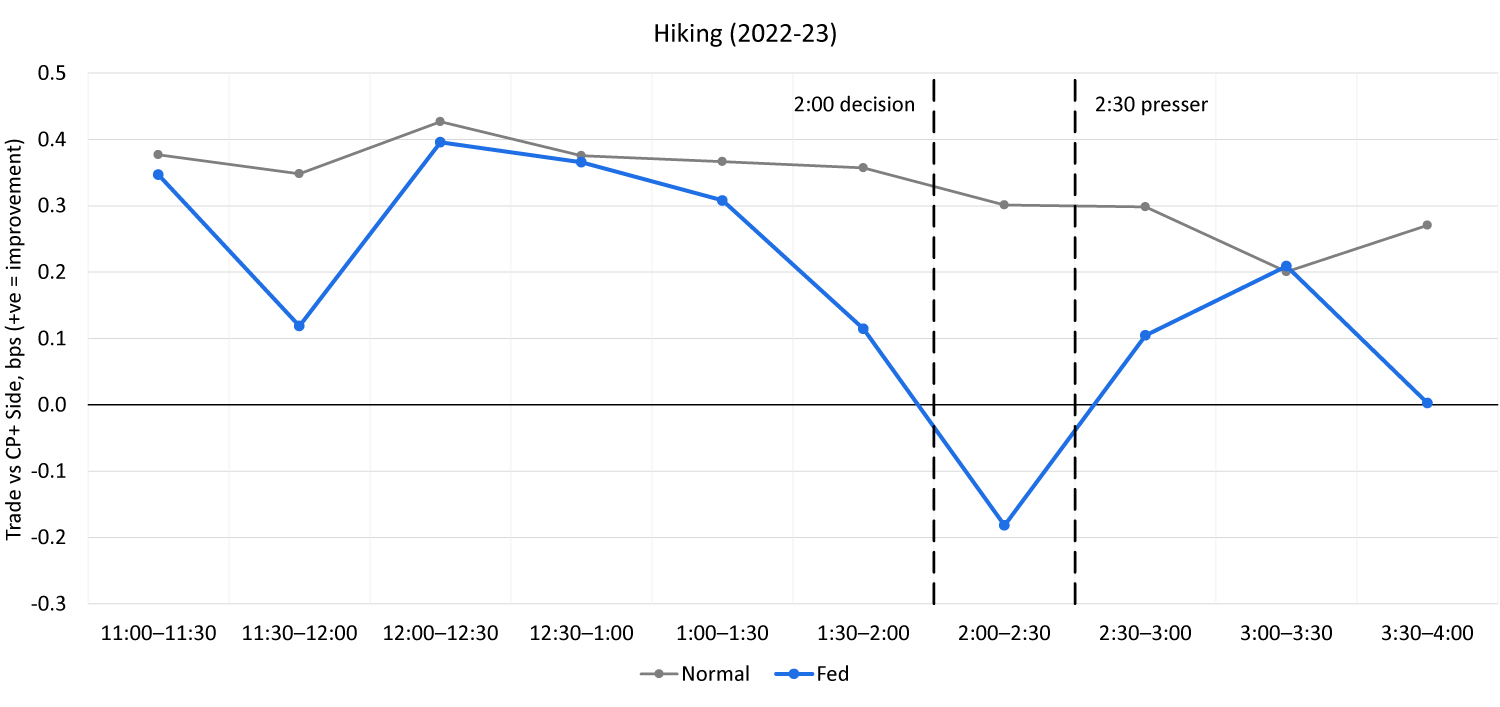
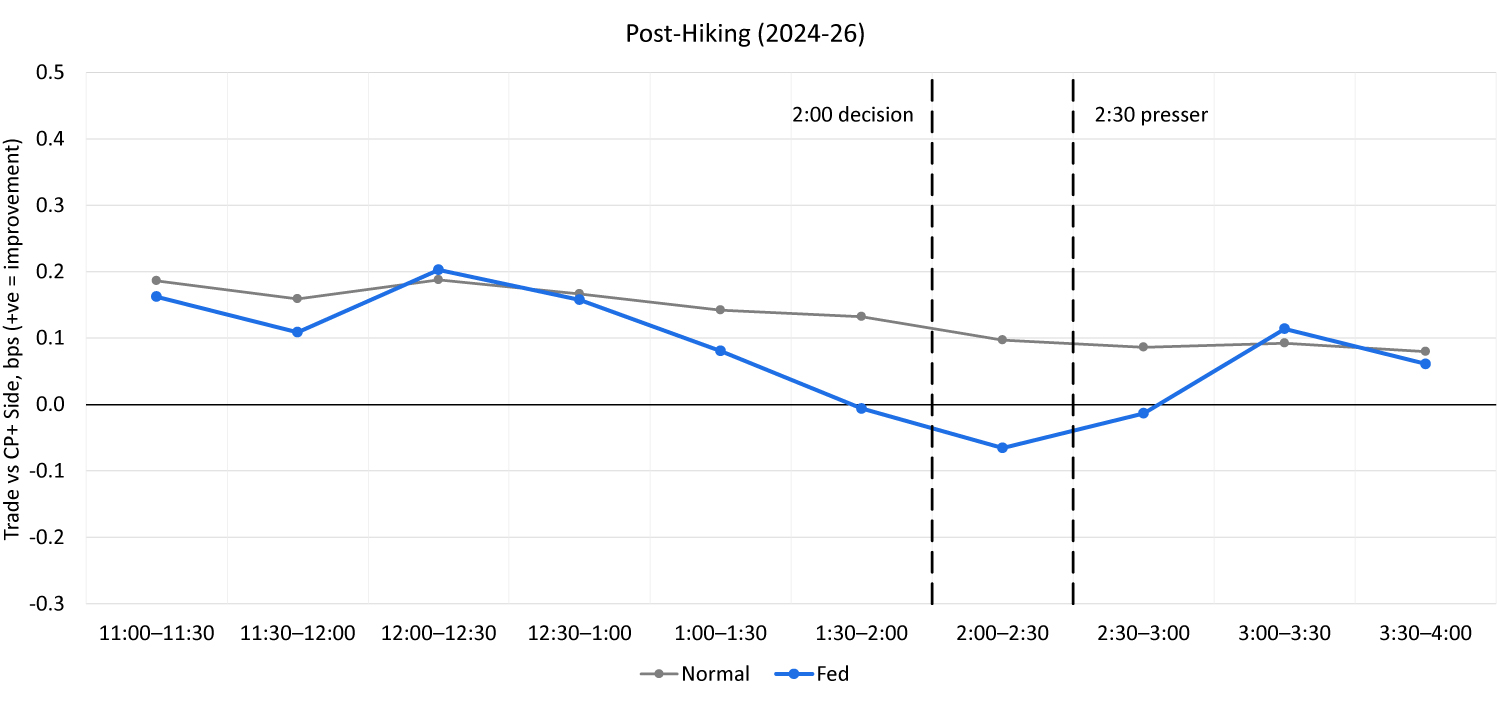
Takeaway: Recent Fed releases have barely increased transaction costs. The 2022–23 hiking cycle suggests the potential for almost half a basis point of additional friction in the release window, if removing forward guidance reintroduces volatility around the release.
Open Trading fills liquidity gaps during Fed releases
A common assumption is that electronic liquidity, particularly all-to-all protocols, might retreat during periods of uncertainty. Even if dealers turn cautious, clients reach the broader liquidity pool that Open Trading (OT) provides. In the 2022-23 hiking cycle, Open Trading’s share of done trades remained within a percent or two of a normal Wednesday’s share.
In the 2024–26 period, Open Trading’s share of won trades jumps to just under 30% immediately after a Fed release, compared to 23% on a normal Wednesday. It remains elevated throughout the press conference: around two to three percentage points above a normal Wednesday’s share.
Won trades tilt to Open Trading through recent Fed decisions
US credit (HG+HY)—OT counterparty share of executed client RFQ trades by count
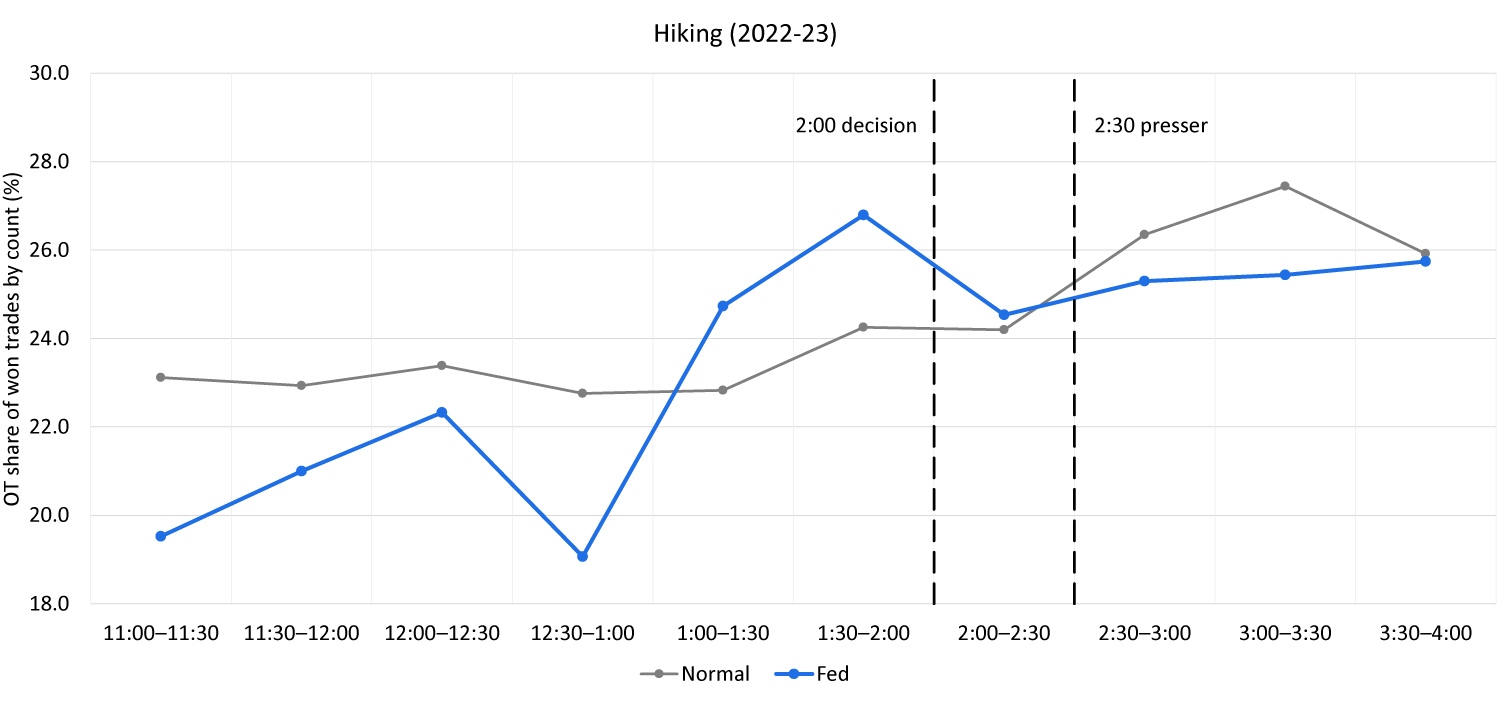
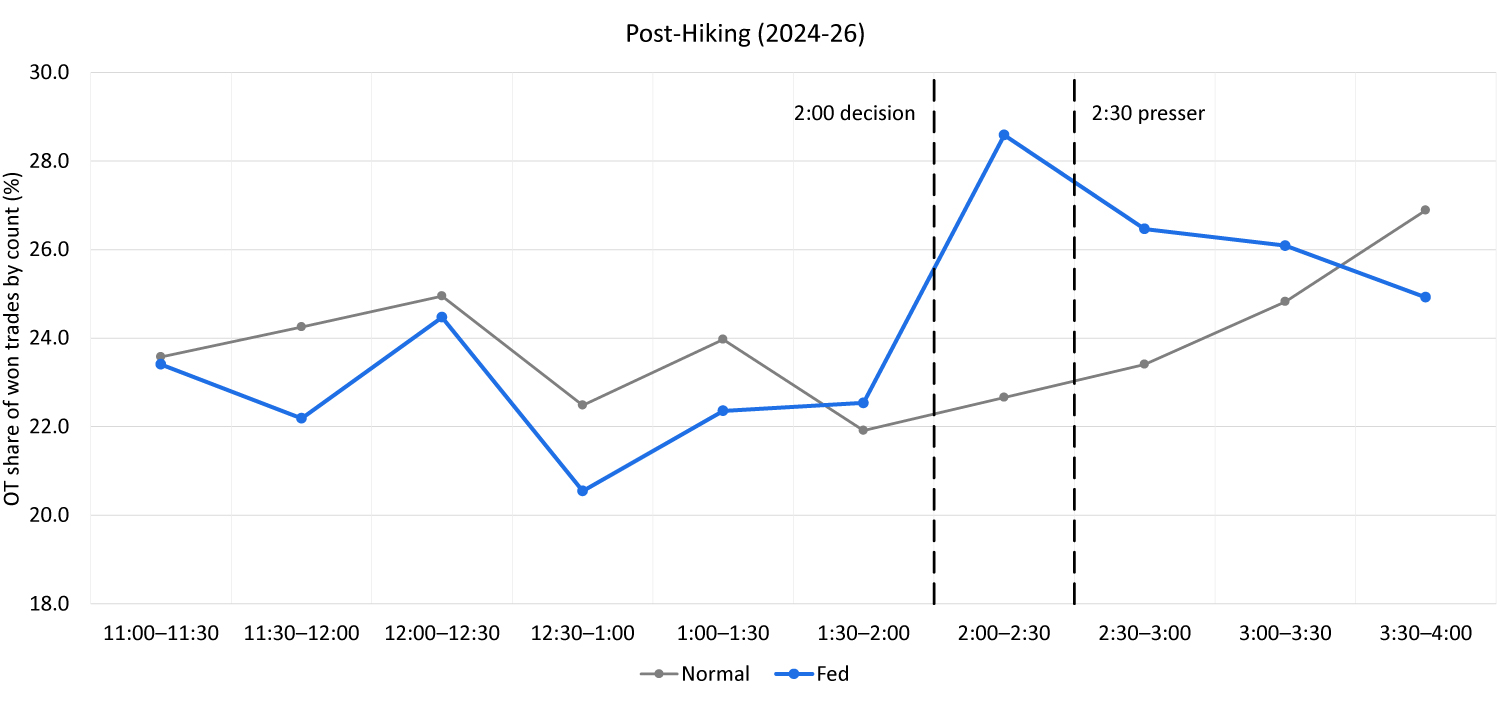
Takeaway: Clients increasingly have their RFQs won by an OT response in recent Fed releases. Even in volatile releases during the 2022–23 hiking cycle, OT as a share of winning responses remained consistent with normal days.
Number of dealer responses strong in both eras
Even as activity lulls, RFQs stay competitive: responses per inquiry dip only slightly into 2:00 pm. In the calmer regime, the decline is modest: only one fewer quote out of 10–12 on a normal Wednesday for most of the announcement, and two fewer quotes during the 2:00–2:30 pm window. The 2022–23 cycle saw a slightly larger dip: down to about seven responses from 10, consistent with a genuinely more uncertain backdrop.
Average dealer responses during Fed releases
US credit (HG+HY)—average number of responses per client RFQ dips at 2 pm, then recover
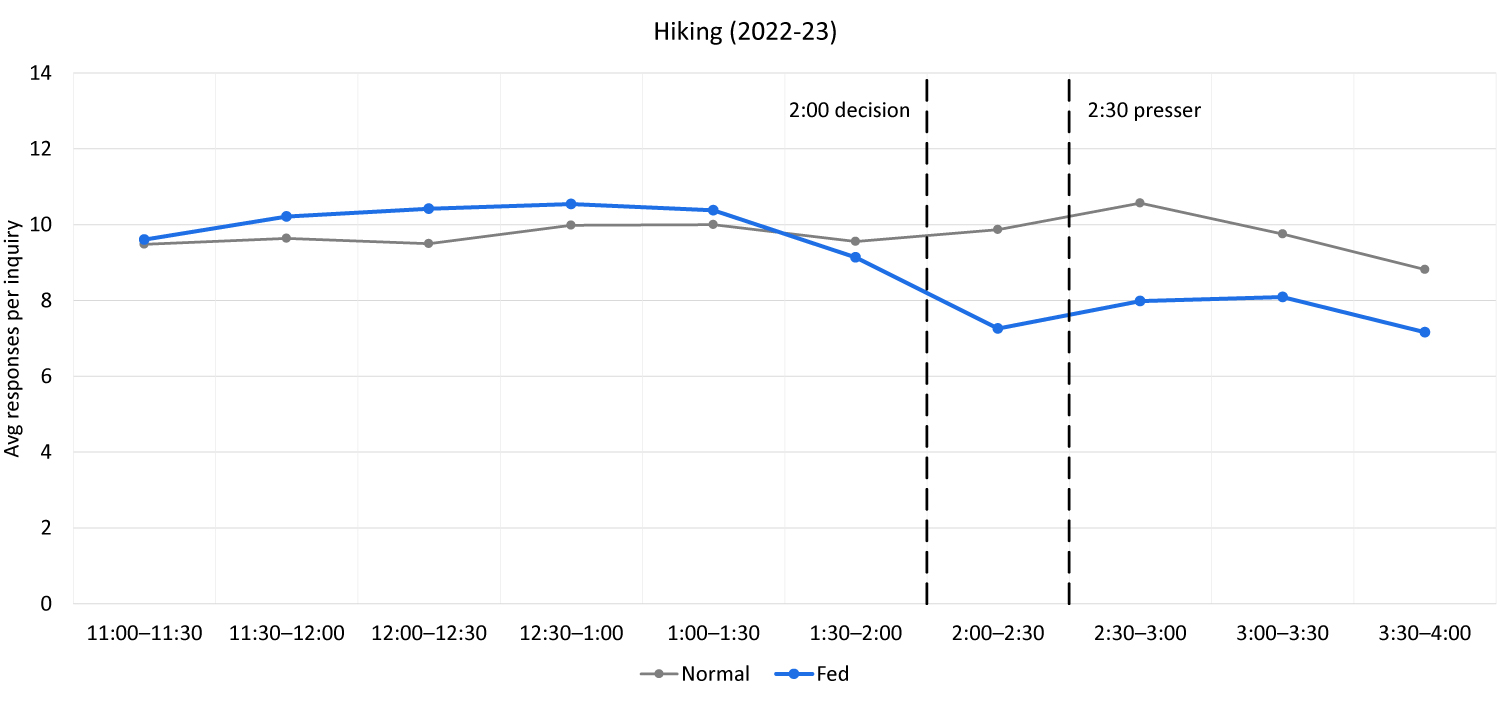
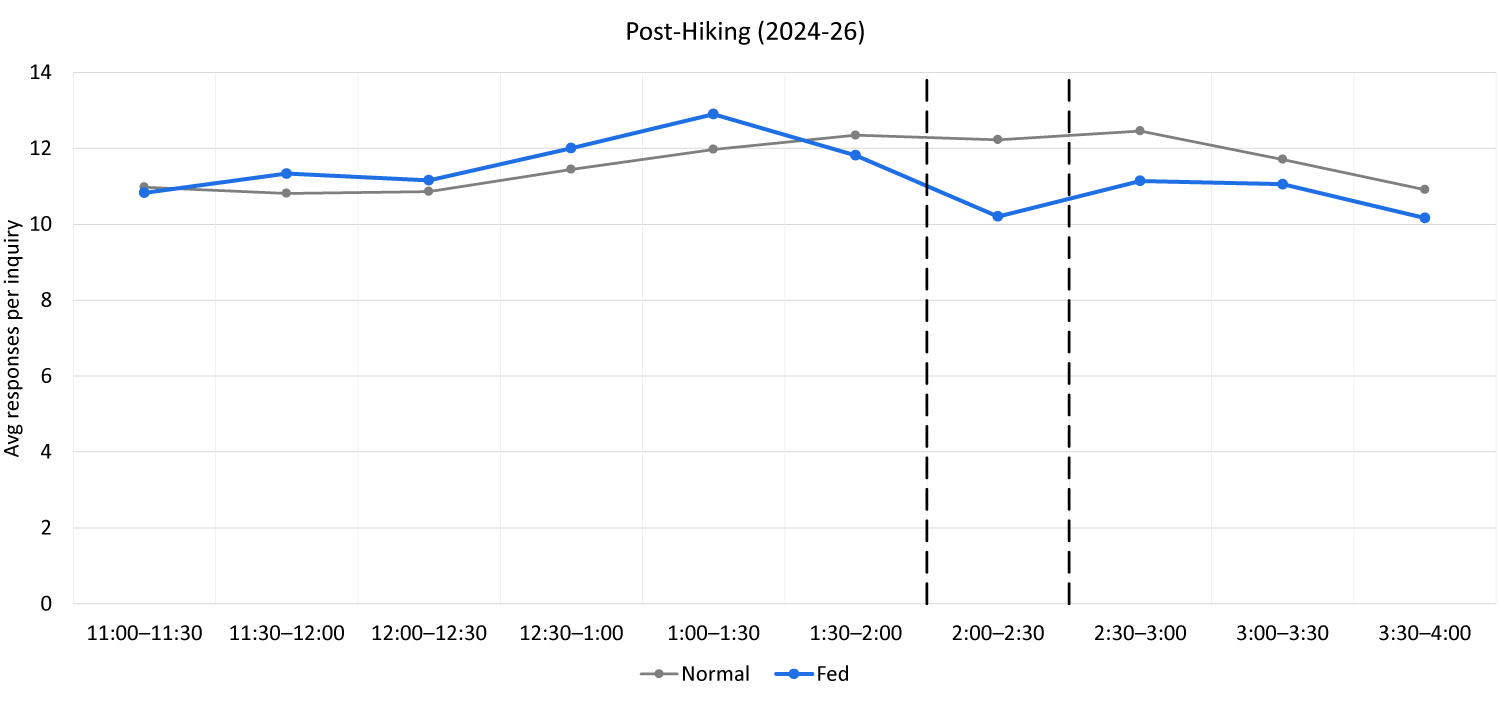
Takeaway: Regardless of era, clients still receive deep, multi-dealer competition even during pivotal policy announcements. For recent meetings, the number and quality of responses have barely budged.
What this means for a market with less guidance
If pulling forward guidance shifts meetings back toward the 2022–23 "less certain" profile, traders should expect a familiar pattern around the decision: a deeper pre-print lull, a tiny wobble in execution quality, a lean on OT liquidity, and dealer competition that remains robust. Each of those frictions was visible last cycle, and each was absorbed on-platform: execution stays within a fraction of a basis point of CP+, Open Trading supplies incremental liquidity, and RFQs maintain a steady number of responses.