
From fringe to familiar: The automation frontier in trading

By Ryan Steffen, Mayako Kawai, Hoary Huang | 13 January 2026
Text
What is the current landscape in the use of automation and algorithms for credit trading?
Since the launch of our first automation tool, Auto-X RFQ in 2018, we've witnessed not only a sharp increase in its adoption but also a transformation in how clients and traders are leveraging it.
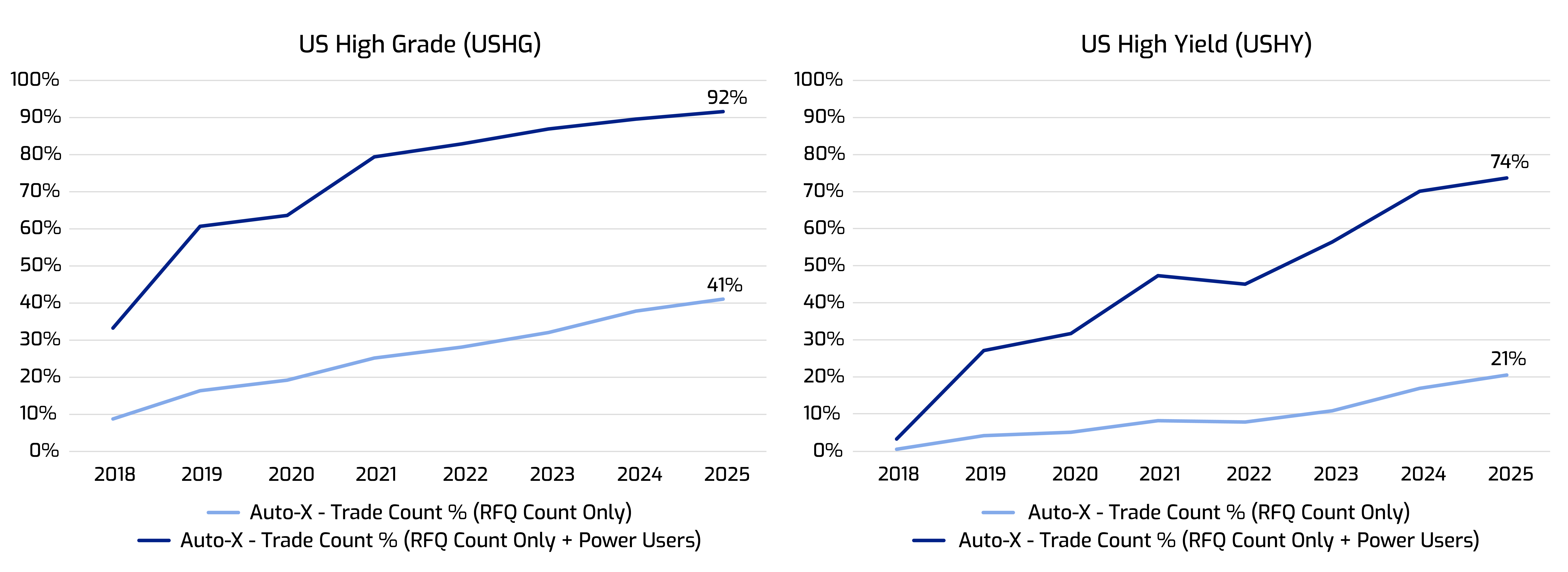
We can see that on the client side, utilization rates have surged dramatically. Today, our most advanced automation clients show a 92% Auto-X RFQ utilization rate in US High Grade and 74% in US High Yield - a remarkable leap from 32% and 9% in 2018.
Auto-X RFQ utilization rate surges: A closer look at client automation growth
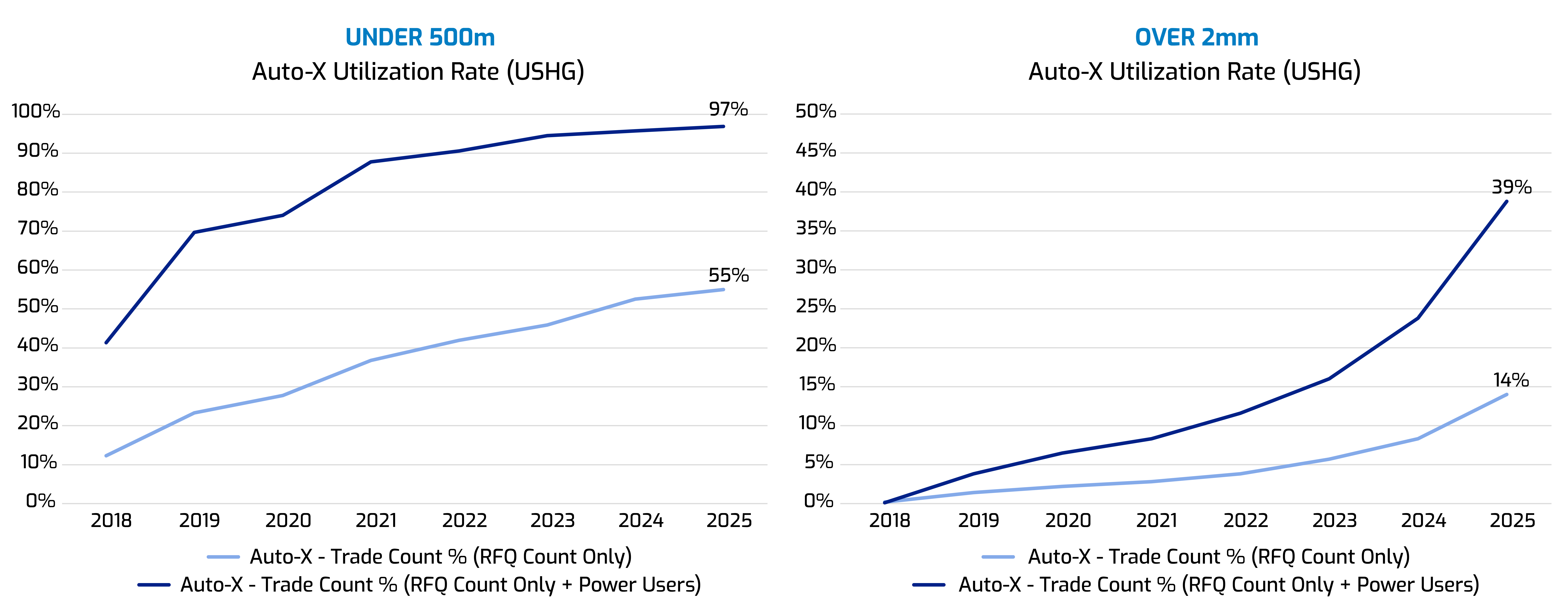
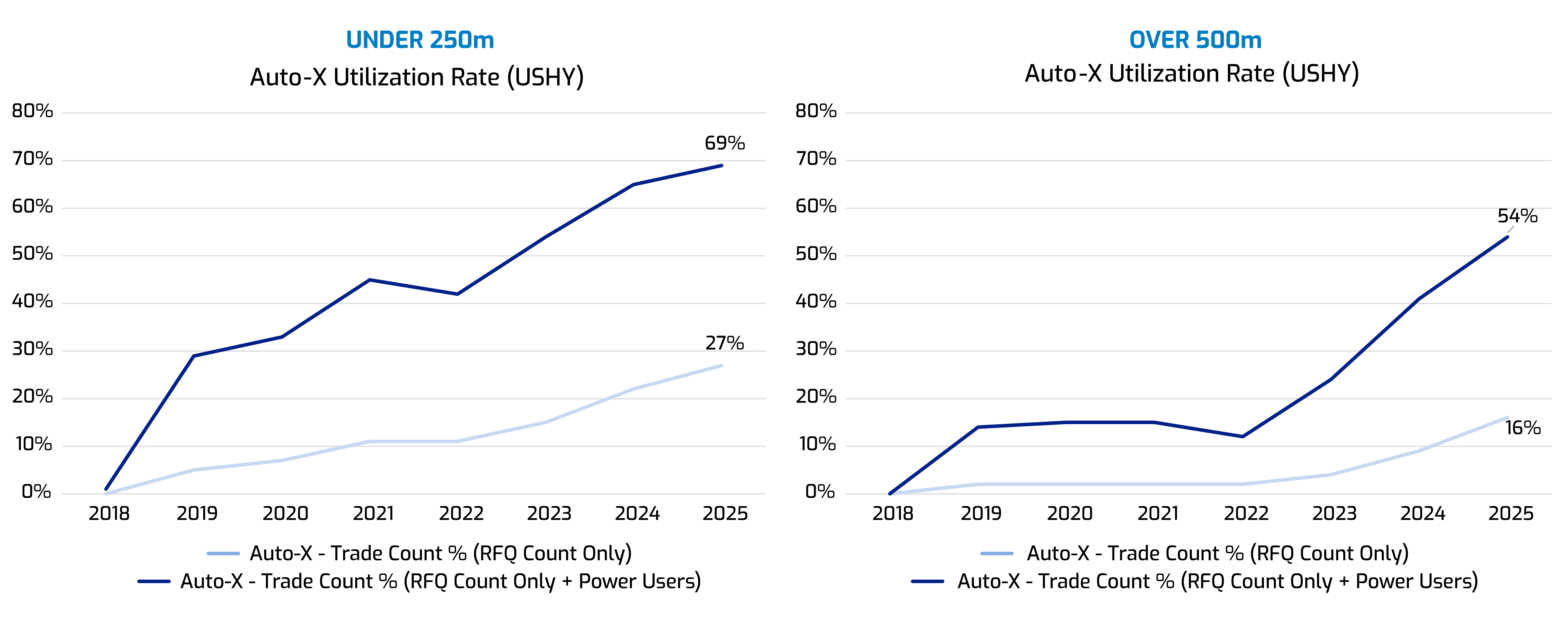
Smaller lot sizes led the early wave of automation, but the momentum has now decisively moved into larger block sizes. In US High Grade, power users placing orders under 500m are now almost fully automated, while trades above 2mm - once thought too complex (too risky) - now see 39% execution. A similar trend is unfolding in US High Yield: lots of 250m and below are automated at a striking 69%, and even trades over 500m have advanced to 54%.
These trends underscore how automation is no longer limited to smaller trades - it's becoming a trusted tool for handling increasingly larger transactions alongside deeper control and governance options that we discuss below.
US High Grade clients scale up automation
US High Yield clients scale up automation
Why has Auto-X RFQ quickly become an essential tool for clients?
Client trading objectives are clear: maximize efficiency, reduce execution costs, and unlock opportunities for price improvement. Auto-X RFQ delivers on all three fronts. It is a powerful, intelligent, yet simple to use rules-based tool that enables clients to achieve these goals by automating all or part of the trading execution workflow.
The advantages Auto-X RFQ are twofold. First, is the unparalleled sophistication it delivers for data-driven decision-making. It is powered by CP+™, an Al-powered pricing engine for global credit and rate markets. By combining the extensive data from the MarketAxess trading platform with public TRACE and proprietary TraX inputs, CP+ equips clients with unmatched accuracy in price discovery, transaction cost analysis, and algorithmic strategies. Complementing this is the relative liquidity score, which provides a precise measure of a bond's tradability and market depth.
Second, is its dynamic waterfall approach to rule setting. Automation criteria can be set and refined using simple variables such as trade size, price, number of respondents and more. With our parameter modeling tool, clients can use their historical data to assess and predict the likely impact of automation and its effect on overall performance. This flexibility enables higher automation rates, greater efficiency in larger trades—including blocks—and the ability to deploy multiple custom rule sets across markets.
What does this look like from the dealer perspective?
Dealer pricing algorithms are gaining ground in block trades, with the strongest growth seen in the 2mm-5mm bucket range. Not only are dealer algos responding more, but they're also winning more - moving from a 10% win rate in 2023 to 25% in 2025 for credit block inquiries.
Dealer pricing algorithms gain ground in block trades
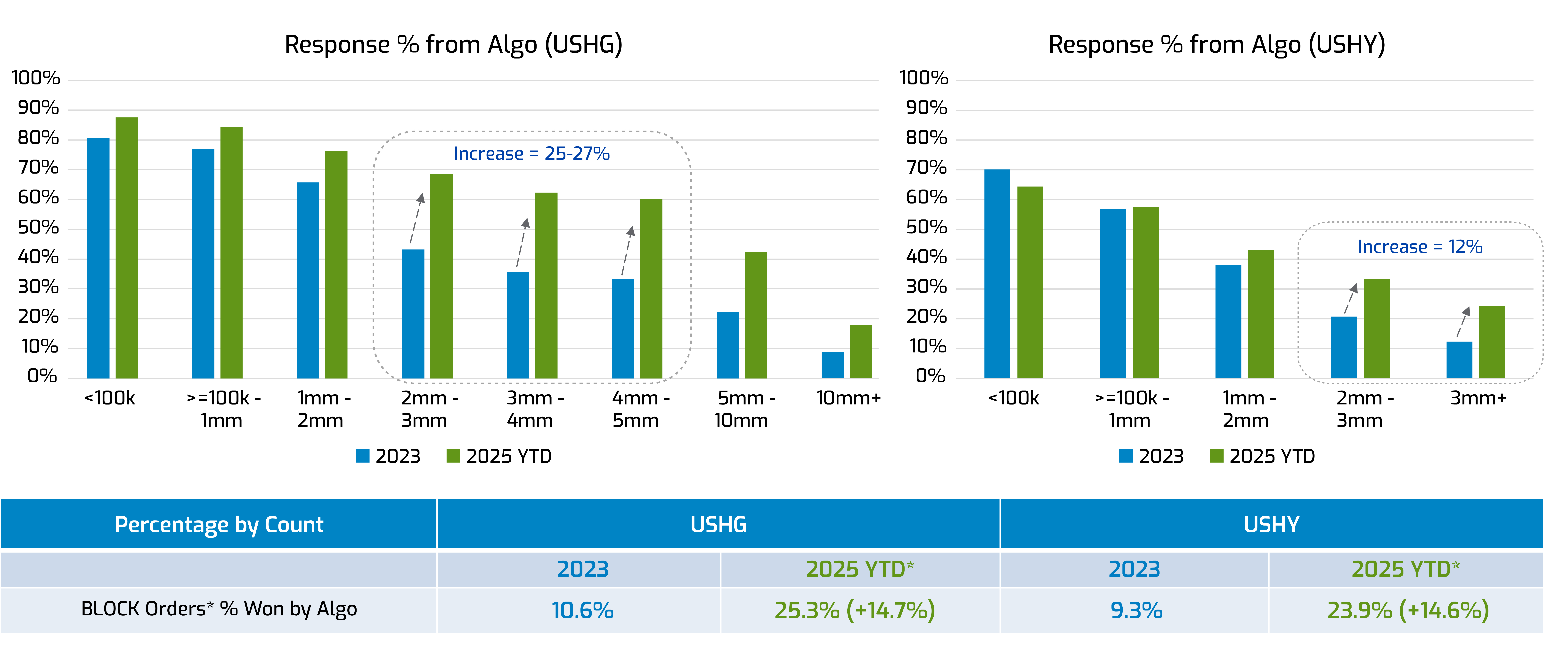
*We are defining block trades 5mm+ for IG and 2mm+ for HY
*YTD 2025 is including Q1-Q3
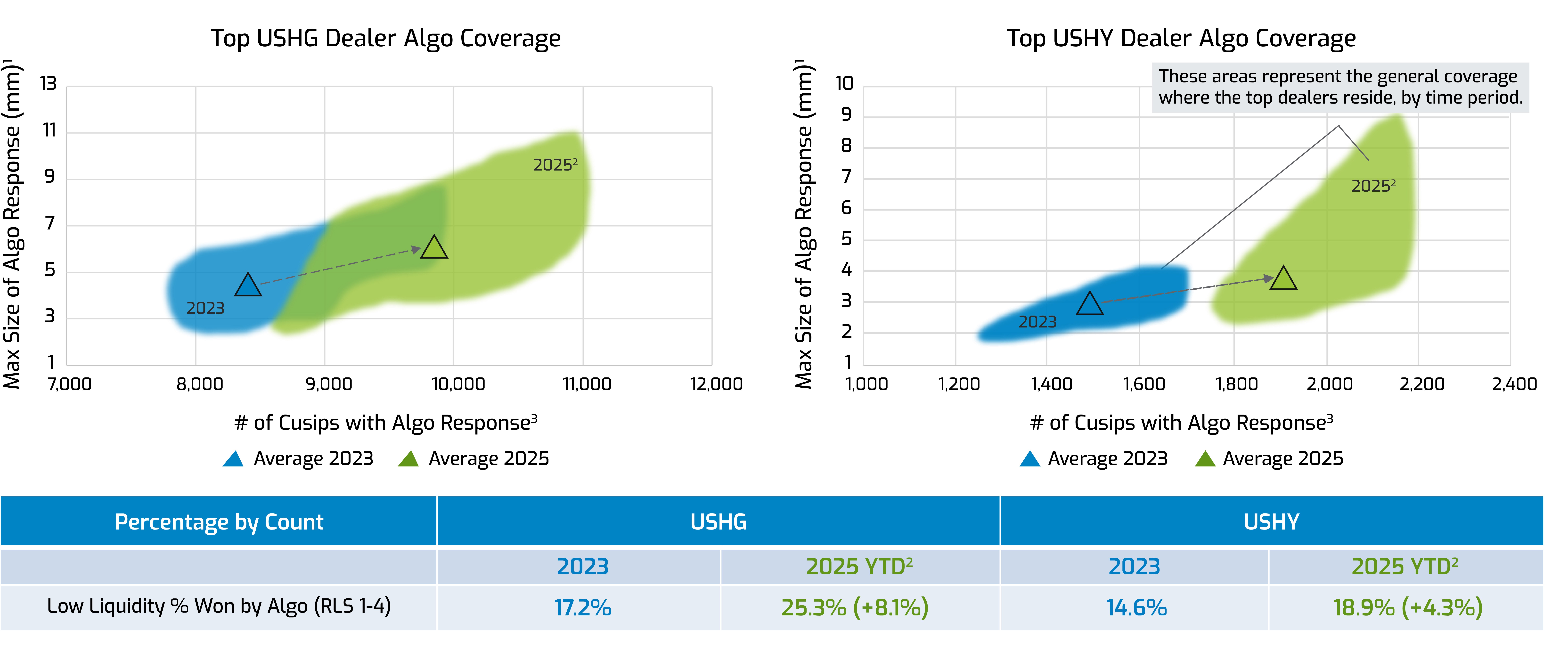
Coverage has expanded as well. In 2023, dealer algos were primarily involved in the more liquid bonds. By 2025, they are responding to a broader set of CUSIPs and handing larger trade sizes. For US High Grade, algo wins in low liquidity bonds rose from 17.2% in 2023 to 25.3% in 2025. In US High Yield, wins increased from 12.6% to 18.9% over the same period.
The result: clients are increasingly likely to find a dealer algorithm on the other side of their trade.
Dealer pricing algorithms expand and widen their reach in coverage
Q1-Q3 2025
1. We removed outliers from the population
2. YTD 2025 is including Q1-Q3
3. For the CUSIP universe, we only included 144a
To what can this overall growth in size and range be attributed?
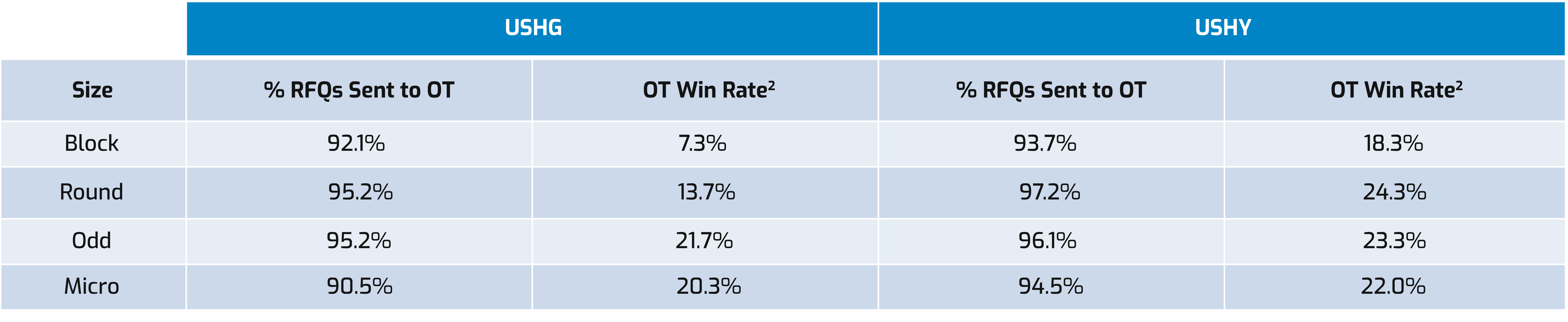
The expansion is driven by Open Trading®, the MarketAxess global all-to-all electronic marketplace. By tapping into the world's deepest liquidity pool for corporate credit, traders achieve real price improvements and broaden their reach.
Unlock price improvement via Open Trading
Q1-Q3 2025
2. OT Win Rate: Open Trading Trades/Number of RFQs with a response from Open Trading.
Open Trading enables smarter trading, greater capacity, and workflow innovation. Combined with automation tools that allow clients to predefine, customize, and parameterize workflows, trading desks can tailor execution to their specific needs - resulting in higher-quality outcomes and more efficient performance.
What’s next for automation in credit trading?
The data shows a clear trajectory: as dealer algos grow more sophisticated, clients are evolving alongside them - moving from rigid, single-rule setups toward dynamic waterfall and model-based approaches powered by MarketAxess.
The automation suite now includes Adaptive Auto-X, launched in 2023, which represents the next stage in automated trading. Adaptive Auto-X uses smart order routing to integrate matching, responding, posting, and requesting across multiple execution protocols and liquidity pools. This creates customized workflows aligned with specific trading objectives, all connected through Open Trading.
Looking ahead, we expect aIgo usage in credit trading to continue its exponential growth. At the same time, adoption of our original automation protocols - Auto-X RFQ and Auto-X Responder - remains strong, particularly among clients beginning their automation journey. Our mission is to provide a comprehensive suite of tools that deliver the deepest liquidity, most competitive pricing, and the most efficient workflows supporting clients at every stage of their automation evolution.