
Persistence of automation through volatility

By Andrew Cameron | 30 May 2023
Text
Automation technologies touch so many parts of our lives that we often forget how integral they are to our every day. From setting the thermostat before you go to sleep to the camera in your smartphone and the advent of self-driving cars, automation has penetrated our lives to a degree that would be hard to calculate.
Automation is no different within the fixed income market. At MarketAxess, we’ve built a suite of automated execution tools (with more on the way) to meet client demands as traders have shifted from voice to electronic trading. In 2018, MarketAxess introduced Auto-X™ to the marketplace to cut down on the time needed to make trading decisions while increasing efficiencies and reducing costs. Our data shows that clients who have adopted automation into their trading toolkits have grown capacity at faster rates than clients who have not adopted any automation, especially through times of volatility, where our clients have counted on our automation technologies to manage risks, establish guardrails, streamline processes, remain compliant, and improve execution quality. Clients who are adopting some degree of automation are scaling more efficiently compared to those who have not adopted automation into their trading toolkits.
During three recent periods of volatility—March 2020 during the onset of the COVID pandemic, March 2022 during the Russian invasion of Ukraine, and March 2023 during the collapse of Silicon Valley Bank and Credit Suisse—automation on the MarketAxess platform sustained new levels of adoption and trade volume on Auto-X. Not only has the number of active clients increased, but Utilization rates have also increased for not only High Grade, but also on a global scale.
As clients have become more familiar and comfortable with automation, rates of “No Touch” order submission have gone up. During COVID, the Average No Touch rate stood at 7%, and during the recent bank collapse, the average No Touch rate increased to 36% showing that clients are willing to do more work up front to set trade parameters, reducing clicks and ultimately becoming more efficient within the platform. Hit Rates have also increased for High Grade. Think of Hit Rates like the performance of Auto-X. More clients are meeting their criteria and can execute successfully via their unique set of parameters—where we now offer up to 30 customized variables.
If those parameters aren’t met—a trade doesn’t match the pre-set size, level, side, etc.—MarketAxess has set up certain guardrails, called Overrides, so that clients always have the option to override a trade if it doesn’t meet their criteria. During volatile periods, Overrides are essential because they allow users the option to move forward with a trade despite not meeting the designated criteria. At the height of COVID, an extremely volatile period, Override rates hovered at 50%, which would be expected during the first true market shock in the fixed income automation era. More recently, clients have garnered more control and comfort and during the SVB/CS collapses, Override rates sat at 21%, showing that during extreme volatility, users can remain in control of their executions. Many clients consider Auto-X RFQ an extension of list trading, with its capabilities able to provide optimal execution results.
As with most new and cutting-edge technologies, the earliest adopters see the greatest gains. As our clients turn to automation and become more comfortable with these protocols, we are expanding our toolkit to include more specific trade execution options and answer specific questions around trade strategy.
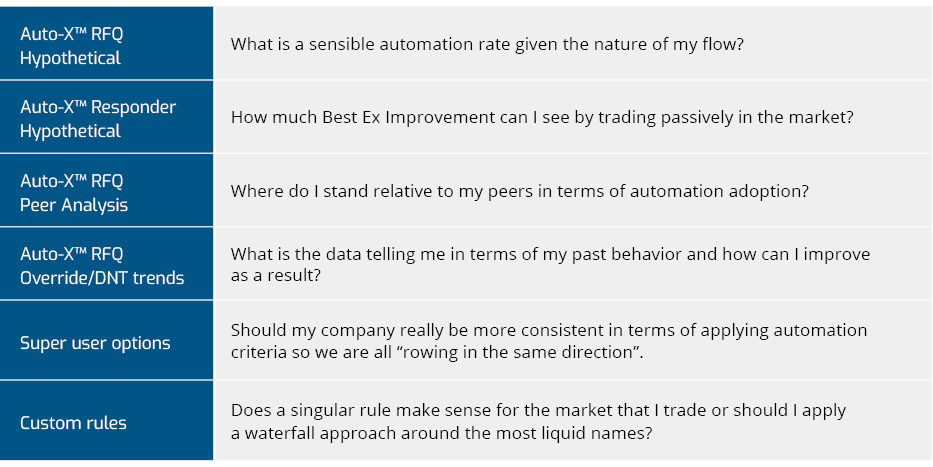
More on the expanded analytics services toolkit in a later post, but our automation trading suite will continue to evolve to meet the growing needs of our users. The MarketAxess team is learning along with our clients as they increasingly get more comfortable with our offerings. Our data shows that both buy- and sell-side clients are using our automation products at a similar rate and they’re all equally accepting of trading more risk during volatility.
Nearly every measurable Auto-X RFQ instance in the first quarter of 2023 has been a record—from average daily volume to the rate of no touch. 3.9+ million trades and $718 billion in volume have been executed since its introduction to the market, and more than 780 active traders across 198 clients have used Auto-X. We are on-track for yet another record year in our automation suite of products, and the number of traders using the product is growing along with it. For these traders, automation is becoming an extension of the traders' desk and an integral part of the trading process. The clear and present need for automation is here.