
Unlocking liquidity: How MarketAxess Opening and Closing Auctions are reshaping bond trading
By Chiqui Matthew | 12 January 2026
Text
The fixed income markets never stop evolving. Over the past 10 years in the credit space, for example, we have seen a dramatic rise in ETF and index trading. We are now north of $10 billion in ETF trades daily, which is ten times what we saw a decade ago. But liquidity patterns for these trades are not the same as for individual securities. Instead, ETF and index liquidity clusters at the beginning and end of the day, echoing the patterns in equity markets.
To help our clients trade in those critical windows, we have launched a first-of-its-kind auction protocol, which is helping investors access deeper pools of liquidity and more transparent pricing when they need it most.
Our new standardized opening and closing auctions were designed in collaboration with leading buy-side and sell-side institutions — including BlackRock, AllianceBernstein, DWS, and State Street Investment Management. The protocol is initially for trading of U.S. high-grade and high-yield bonds and is accessed through our X-Pro Trading platform.
Launching auctions serves several key purposes: optimizing trading opportunities, managing volatility, and reducing price movements in less liquid securities. By aggregating supply and demand, we can improve price formation and transparency, while widening access to concentrated liquidity. Auctions also create market benchmarks, which can be integrated into end-of-day pricing services. The benefits of the protocol extend to all market participants, with simultaneous order matching, input, and confirmation rules ensuring a level playing field. Moreover, tracking error is reduced because the auction price reflects the inputs of multiple counterparties.
In early December, over 600 market participants joined us for a webinar to discuss how auctions could serve them best. In case you missed it, here are a few of the key themes:
How do the auctions work?
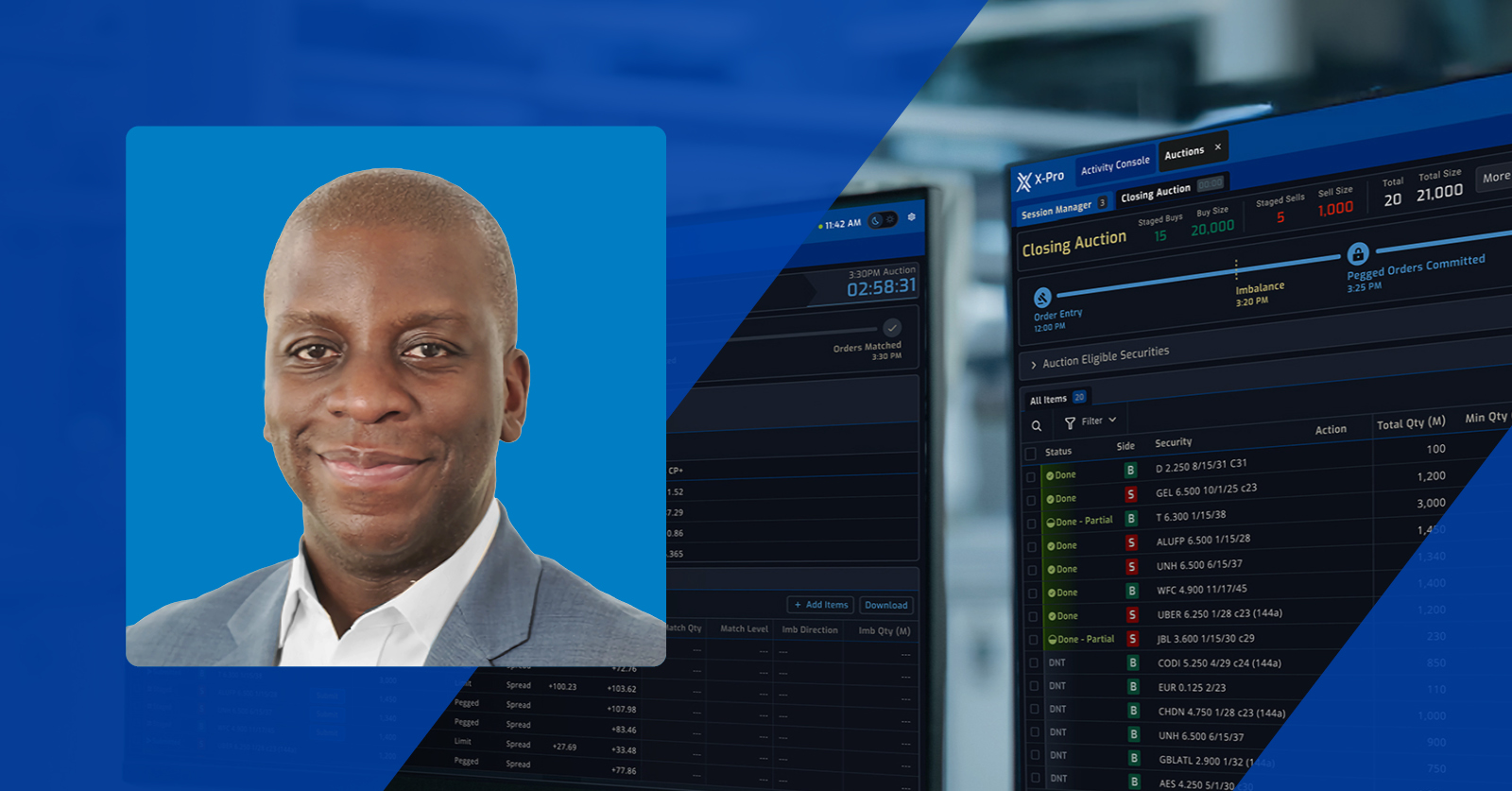
At open and close of the trading day, the auction pools buy and sell orders across the platform to aggregate liquidity and reach a clearing price. Market participants can enter orders using three unique order types – pegged orders, limit orders, and offsetting only orders. We also plan to introduce custom orders pegged to the CP+ price. The auction has two phases – the book building phase and the imbalance phase. During the imbalance phase, MarketAxess publishes auction characteristics, including imbalance information and match levels.
How are orders filled?
Fundamentally, the auction clears at the price that maximizes total trading volume. So, rather than trying to build consensus around a theoretical or derived midpoint, it’s all about identifying what is tradable and executable.
Once the price is formed, the protocol decides which orders get filled based on supply and demand. If there is more buy interest than sell interest, sellers are fully filled because there is sufficient demand to match their orders.
The protocol prioritizes orders in a specific sequence. First, pegged orders are filled, because they maximize traded size. Second, limit orders are filled, as they help form prices and maximize notional volume. Finally, offsetting orders are filled -- these don’t display publicly but help address imbalances. Within each category, larger orders are prioritized over smaller ones, and orders of the same size are filled chronologically. At the end of the auction, all matched orders execute at the same clearing price.
What are the benefits of the auction protocol?
By concentrating supply and demand into a defined window, the auction generates a single clearing price for all participants. Because the protocol draws on input from multiple institutional players and consolidates orders, the auction price serves as a reference for index players, ETF managers, and firms conducting portfolio-level trading or rebalancing -- all at significantly lower price asymmetry than previously available.
MarketAxess CP+ offers a common pricing reference, backed by our proprietary, two-sided, AI-powered pricing engine. Additionally, participants can execute a large order without moving the market, because everyone from the buy-side and sell-side is in at the same time.
Why wait for the close?
The simple answer is that the liquidity benefits are real at the close, when there is a marked contraction in the bid-ask. If you look at our CP+ composite price, the bid-ask collapses by 35% between the first and last hour of the trading day. Organic buy and sell interest drives that contraction – creating an opportunity for institutional investors to manage large portfolios, execute block trades, or bring overall exposures back into (in-line with) target asset allocations.
There are also significant advantages at the open. Consider a sell-side firm that is ranked lower in the league tables and wants to participate but lacks price certainty that larger firms have. The auction protocol changes this – all participants see the same price discovery, allowing smaller dealers to start trading much faster, because they know where the bonds are pricing.
Building a market-wide utility
Looking ahead, our goal is to get as many market participants involved in auctions as possible. We plan to expand coverage, both to non-US investors and into emerging markets and euro credit. Over time, our ambition is to create a utility, that boosts liquidity and fulfills our mission to build more transparent and efficient fixed income markets.
If you have any questions, please do not hesitate to get in touch.