
Axe quality in electronic credit markets: What the data tells us

Axe quality has become one of the more energetically debated topics in electronic fixed income, and it was a pleasure to be part of the FIX panel exploring it with Byron Cooper-Fogarty of Neptune Networks Ltd, Mike Roffey of Tradeweb, and Ricardo Goddard of Schroders, chaired by Matthew Coupe of Susquehanna, and the broader community. These are important conversations, and they are most productive when grounded in shared data.
This note sets out how we at MarketAxess think about axe quality: how we define it, what we measure, and what we are building to keep standards high. It is not intended as a defence of any particular position, but as a transparent account of what our data shows and where we think the industry can continue to improve together.
Measuring axe quality through outcomes
There are a number of measures the market participants use to determine whether an axe is an authoritative signal in clients’ decision-making process. We have generally found it useful to anchor our research in outcomes: does the dealer respond when inquired? Do they stand firm at the levels they posted? Are their prices competitive relative to non-axed alternatives? These items are measurable, and they give us a consistent basis for assessment. By these standards, a high-quality axe is one that is current, responsive, and aggressive relative to the market at the time of inquiry.
A broadly healthy ecosystem
Looking at EUR IG, which represents the most mature axe ecosystem across the markets we operate in, the headline metrics are encouraging. Axed dealers, as a community, consistently outperform their non-axed counterparts across standard measures—responsiveness, slippage (improvement), and aggressiveness.
Today, axed dealers win 48% of all inquiries in EUR IG, and on average, an axed dealer has around 2x higher responsiveness compared to non-axed dealers and has close to 3x higher win rates when participating in the same inquiry, as we demonstrated here. These are meaningful differentials, and they have been stable or improving over the period we have been tracking them.
This does not mean every axe posted is of equal quality. Volume has grown as dealers have recognised the competitive importance of electronic axe distribution, and with higher quantity comes variation in quality. The question worth asking, though, is whether the axe ecosystem as a whole is functioning well enough to remain a useful signal. What we posit is that, with their occasional flaws, axes are still the most accurate predictor of the winning dealer in European markets across other available metrics today.
On axe size
There is an open question about whether small axes (sub-5MM in particular) should be treated differently, or whether minimum size thresholds would improve overall quality. It is a reasonable point to raise, and one we have looked into carefully.
What the data suggests today is that axed dealers outperform other dealers across every axe size bucket for aggressiveness of pricing and improvement during the trade. The performance differential is consistent and demonstrates care taken by axed dealers to provide better execution across axes of various sizes.
Median quote/CP+™ delta by axe size in EUR IG1
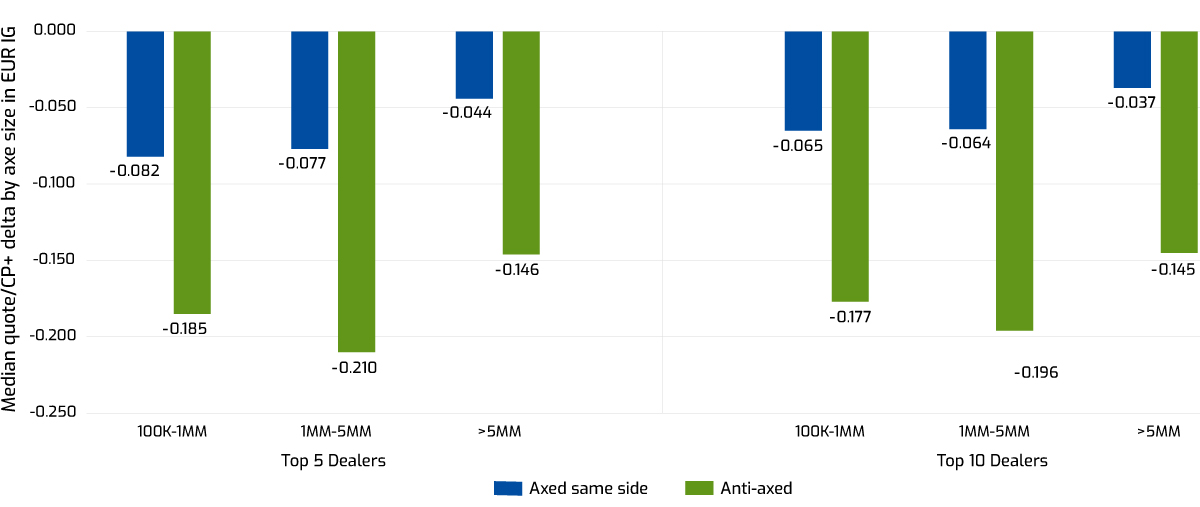
1Delta is calculated as the difference from CP+, our composite price that aims to predict where a trade will print – reflected here as 0. Negative values are interpreted as wider than CP+, values closer to 0 are more aggressive.
Median axe slippage by axe size in EUR IG2
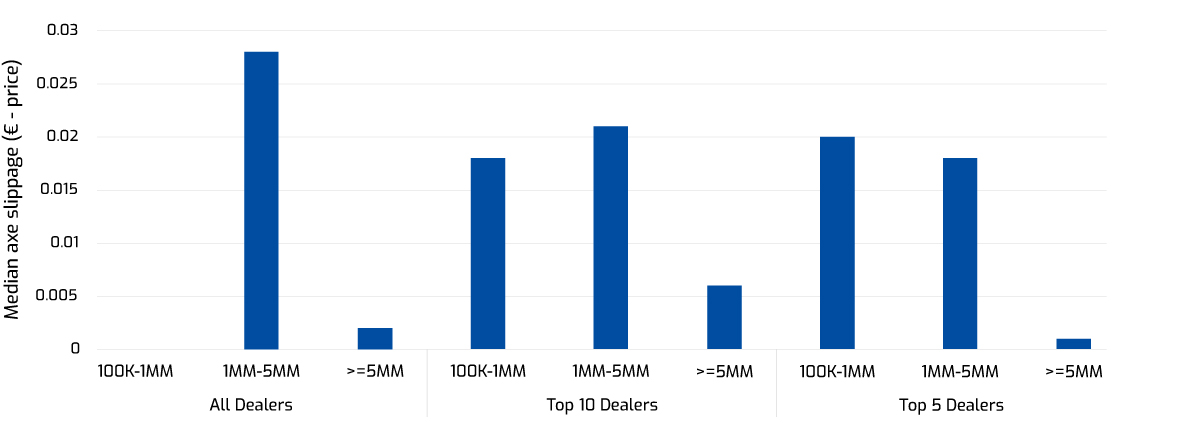
2Positive slippage demonstrates improvement on advertised levels. Absence of values demonstrates levels that repeated the advertised level.
It is also worth noting that use cases for axes have broadened. Our largest clients automate 80% of their tickets—and for an automated order of 3MM, a 3MM axe from a dealer who reliably performs at that size is exactly the right signal to surface the dealers most likely to win. Where quality issues do exist, axe laddering with axe performance indicators would be a more precise tool for addressing size-related quality concerns.
At this time, however, across all inquiry sizes, clients appear to receive more aggressive levels from axed dealers than non-axed or anti-axed dealers.
Median quote/CP+ delta by inquiry size in EUR IG3
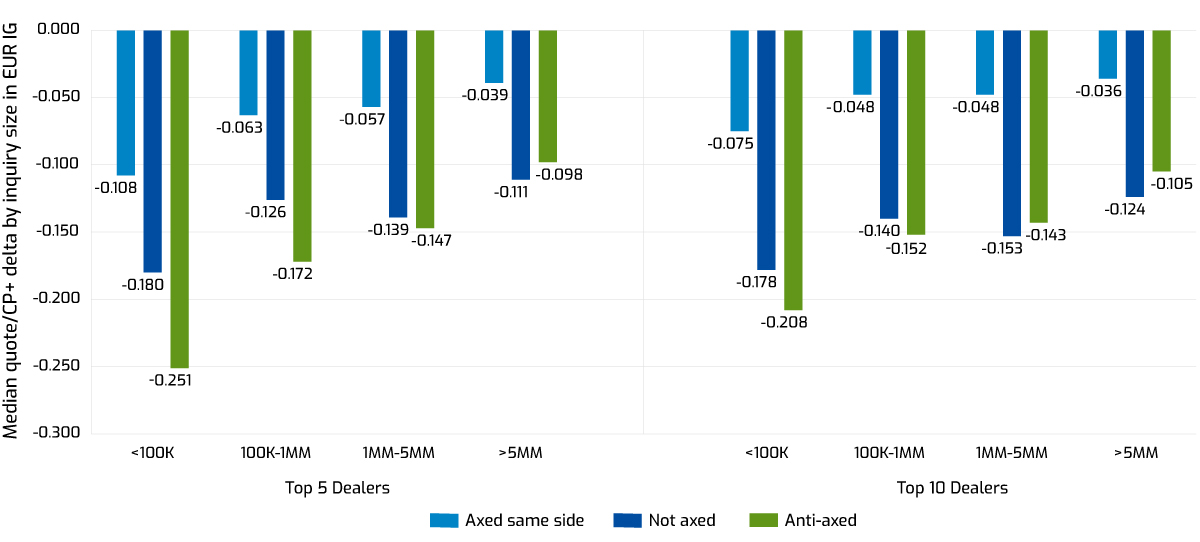
3Delta is calculated as the difference from CP+, our composite price that aims to predict where a trade will print – reflected here as 0. Negative values are interpreted as wider than CP+, values closer to 0 are more aggressive.
On two-way axes
Two-way axes attract understandable scepticism, as the dealer appears to have no meaningful directional conviction, but there are legitimate reasons for a dealer to be genuinely competitive on both sides: a large new-issue allocation where supply and demand are both active, or when a dealer operates an algo book and a trader book that run in parallel with different positioning. Trading outcomes with two-way dealers can, in these situations, be superior to the outcomes of trading with non-axed dealers.
Data shows that today, two-sided axe providers in EUR IG respond to 84% of inquiries, win 9.8% of these inquiries, and improve on their advertised levels by 1.8 cents. These outcomes are encouraging and allow us to believe that 2-sided axed dealers are overwhelmingly serious about trading on both sides.
That said, clients and dealers would benefit from more granular context clues for when two-sided axes are used. More precise taxonomy to accompany axes (e.g., distinguishing algo from trader axes, or inventory from non-inventory positions) would allow for buy-side clients to realise any advantages offered by two-way axes without removing legitimate liquidity signals.
What we are building
The most useful contribution platforms can make to this debate is to make quality indicators visible and to align incentives around it. That is what we are focused on.
Axe quality scoring is rolling out this year, giving clients transparent, data-driven visibility into their dealers’ performance on their axes. This directly addresses the structural incentive concern: if what determines selection is not whether a dealer is axed but how well they perform on axes, the incentive to post high-quality content is materially stronger.
Additionally, we want to ensure that clients are furnished with tools to surface the best dealers available for them in situations where axes are unavailable or ambiguous. AI Select, our AI-powered dealer selection engine, has been effective in predicting the best dealer in 59% of the backtested universe† by observing the dealer’s historical performance across 60 weighted trading metrics.
†This is the proportion of Smart Dealer Select inquiries where when top 3 AI Select-predicted dealers were invited, an AI Select dealer won the inquiry.
We have also invested in ensuring sufficient information flow to dealers. Dealers are informed of when automated dealer selection drove the order and when their axe attracted the order in. Better feedback to dealers on the inquiry should ensure that dealers can continue to service their axes well.
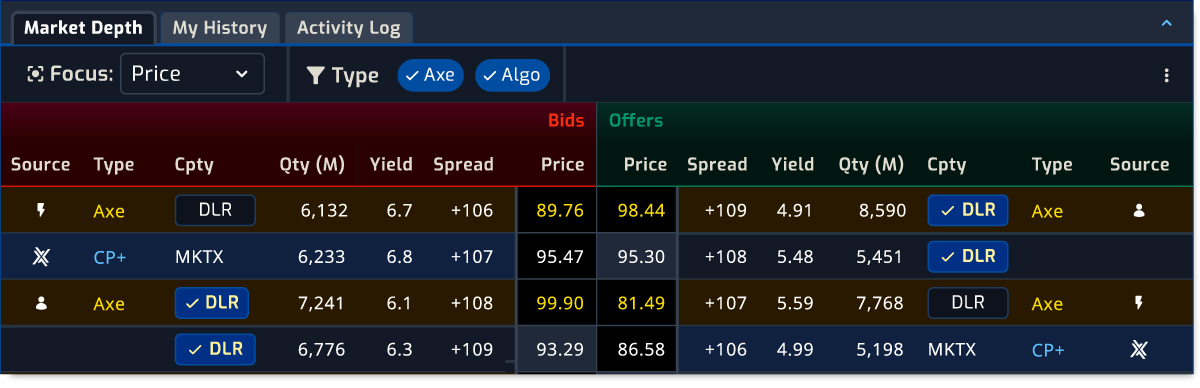
When source of the axe matters, algo vs. trader axe demarcation enables granular flagging that makes two-way axes more interpretable. Dealers can distinguish axes originating from algo books versus trader books, giving clients clearer context on the nature of the liquidity being offered.
A shared interest in getting this right
The conversations happening at FIX and across the industry on axe quality are valuable, and we want to be a constructive part of them. Our view is that the data, on balance, tells an overall encouraging story, but that there is real work to do on measurement, transparency, and incentive design to keep it that way.
We are committed to publishing the data that supports or nuances that view and to building the tooling that keeps the axe ecosystem honest. We welcome the nuanced discussion, and we look forward to the next iteration of this conversation.
We thank the FIX community for a thoughtful and constructive discussion.