
AxessPoint: The expanding role of algos in block trading and market liquidity
Highlights
Algos currently supply liquidity to 96% of US HG, US HY, EUR IG and EUR HY client RFQs on the MarketAxess platform and are rapidly expanding into block trades (≥5MM).
Inquiries in US HG saw the share of responses coming from algos jump from 12% to 37% for 5-10MM sizes and from 1% to over 16% for ≥10MM orders in the past four years.
Unique bond coverage by algos has grown by 82% since Q1 2021, ensuring near-complete coverage of key ETFs like LQD and HYG.
In the 5–10MM range for EUR IG, the share of inquiries with one or more algo responses surged from 45% to 70% in just two years, demonstrating a shift toward expanding algo liquidity across markets.
The evolution of algorithmic trading is reshaping the future of electronic fixed income trading by enhancing liquidity sourcing and execution outcomes across market segments.
Dealer algorithms are liquidity provisioning programs that quote prices back to RFQs using fully automated systems. They now command a significant and growing share of trading volume in the largest market segments, while rapidly expanding into the HY space (both US and EUR). This rise has been fueled in part by the growth of the electronic bond market and by the increasing availability and depth of data from platforms, allowing dealers to continuously refine pricing and liquidity‐prediction models. In Q1 2025, US HG algos were on average providing 11 responses per inquiry and were the counterparty on 88% of trades, which is up 21 percentage points from Q1 2021. It is becoming clear that algos are dominating the liquidity pool and will continue to increase in importance.
In particular, the role of algos in executing large-volume transactions is quite significant. This trend is especially evident in block trades where algo-driven trades continue to grow steadily each quarter. The increasing reliance on algorithms not only boosts efficiency and speed but also enhances market depth. The continued expansion of algorithmic trading in the bond market is expected to further transform traditional trading structures and practices, driving changes in how liquidity is sourced.
Percent of responses from algos by quarter & size bucket US HG
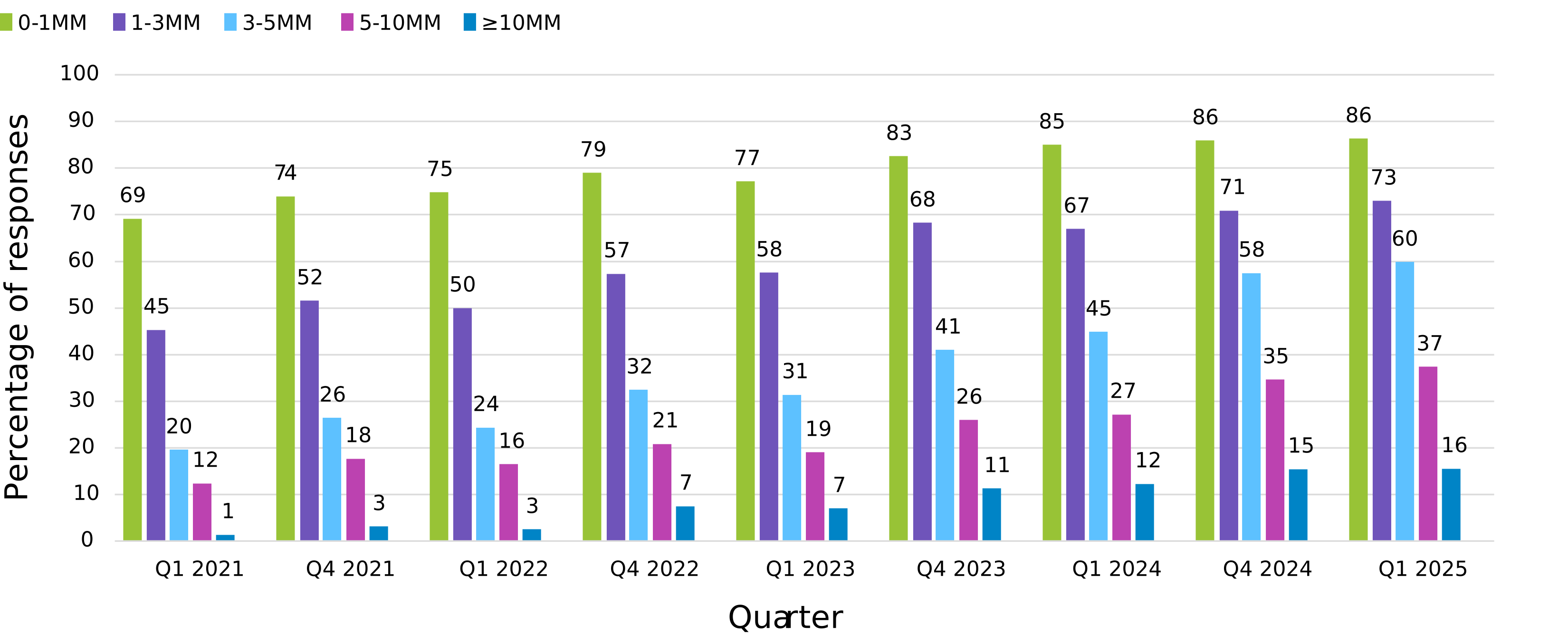
Looking at US HG activity on the MarketAxess platform we can see that from Q1 2021 to Q1 2025, the percent of responses coming from algos for inquiries of size 5-10MM has increased from 12% to 37%. For inquiries of size ≥10MM, algorithmic responses have surged from 1% to over 16% in four years. This same trend is also very prominent when we examine the percentage of inquiries with more than one response coming from algos. For inquiries of size ≥10MM, the percentage has seen a massive increase from 10% to 78% in the past four years.
Percent of responses from algos by quarter & size bucket US HY
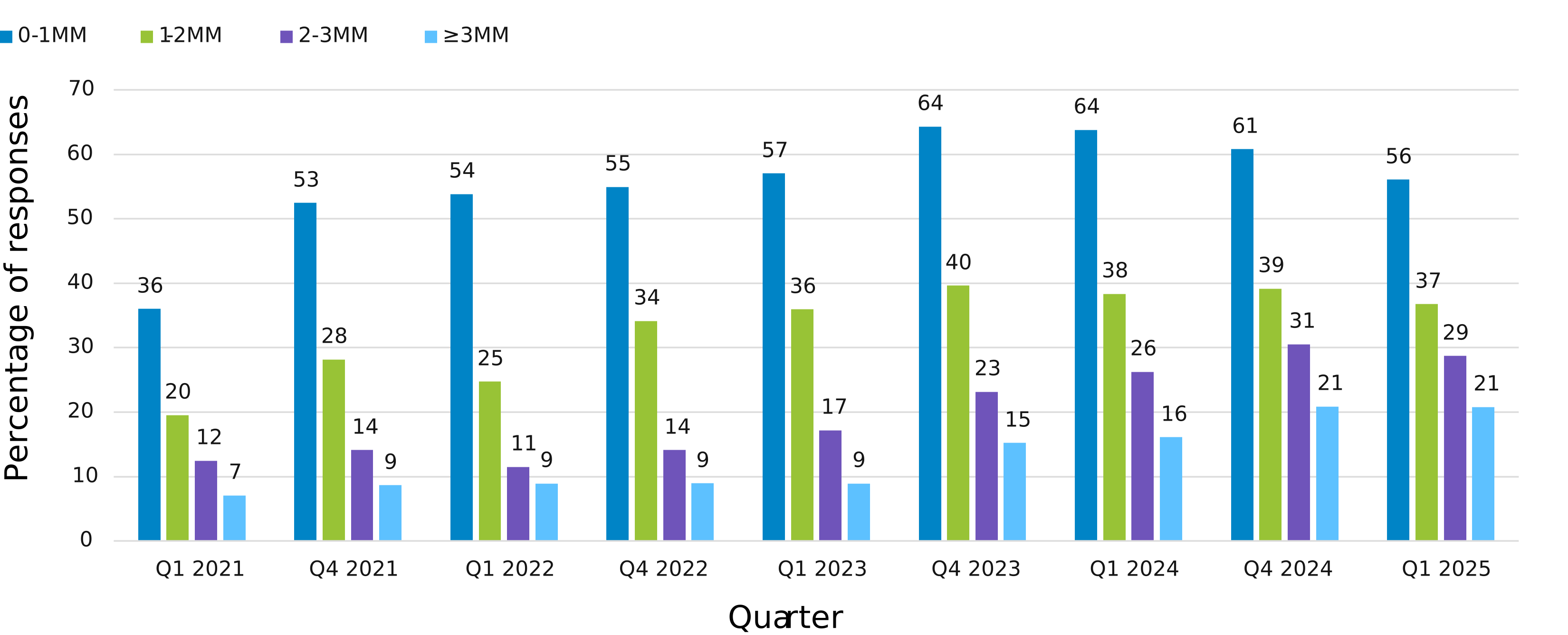
Focusing on the US HY market, we see a remarkable shift in algorithmic participation over recent years. In Q1 2021, only 20% of responses to inquiries ranging from 1-2MM in size were generated by algos. In Q1 2025 we are observing even greater levels of algorithmic penetration in trades of 3MM and above. In 2021, these larger inquiries had only 7% of responses originating from algos, but in Q1 2025, it had grown to 21%.
This increasing share of algo activity is seen across all markets in the 5-10MM range — US HG currently has 93% of inquiries with more than one algo response, US HY at 64%, EUR IG at 70%, and EUR HY at 29%.
Percent of Inquiries with ≥1 Algo Response for 5-10MM

Provider algorithms also have wide coverage in terms of unique bonds and size of orders. In Q1 2025, roughly 11,700 unique US HG bonds were covered by algos which represents a 32% growth from the 8,900 bonds covered in Q1 2021. As the universe of available bonds increases, algos are moving in tandem to maintain their growing coverage. This liquidity results in coverage for 99.8% of CUSIPs in the LQD ETF and 95.8% of CUSIPs inquired for on MarketAxess. For US HY, roughly 3,100 unique bonds are covered representing 95.8% of CUSIPs in the HYG ETF.
CUSIPs covered by algos
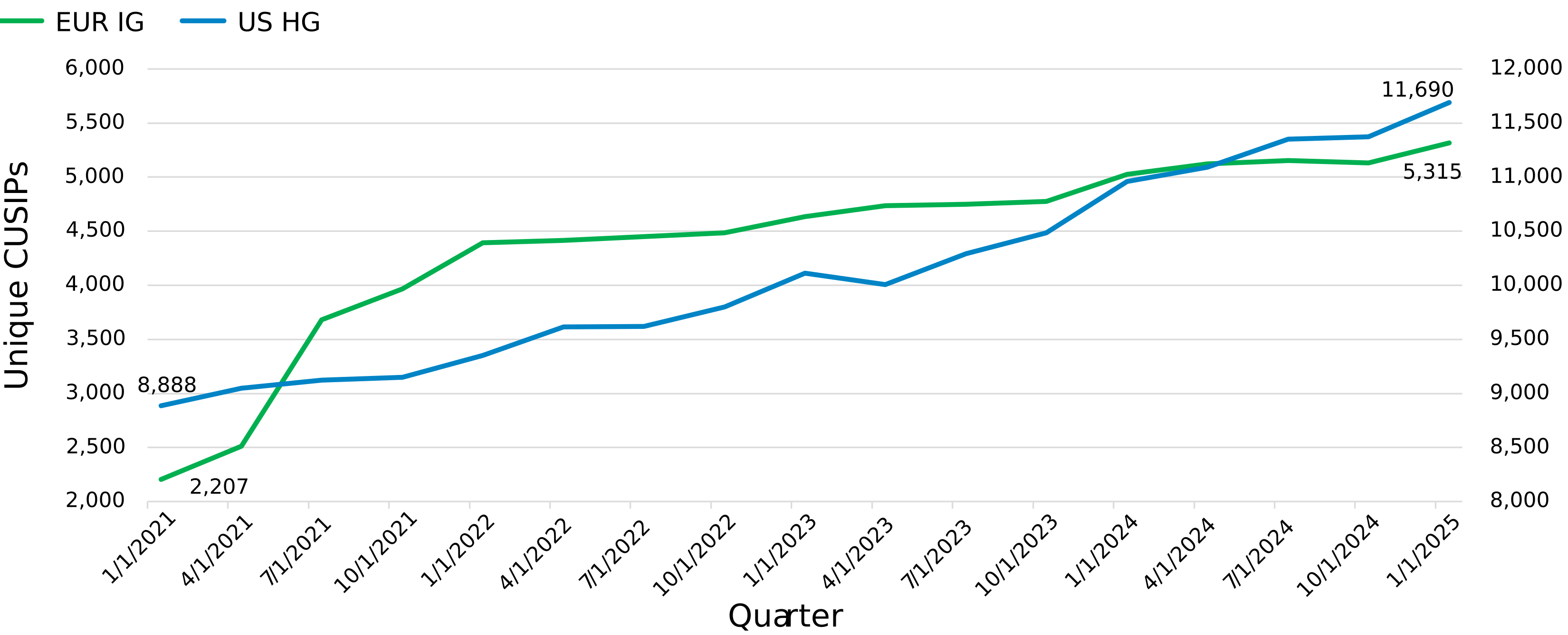
And it is not a handful of algos that are providing this coverage—from MarketAxess platform activity we can see that 8.7K out of the 11.7K US HG bonds are covered by 10 or more algos while only 2K bonds are covered by 5 or less. A slightly different dynamic emerges in US HY algo coverage since 900 out of the 3.1K unique bonds are covered by 10 or more algos while 1.8K are covered by 5 or less. Traders can feel much more confident that they will have competitive and fast pricing on their RFQs due to the growing presence of algos.
Additionally, the universe covered by algos has been steadily expanding across both size and liquidity profile. The tables below show how responses from algos vary across liquidity and quantity dimensions. The Liquidity Buckets represent groupings of our Relative Liquidity Score. Over the past four years, US HG has seen the percentage of responses coming from algos roughly double in larger-size segments. For example, in the 2MM-3MM bucket, algo responses have jumped from averages in the mid-20s in Q1 2021 to over 60–71% in Q1 2025. More extreme trends are observed in the 3MM-4MM and 4MM-5MM buckets, where increases of over 300% indicate that even as trade sizes grow, algos are now able to provide robust liquidity and pricing.
Percent of responses from algos US HG Q1
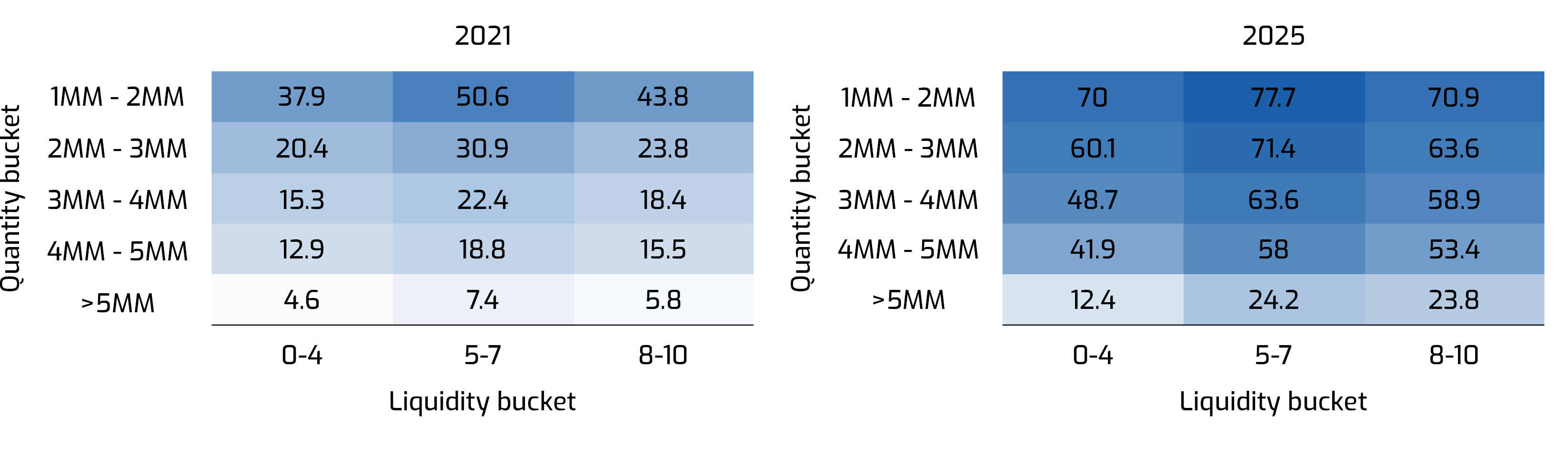
In US HY, the growth is even more dramatic with several segments more than tripling their algo participation. In the 5-7 liquidity 2MM-3MM segment, the percentage of responses from algos has grown from approximately 12% in Q1 2021 to 33% in Q1 2025. Additionally, for inquiries >3MM, the percentage of responses from algos have increased from roughly 4% to 20%, underscoring that high-volume, HY trades are now supported by a significantly enhanced liquidity pool.
Percent of responses from algos US HY Q1
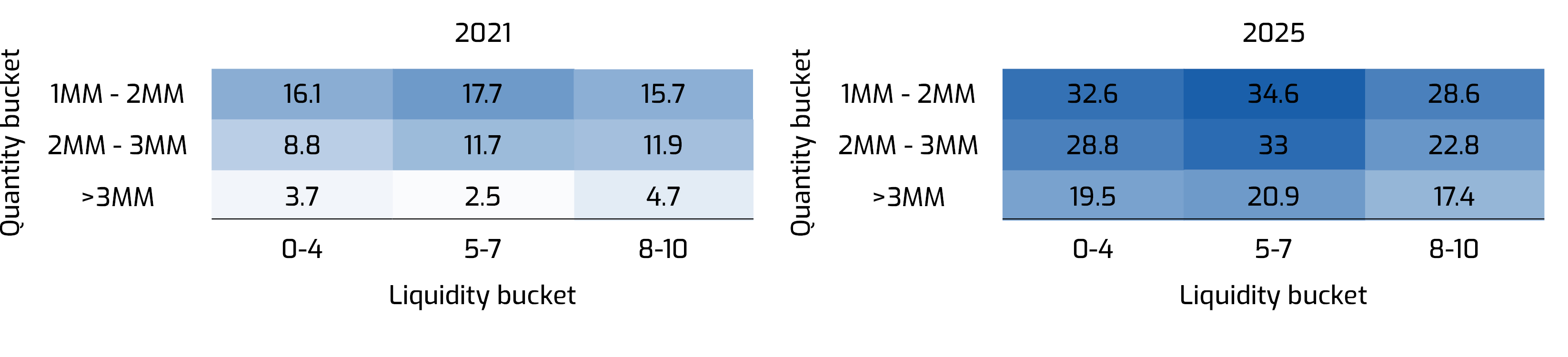
These responses are also leading to increased trades with algos as the counterparty. Between Q1 2021 and Q1 2025, the share of trades with algos as the counterparty for orders over 1M in US HG increased by roughly 30 percentage points. In US HY, the proportion of algo trades for trades over 1M grew by about 20 percentage points.
Similar trends are seen in the European market across EUR IG and EUR HY with increases in both the percentage of responses and trades coming from algos.
The tables below show various metrics segmented by trade size for US HG and US HY. The US HG data shows that for larger trade sizes (5–10MM and >10MM), the MarketAxess platform delivers robust liquidity with competitive pricing. For instance, on the >10MM bucket – which represents 8.2% of inquiry volume – there is an average of 8.4 responses and a hit rate of 85.4%, indicating efficient execution and minimal price impact.
US HG Q1 2025 metrics
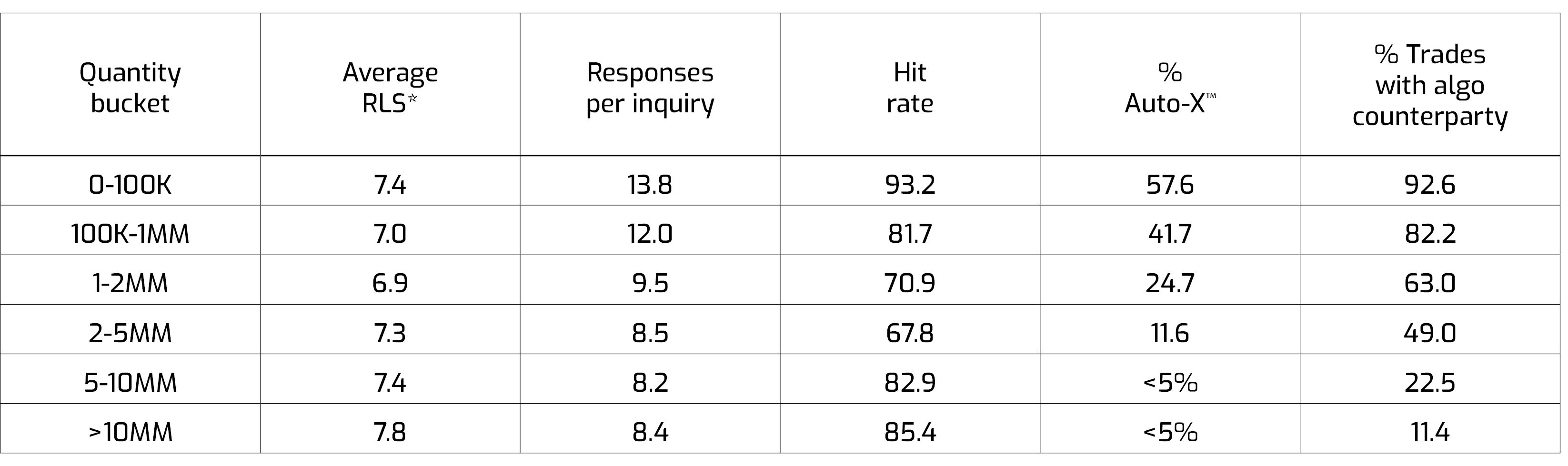
*RLS = Relative Liquidity Score
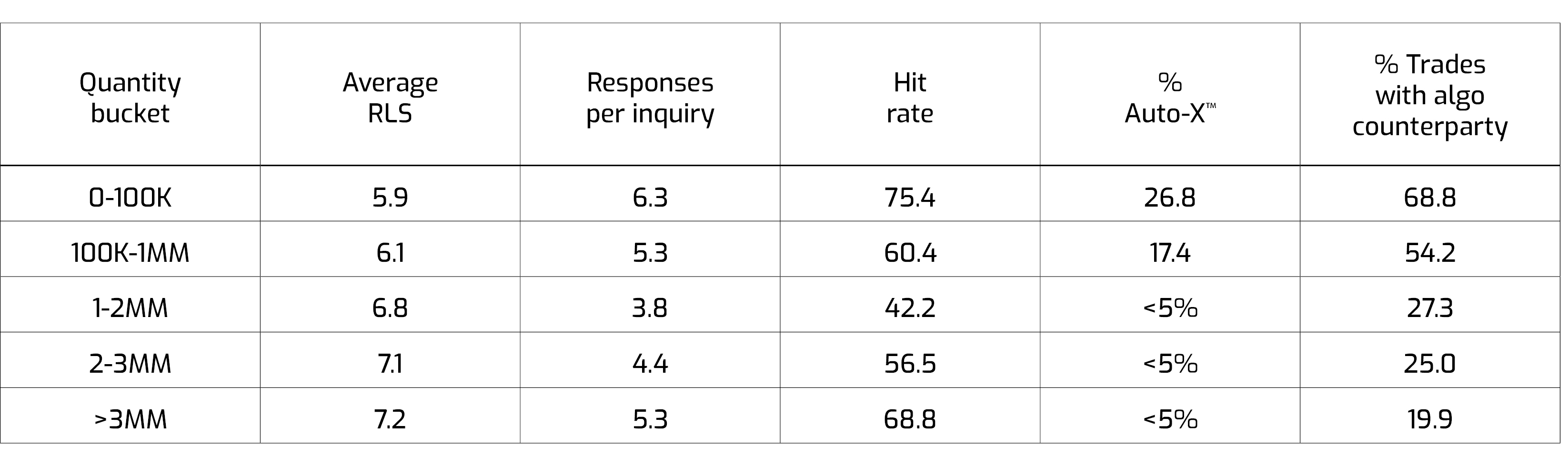
Similarly, there is evidence to support executing larger block trades in high-yield markets. The >3MM bucket averages 5.3 responses with a hit rate of 68.8%, reinforcing that block-sized trades can secure competitive pricing and reliable liquidity.
US HY Q1 2025 metrics
The growth of algorithmic trading has had a transformative effect on the bond market, significantly enhancing market liquidity and pricing efficiency. Better RFQ and trade data, along with improved models, have enhanced algo pricing capabilities, encouraging dealers to take on more risk. As the share of algo responses continues to rise across market segments and trade sizes, traders are becoming confident in executing larger orders electronically.
The rapid expansion of algo participation—particularly in larger size transactions—has not only improved execution quality but also fostered greater competition and speed in pricing. The increased coverage of unique bonds and the continued evolution of algorithmic strategies have created a large liquidity pool, empowering traders to engage in higher-value trades with greater confidence. This trend is expected to persist, with algorithmic trading playing an increasingly dominant role in shaping the future of fixed income market dynamics.
CP+™ is MarketAxess’ proprietary AI-powered pricing engine for corporate bonds. It produces an unbiased, two-sided market for more than 33,000 instruments globally. Updated every 15 to 60 seconds, the engine generates nearly 30 million levels per day covering 90-95% of trading activity in its markets.
Relative Liquidity Score (RLS) provides a defined measurement of the current liquidity for individual bonds and highlights the potential ease that a trader can expect to transact in that instrument. It covers nearly 36,000 bonds daily, with scores ranging from 10 - the highest level of liquidity - down to 1.
For questions or follow-up, email our data scientists: