
AxessPoint: Comparing transaction costs for retail vs institutional investors
Highlights
- We observe via TRACE that small size trades execute significantly wider than larger trades. For example, trades less than $50k in notional size execute more than 6 cents wider in US High Grade and more than 30 cents wider in US High Yield.
- However, this small size effect on transaction costs doesn’t hold for 144a bonds. Since 144a bonds are only tradeable by qualified investors, and since retail investors trade mostly smaller quantities, we believe that whether an investor is institutional or not is a more determining factor than trade size.
A look at US High Grade
Firstly looking at TRACE, we observe that micro lots trade wider than larger trades. Wider means that the trade price is further away from the CP+™ price (for ‘Dealer Buys’ trades we compare to CP+ bid and for ‘Dealer Sells’ to the CP+ offer) and therefore less advantageous for the liquidity taker, which is usually the buy-side client.
However, trade size is only a confounding factor and the dimension that matters most is whether the investor is institutional or not. Even though there is no investor type field in the TRACE database, we can control for the investor variable by comparing 144a bonds, which only qualified investors can trade, to other bonds which anybody can trade, including retail investors.
Transaction costs by trade quantity and bond type | US High Grade*
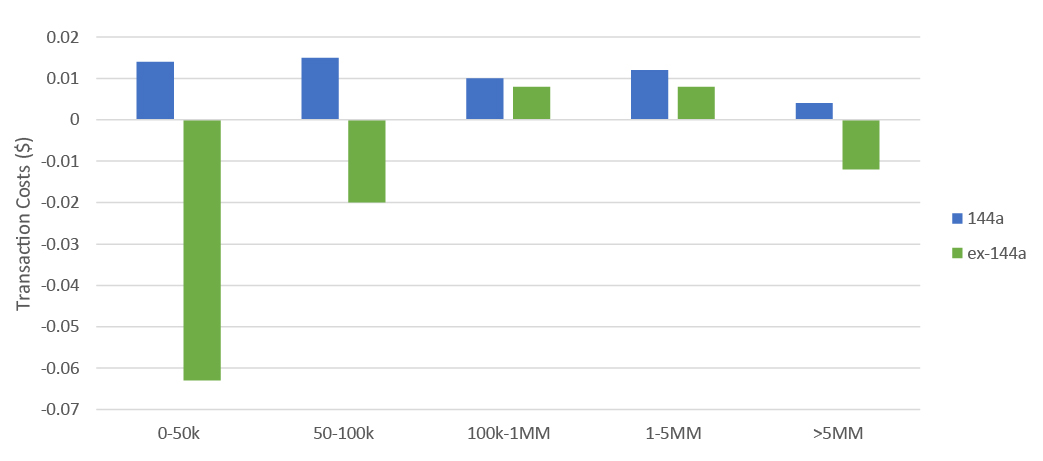
The graph above represents the US High Grade transaction cost (US$) by size bucket. It is defined as the distance between the TRACE trade price and the CP+ price on the corresponding side.
A positive value on the y-axis means that the trade was inside CP+ (better for the liquidity taker). A negative value means that it was outside CP+ (worse for the liquidity taker). Each size bucket’s value in the chart is the median of all observations.
On the one hand, the graph shows that, for non 144a bonds, trades under $100k are priced significantly wider than CP+ while trades above $100k are in-line with CP+. On the other hand, for 144a bonds, quantity is hardly a factor at all, and all size buckets are in line with CP+.
A look at US High Yield
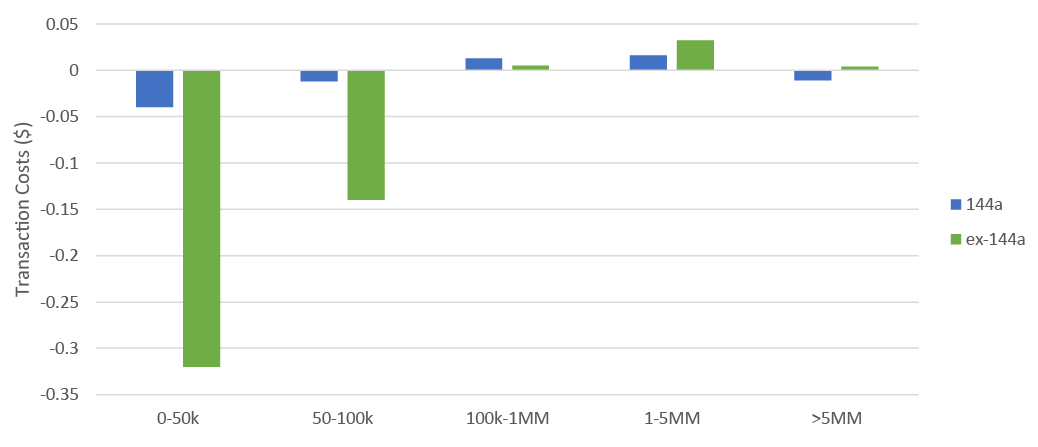
In US High Yield, the same trend is confirmed. The size effect is even more pronounced for non-144a bonds and, hardly a factor for 144a bonds.
Transaction costs by trade quantity and bond type | US High Yield*
Sizing the impact
A final illustration of the relationship between investor type and trade quantities on TRACE is that only 17% of the trades in 144a bonds are micro lots (i.e. the notional is less than or equal to $100k) vs 68% for non-144a bonds.
*May to July 2020 TRACE data (Client to Dealer trades only, riskless principal trades are excluded)
Redefining real-time bond pricing
CP+™ is MarketAxess’ proprietary AI-powered pricing engine for corporate bonds. It produces an unbiased, two-sided market for more than 28,000 instruments globally. Updated every 15 to 60 seconds, the engine generates over 30 million levels per day covering 90-95% of trading activity in its markets.