
AxessPoint: Estimating pre-trade Open Trading™ cost savings

Highlights
- Open Trading contributes meaningful cost savings for liquidity takers (inquiry submitters), which is most often presented in post-trade reporting.
- Establishing pre-trade expectations of Open Trading’s cost savings for liquidity takers can be an important factor in determining how to manage an order.
Cost savings expectations
Any post-trade review of Open Trading cost savings is an important part of understanding its total contribution to trading outcomes.
How can traders incorporate that insight into their pre-trade process, however? Of course, they can always oversimplify and assume that the recent historical cost savings would be a good approximation of what to expect in the near future, which is a common and reasonable starting point.
But for any specific order, what should Open Trading cost savings expectations be? We know, for example, that realized cost savings are highest where liquidity can be more challenging, so the pre-trade effort of being more specific should pay off.
To help traders create a pre-trade expectation, we can link it with something that traders more thoroughly understand and experience.
Since Open Trading cost savings for liquidity takers is structurally similar to the cover level, we’ve added a chart plotting those two elements—Open Trading cost savings and cover delta—over the last 52 weeks for the US Investment Grade activity on MarketAxess. Here we can observe a direct linear relationship between them.
Open Trading cost savings (liquidity taker) vs true best to cover
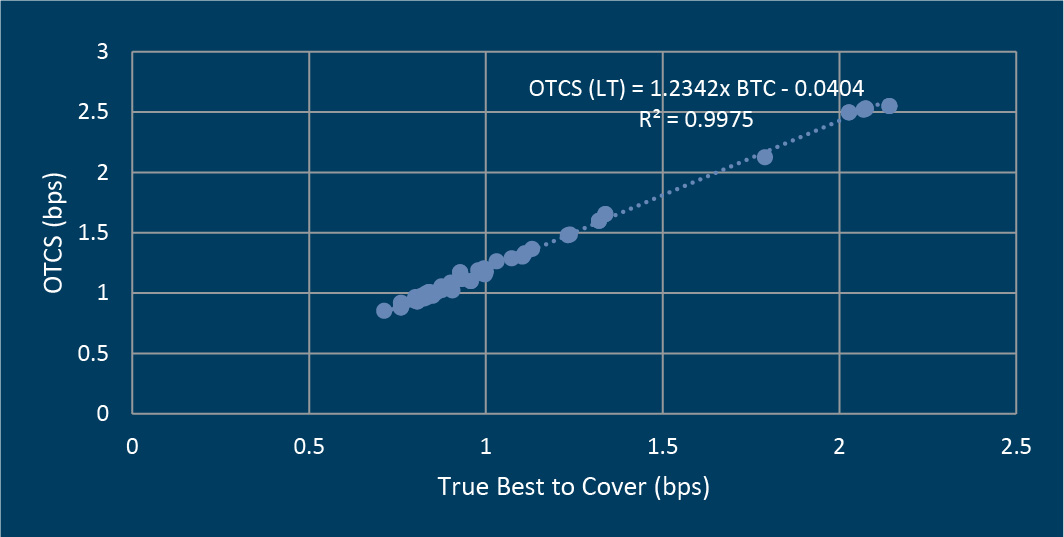
In the chart, we see that when a cover is 1.5 bps, the cost savings is 1.8 bps. Similarly, when the cover is 2 bps, the cost savings is 2.5 bps. The correlation is an extremely high at 0.99.
Open Trading cost savings (liquidity taker) by liquidity score and dealer side
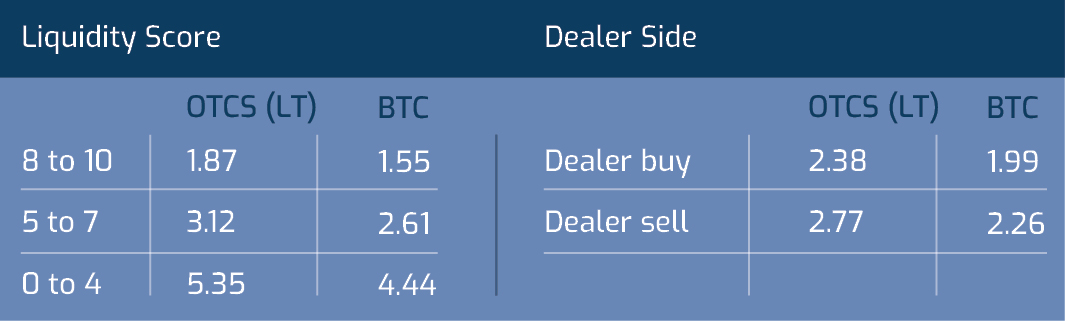
Taking it a step further, the tables highlight that this strong relationship holds when split by Liquidity Score or by side.
By establishing confidence in this linkage, traders can build pre-trade Open Trading cost savings expectations, which can then be used to improve trading outcomes especially in circumstances where Open Trading cost savings is expected to be large and add the most value.
Calculating the Open Trading cost savings (OTCS)
Measured per bond, Open Trading cost savings for Liquidity Takers is the price differential (improvement) between the winning Open Trading response and the best disclosed dealer response; e.g. the disclosed dealer cover, which would have been the best available response absent Open Trading.
For questions or follow-up, email our data scientists at research@marketaxess.com.