
AxessPoint: Growing adoption of delayed spotting in corporate bonds

Highlights
- Reported corporate bond transaction volumes spike at regular times daily due to the printing of delayed treasury spot trades.
- Delayed spotting is commonly used to hedge against price movements in the underlying benchmark Treasury and reduce interest rate risk.
- Delayed spotting has grown from 2% of the IG market in 2017 to 7% of the IG market in 2021.
Investment grade corporate bond volumes - as reported by FINRA’s Trade Reporting and Compliance Engine (TRACE) - follow a familiar pattern. Trading volumes begins to rise in the morning (US Eastern Time) around 8am, dip slightly around lunch, and start to wane around 4pm; except for the daily spikes in reported volume. These daily spikes in reported volume represent trades made using delayed treasury spotting; in investment grade corporate bonds, transactions are often made by counterparties agreeing on a spread to a benchmark Treasury security. The price of the trade is calculated at a specified time using the agreed upon spread-to-Treasury. For example, counterparties may agree to a spread at 2:00pm, and the price is calculated (and reported to TRACE) based on the benchmark’s yield at 3:00pm.
Investment Grade client-to-dealer TRACE volume share by minute (Q4 2021)
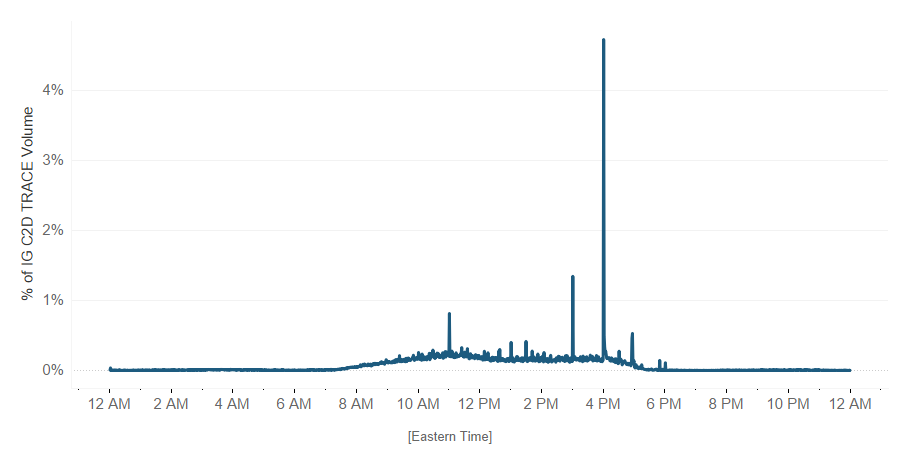
By analyzing the TRACE feed, we can get an accurate picture of how much of the trading volume is conducted using delayed treasury spotting. For years, most delayed spot trades were done at 3:00pm, with some earlier or later trades printing at 11:00am or 4:30pm; in January of 2021, a significant amount of the 3:00pm volume was shifted to 4:00pm, following a change in pricing convention by the Bloomberg Barclays Indices.
Quarterly Investment Grade client-to-dealer TRACE volume share by minute
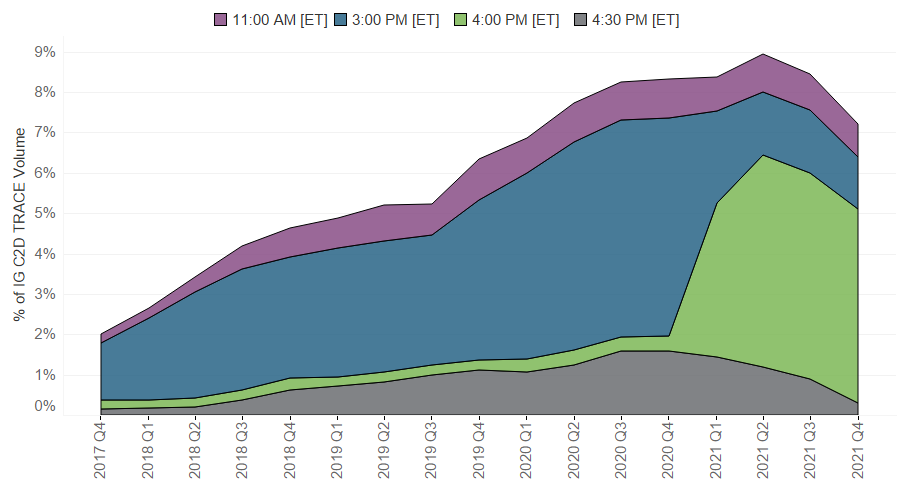
Over the past several years, the practice of trading using a delayed treasury spot has grown in popularity. In the fourth quarter of 2017, only around 2% of investment grade transactions on TRACE were estimated to be done with a delayed spot. In Q4 of 2021, delayed treasury spot trades represented an estimated 7% of the investment grade market. The surging growth of this type of trading of investment grade bonds can help traders effectively manage the separation of credit risk and interest rate risk.
TRACE Context
A MarketAxess data product, TRACE Context allows subscribers to gain real-time and historical insights into transactions reported to TRACE, enriched with proprietary supplemental data points. For delayed spot transactions which occurred on the MarketAxess platform, TRACE Context reveals the time that the spreads were agreed upon, in addition to when the price was reported to FINRA.
For questions or follow-up, email our data scientists at research@marketaxess.com.