
AxessPoint: Impacts of high issuance days on secondary market activity

Highlights
- In secondary European Investment Grade (IG) Credit markets, we observe more selling pressure on days of high primary market issuance. On average, there is an 8% excess selling in MarketAxess trading platform volumes during days of very high issuance.
- On busy primary market issuance days, buy-side traders aim to free capital by selling shorter dated bonds in the secondary market.
Primary market
In 2021, the European Investment Grade Market (EUR IG) had on average €2.6 billion issuance per day. The top 5% highest issuance days had a daily average of €8.4 billion. We get primary market information on TraX, a unique centralised source of European cleansed fixed income data. By looking at the first trading day of a bond and its deal price, we can identify days of large primary market issuance, and hence the total amount of primary market issuance.
Secondary activity during high issuance days
We investigate buy-sell split in trading activity during high issuance days between 2017 and 2021. From TraX data, we identify the top 5% of high primary market issuance days and look at the trading volume ratio on the MarketAxess platform, a proxy for secondary market activity. Specifically, we compare the fraction of sell orders during high issuance days (the top 5%) and the remainder of the days (excluding the top 5% of high issuance days). We present this in Figure 1 for each year since 2017 and, on average, we see selling skew during high issuance days of circa 55%. Contrast this to the remainder of the year, where selling skewness is circa 51%. Clearly, secondary markets have seen more selling pressure on days of high primary market issuance in EUR IG since 2017. This phenomenon can be attributed to buy-side traders wanting to free capital in the secondary market to buy newly issued bonds in the primary market.
Fraction of sell trades by volume in EUR IG
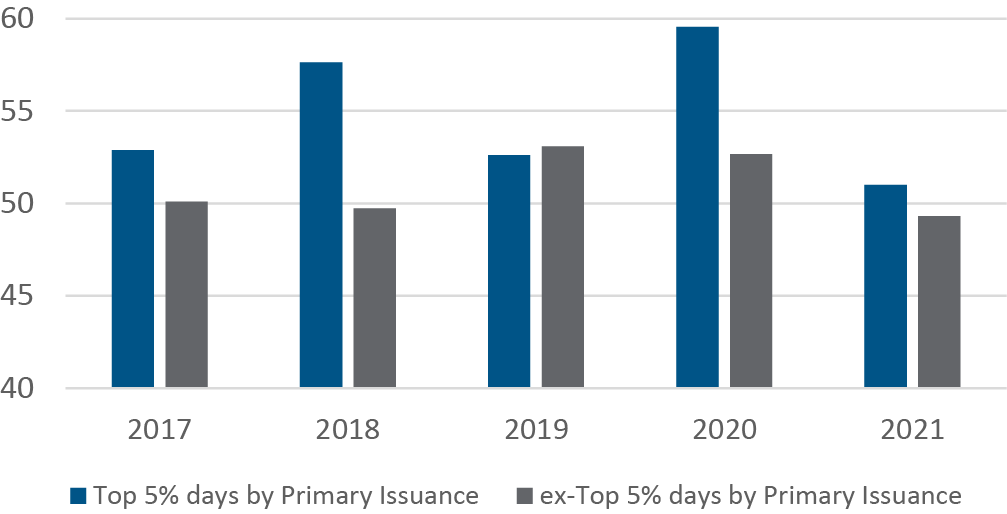 Fig 1: The fraction of sell orders during high issuance days and the remainder of the days (excluding high issuance days).
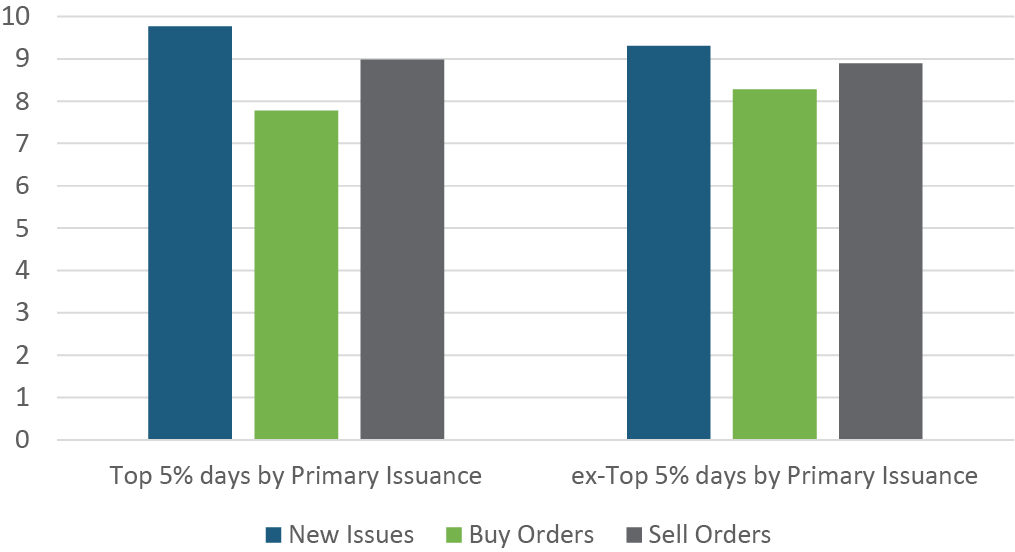
Heavy selling creates opportunities for clients to provide liquidity on bonds that other clients are selling through Open Trading. Figure 2 shows average issuance and trading maturity breakdown. We observe that, clients tend to sell short maturity bonds more than long maturity ones. During high issuance days average issuance maturity is 9.8 years whereas average sell maturity is 7.8 years. Traders tend to sell their low maturity bonds in the secondary to purchase higher maturity bonds in the primary.
Average Maturity Breakdown During Issuance Days EUR IG (2017-2021)
Deeper insights with Trax® data
Trax data from MarketAxess aggregates bond market activity executed by European banks, asset managers and trading firms across both voice and electronic trading methods that is validated in near real-time through a post trade regulatory reporting and trade confirmation engine.
For questions or follow-up, email our data scientists at research@marketaxess.com