
AxessPoint: Meaningful price improvements with partial-size trades

Highlights
- Partial-size responses can offer significant price improvement over full-sized responses. In 1H20, the median traded premiums for partial responses were 6.7 bps for US Investment Grade and 68 cents for US High Yield.
- When the best level is a partial, participants tend to accept partial size orders that offer price improvement over full-sized orders across all liquidity scores.
A look at US Investment Grade
MarketAxess gives RFQ inquiry submitters the option to allow partial-sized responses from liquidity providers. When the best level is a partial, the liquidity taker can trade the partial or full at their discretion.
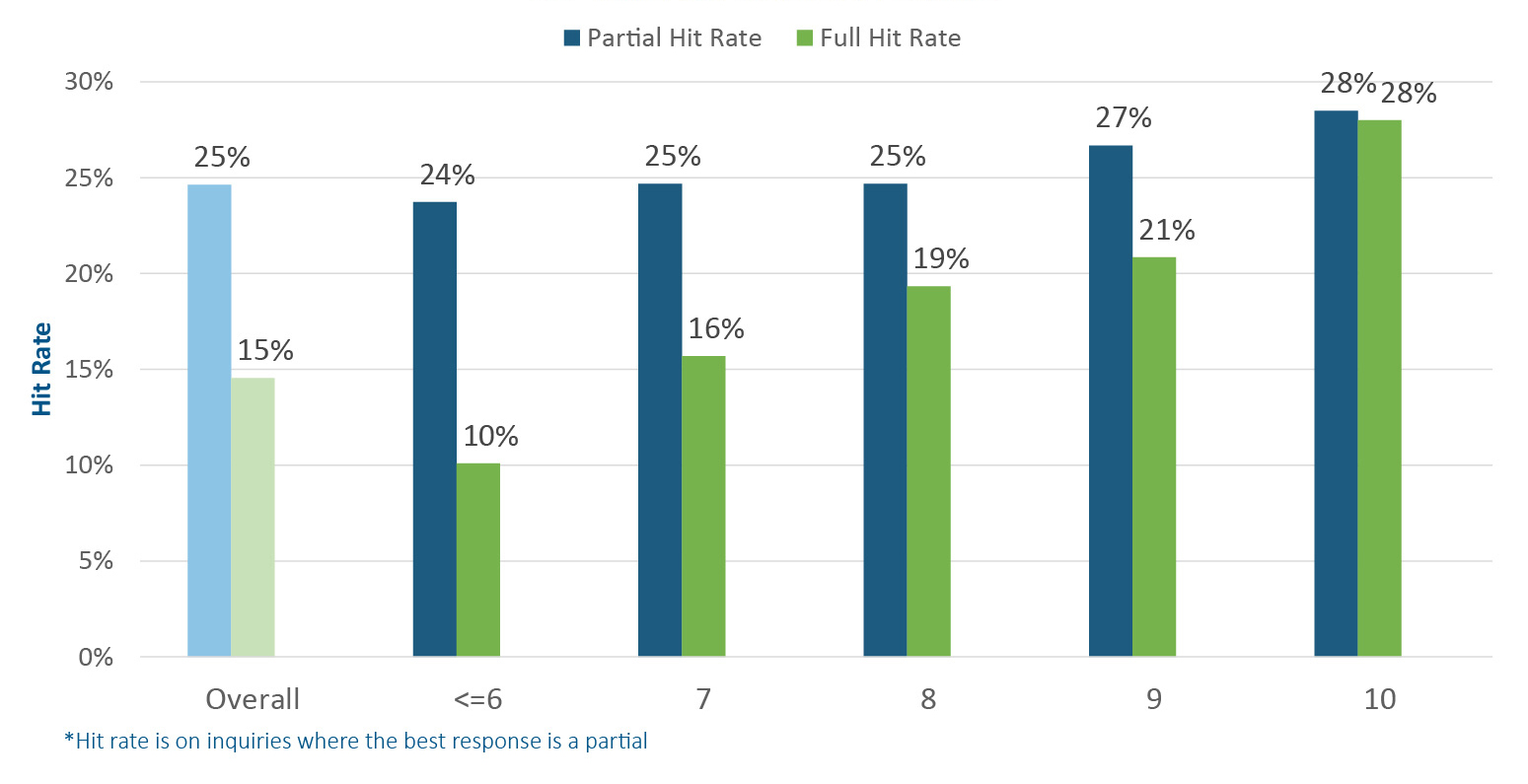
In 1H20, 64% of US Investment Grade inquiries allowed partials. Of those, 15% had one or more partial responses and 3% had the partial as the best level. When a partial response is the best level, liquidity takers tend to trade the partial response (25% hit rate, median 6.7 bps premium) over the full-sized response (15%, median 1.8 bps premium). As the premium increases, so does the likelihood to trade the partial response. Inquiries that do not trade (DNTS) are still common (60%, median 6.9 bps premium).
These aggregate results can vary by bond. The chart below looks at the results when the best level is partial, split by liquidity score. Partial-sized responses’ hit rates (in blue) increases as relative liquidity scores increase. Additionally, they’re much higher than the full-sized responses’ hit rates (in green), particularly for lower liquidity scores.
Hit rate vs Liquidity score
A look at US High Yield
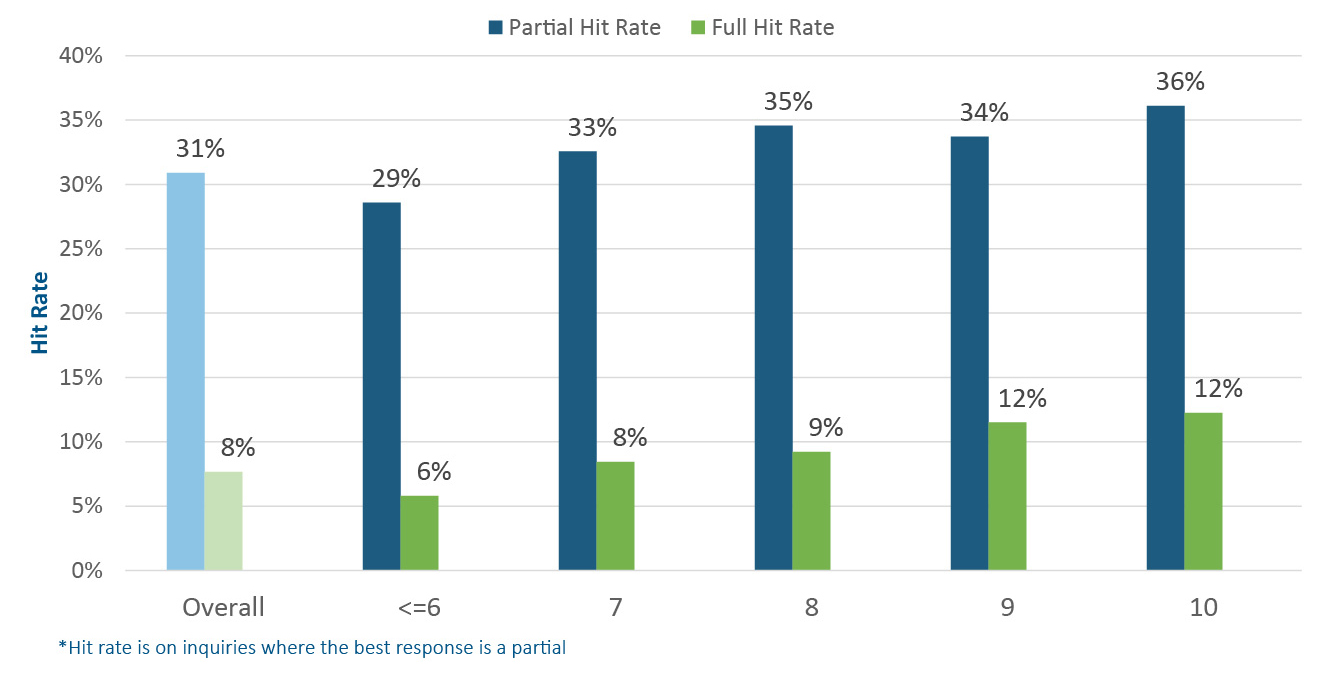
In 1H20, 81% of US High Yield inquiries allowed for partials. Of those inquiries, 8% had one or more partial responses and 4% had the partial as the best level. As with US Investment Grade, liquidity takers tend to trade the partial response (31% hit rate, median 68 cents premium) over the full-sized response (8%, median 14 cents premium) when a partial response is the best level. They are also more likely to trade the partial response as the premium increases. DNTS are still common (61%, median 71 cents premium).
Similarly, when the partial is the best level, partial-sized responses’ hit rates (in blue) increases as relative liquidity scores increase, and they are consistently higher than the full-sized responses’ hit rates (in green) across all liquidity scores.
Hit rate vs Liquidity score
Improving trading outcomes
Partial-enabled inquiries can be an appropriate option for buy-side traders who prioritize execution performance, and partial responses can benefit dealers who provide superior pricing. Ultimately driving better trading outcomes for all participants.
Relative liquidity score
The MarketAxess Relative Liquidity Score provides a defined measurement of the current liquidity for individual bonds by highlighting the potential ease that a trader can expect to transact in that instrument. Available for Euro, Sterling and Dollarâ€denominated bond markets, our scoring method covers nearly 26,000 bonds daily, with scores ranging from 10 – meaning the highest level of liquidity – down to 1.
For questions or follow-up, email our data scientists at research@marketaxess.com.