
AxessPoint: Pre-trade Open Trading™ cost savings | Liquidity providers

Highlights
- Open Trading contributes meaningful cost savings for liquidity providers (inquiry responders).
- Establishing pre-trade expectations of Open Trading’s cost saving for liquidity providers can be an important factor in determining how to manage an order, especially when traders can prioritize price improvement vs. immediacy.
- See our prior AxessPoint for detail on Open Trading cost savings opportunities for liquidity takers.
Cost savings expectations
Traders always have the opportunity to meet their immediate liquidity needs by submitting an RFQ and taking liquidity, either by hitting the bid or lifting the offer. The bid/ask spread is the “price” of such a transaction.
Through Open Trading, traders have the opportunity to instead provide liquidity to another participant’s RFQ. For example, they can provide a bid for another participant’s BWIC or an offer for another’s OWIC.
Of course, buying on the bid-side as a liquidity provider rather than lifting an offer to achieve liquidity has an obvious benefit: the price is improved by the bid/ask spread.
We measure Open Trading Cost Saving for Liquidity Providers exactly that way: the traded level vs. the available level on the opposite side.
Cost savings vs Bid/Ask spread
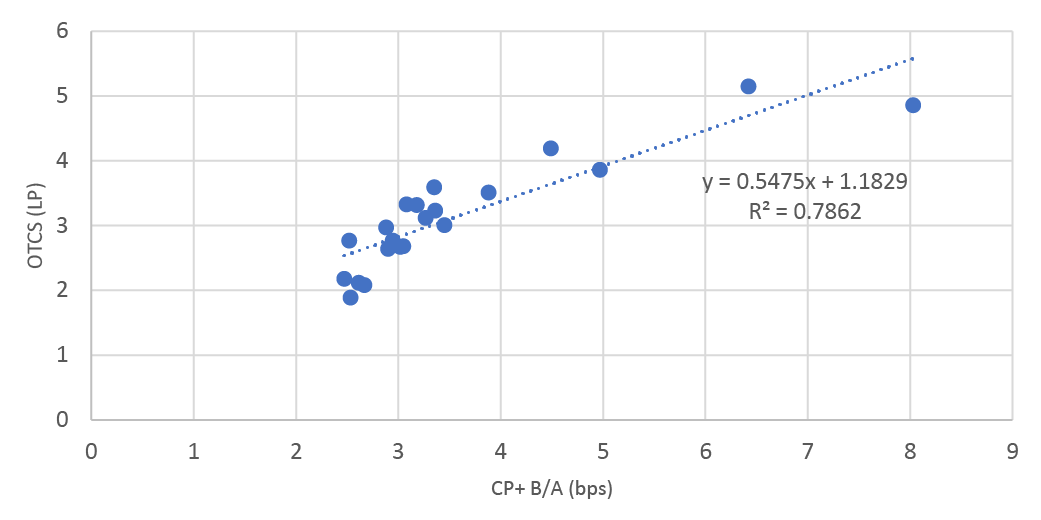
We’ve added a chart plotting those two elements – Open Trading cost savings (OTCS) for Liquidity Providers vs. bid/ask spread since January 2019 for US investment grade activity on MarketAxess. Here we can observe a reliably linear relationship between them. In the chart, for example, we see that when bid/ask is 4 bps, the OTCS is expected to be 3.5 bps. The R-squared is high at 79%.
USD Investment Grade OTCS (LP) vs Composite+™ B/A
Further, we can plot OTCS as a percentage of bid/ask, which can be used as an effective shorthand on the pre-trade value of OTCS given a bond’s bid/ask spread.
USD Investment Grade OTCS (LP) as a % of Composite+ B/A vs Composite+ B/A
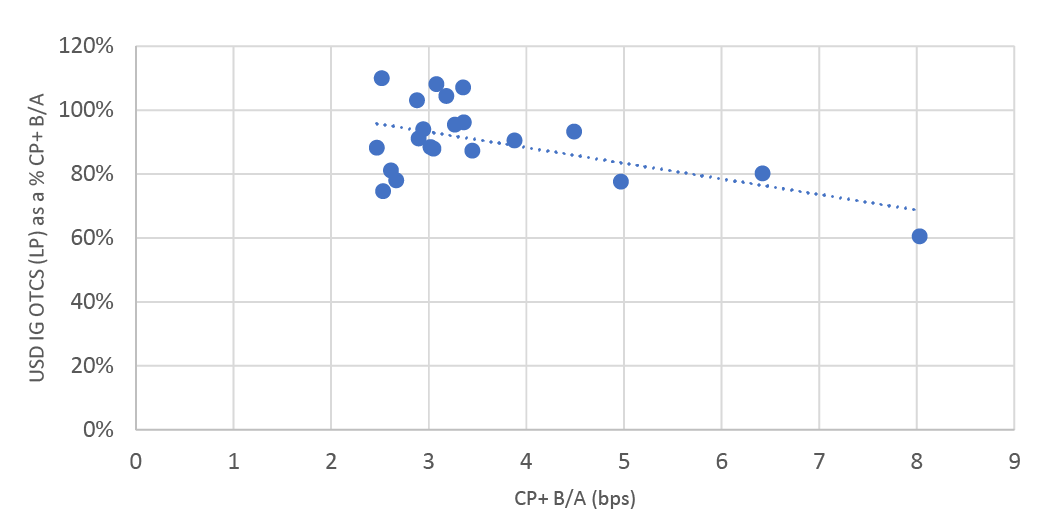
We observe OTCS as consistently 80-100% of bid/ask, though the percentage dips lower when bid/ask is elevated.
By establishing confidence in this linkage, traders can build pre-trade Open Trading cost savings expectations, which can then be used to improve trading outcomes in circumstances where bid/ask is wide and can add the most value.
Calculating the Open Trading Cost Savings (OTCS)
Measured per bond, Open Trading Cost Savings for Liquidity Providers is the price differential (improvement) between the winning Open Trading response and the Composite+ level on the opposite side; e.g. the expected trade level that the client might have experienced had they instead met their need as Liquidity Taker.
For questions or follow-up, email our data scientists at research@marketaxess.com.