
AxessPoint: Pricing dynamics of EU bonds in the wake of SURE and NGEU

Highlights
The European Union’s SURE and NGEU programs (launched in October 2020 and June 2021 respectively) was unlike anything the bloc had undertaken before. Issuing debt in amounts normally reserved for sovereign nations, SURE and NGEU transformed the size of the European supranational bond market and elevated EU bonds to trading levels of European Government Bonds (see here).
As a follow up, we here investigate the price comparison between these EU bonds and EGBs, demonstrating:
- EU bonds offer very similar yields in the belly of the curve (5-10 years) to France.
- EU bonds have a yield curve comparable to safe-haven assets such as Germany and the Netherlands.
- EU bonds have higher transaction costs than Germany and Netherlands with a wider bid/ask spread.
Issuer Curves
Unlike the peripheral EGB countries (such as Italy and Spain) where investors want to be compensated with higher yields for assuming the added risk of investing in longer-term bonds, EU bonds are priced with a lower yield on the long end of the curve alongside German Bunds and Netherlands DSLs, which have less associated risk (see the below yield curves).
Composite+™ issuer curve
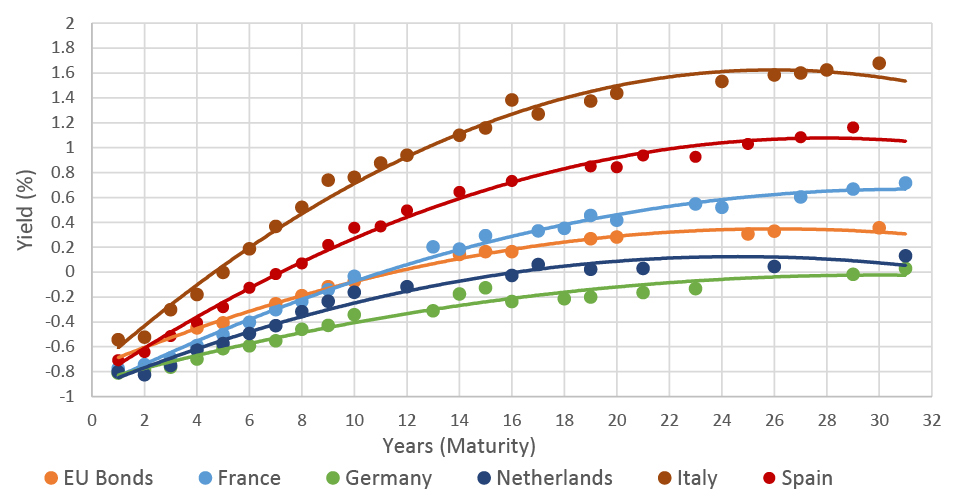
Fig 1: Chart displaying government bond yield curve using Composite+. Yield value is the mid Composite+ value taken at 4pm UK time on 9 November 2021.
Although the whole EU bonds curve is not negatively yielding like Germany, they are closer on the belly and long end of the curve to all the safe-haven bonds. The EU yield curve indicates they are viewed as the third safest asset available in the Eurozone, with the third lowest long end yields.
Transaction costs
Bid/ask spreads for EU bonds are wider than core EGBs and more akin to the semi-core and peripheral countries (e.g Spain, see below). The largest difference to the core EGBs can be found on the belly of the curve (see maturity bucket “>5Yrs and <=10Yrs” above) where the transaction costs for EU bonds are two cents higher than Bunds.
Composite+ bid/ask spread by maturity
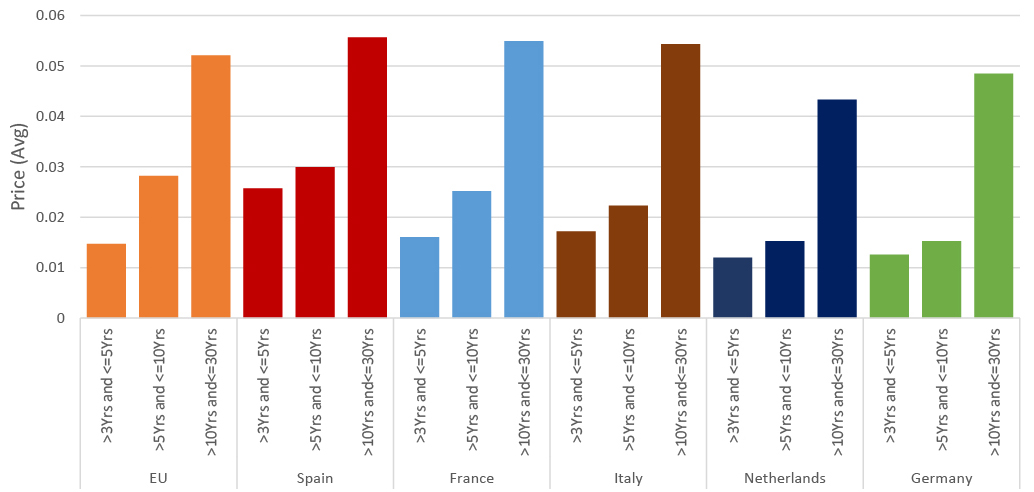
Fig 2: Chart displaying average bid/ask price spread by bond country and maturity in November 2021 using Composite+. Average price values in EUR e.g., €0.01 = 1 euro cent.
As it was recently announced, the ECB’s bond Pandemic Emergency Purchase Program (PEPP) would end in March, impacting confidence in semi-core and peripheral EGBs, EU bonds now offer an appealing alternative to ultra-safe Bunds
Redefined real-time bond pricing
Composite+ (CP+) is MarketAxess’ proprietary AI-powered pricing engine for corporate bonds. It produces an unbiased, two-sided market for more than 30,000 instruments globally. Updated every 15 to 60 seconds, the engine generates nearly 30 million levels per day covering 90-95% of trading activity in its markets.
For questions or follow-up, email our data scientists at research@marketaxess.com.