
AxessPoint: Return of volatility and widening credit market bid/ask spreads

Highlights
- Market wide Bid/Ask Spreads spiked significantly in February 2022 compared to October 2021.*
- However, the widening of spreads is not as dramatic as it was during the height of the COVID-19 pandemic back in March 2020.
Increase in bid ask spread
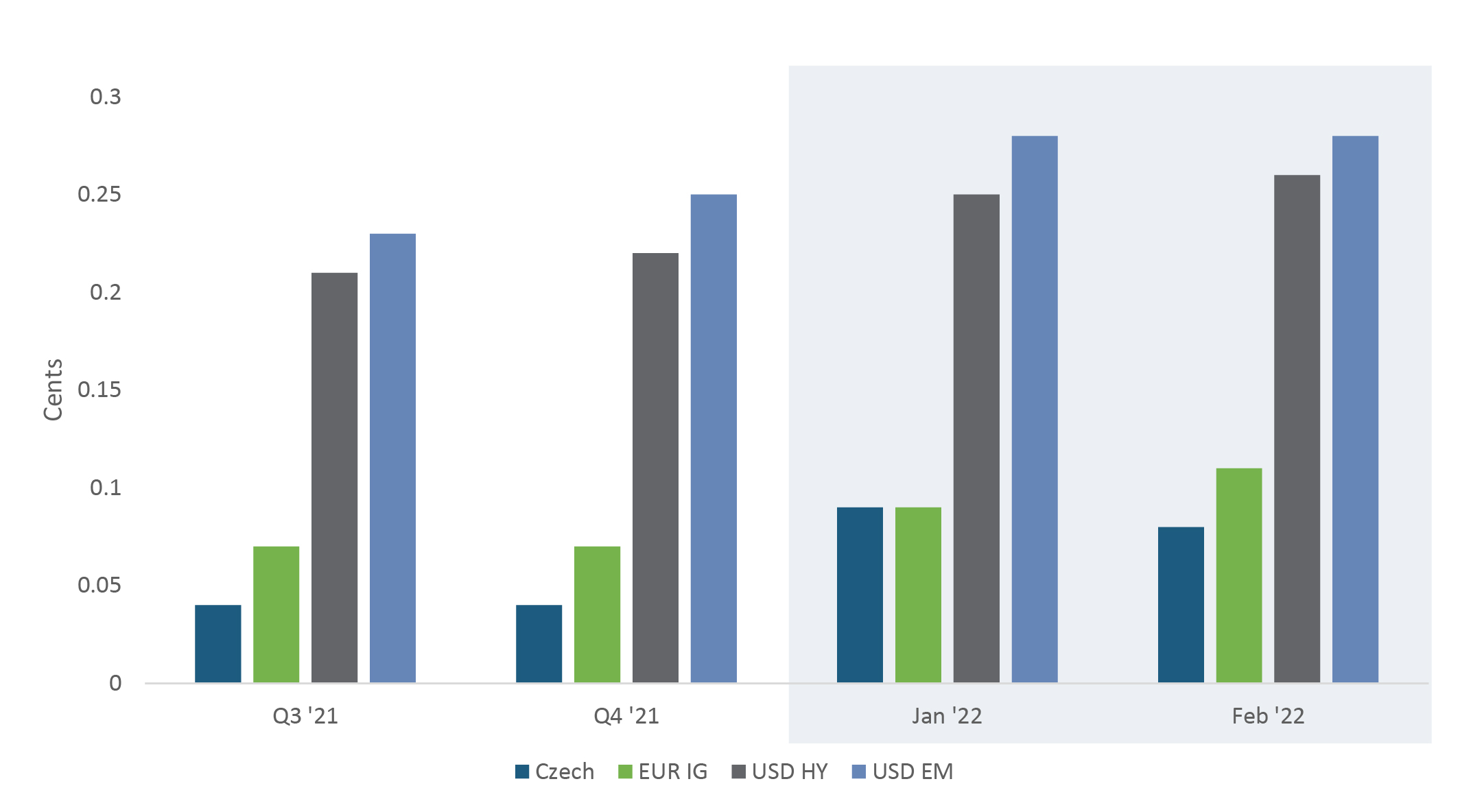
In previous AxessPoints, we illustrated pandemic-related credit spread changes and the subsequent return to more normal levels this past summer. Recent market activity and an increase in volatility has prompted us to revisit these figures. Credit market bid/ask spreads in October 2021 started increasing towards the end of the year and have continued to widen in 2022. USD IG was at 1.90 bps in October, we observed an uptick in November to 2.06 bps, and bid/ask spreads continued to expand to 2.56 bps in February. Similarly, EUR IG was 6 cents in November, 8 cents in December, and 11 cents in February. The increase in transaction costs, and thus widening in bid/ask spreads, can be seen across other markets as well from Q4 2021 to February 2022: +12% for USD EM, +18% for USD HY, +57% for EUR IG. Notably within EM, bid/ask spreads of Czech Koruna (CZK) debt was up +100%.
Composite+ bid/ask spreads by market
Bid ask spreads at relative lows
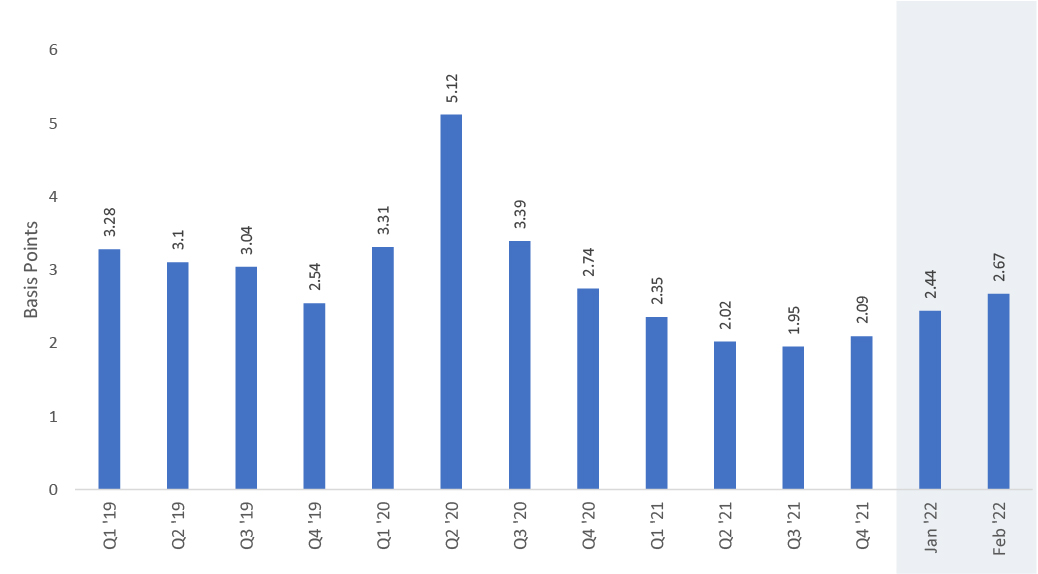
If we expand our view to give context to these developments, we can see that these bid/ask spread expansions are not as dramatic as other recent events. Simultaneously, even at these expanded levels, bid/ask spreads are still tighter than other comparable periods. Using USD IG bid/ask spreads from 2019 onwards, we see that transaction costs remain lower than 3 out of 4 quarters leading up to the COVID-19 pandemic. After that notable peak in the second quarter of 2020, bid/ask spreads began to decrease and relatively flatline from the end of 2020 into mid-2021, before observing a widening in Q4 2021 as noted above.
Composite+ bid/ask spreads | USD IG
Redefined real-time bond pricing
Composite+™ is MarketAxess’ proprietary AI-powered pricing engine for corporate bonds. It produces an unbiased, two-sided market for more than 32,000 instruments globally. Updated every 15 to 60 seconds, the engine generates nearly 30 million levels per day covering 90-95% of trading activity in its markets.
*MTD as of February 22, 2022. Although our analysis was completed earlier in February, at the time of publishing the conflict in Ukraine is, of course, significantly impacting markets, and we would therefore expect to see further spikes in the coming weeks.
For questions or follow-up, email our data scientists at research@marketaxess.com