
AxessPoint: Understanding TCA Outcomes in US Investment Grade

Highlights
- Liquidity takers can achieve better price execution when trading US Investment Grade (IG) on MarketAxess, relative to a market benchmark such as TRACE.
- A key driver in determining price outcomes, when trading electronically, is the number of responses received on an RFQ. More responses equate to improved pricing with more competition among liquidity providers.
- Our analysis shows that every additional response improves TCA by ~0.36 bps on average.
Electronic and voice trading TCA in the US IG market
Transaction Cost Analysis (TCA) is used by participants in corporate bond markets as a post-trade tool to assess the pricing and execution quality of their trading activity. Looking at TCA in aggregate can give us a unique view into broader trends in the corporate bond market and electronic trading.
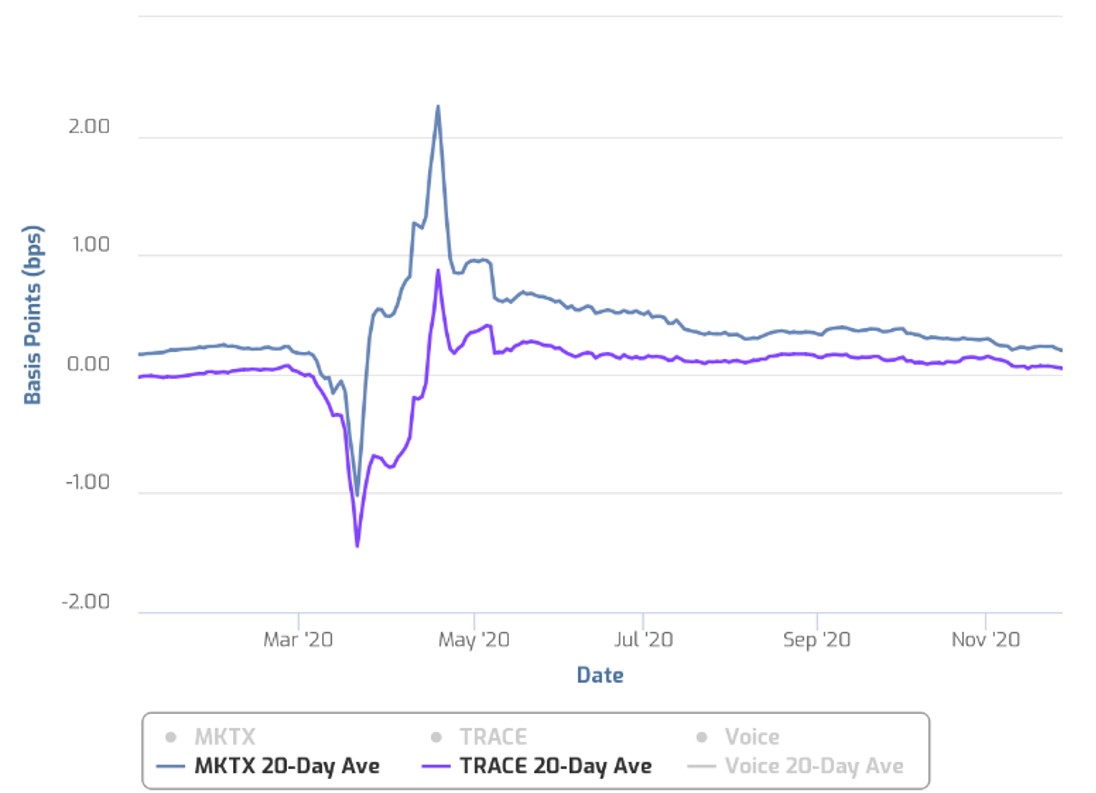
Across 2020 we have seen consistent overperformance of pricing quality executed on MarketAxess compared to non-electronic bond trading. In 2020 (Jan-Nov inclusive), the US IG trades executed on MarketAxess saw an average of 1.1 bps price improvement over other traded activity reported to TRACE, as shown in the performance indices below.
What’s responsible for electronic TCA outcomes
One of the primary factors that influences TCA outcomes is the number of firm price quotes received on an order. The more price responses received on an order, the more likely the best quote is to outperform a benchmark.
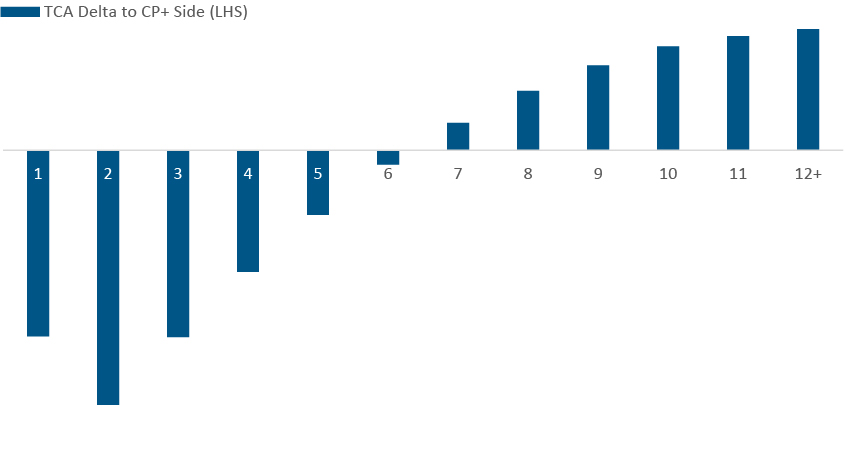
A clear correlation between responses and pricing outcome emerges (see below plot); a linear regression fit shows correlation (R-squared) at 93%, with each additional response improving TCA by ~0.36 bps. On average, in 2020, RFQs that received seven or more responses outperformed Composite+™ bid/offer, while over 70% of trades received at least seven responses and significantly outperformed Composite+ side.
To help improve pricing outcomes and achieve best execution, clients can aim to maximize the number of responses they receive on their inquiries. Having a pre-trade estimate for the numbers of responses that will be received on an RFQ can help inform best execution mandates.
Transaction cost analysis (TCA)
TCA is defined relative to Composite+ and is calculated as the distance between the trade price and the Composite+ price on the corresponding side, at inquiry time. A positive value means the trade occurred inside (more competitive than) Composite+ bid or offer, while a negative value means the trade occurred outside (less competitive than) the Composite+ bid or offer.
For questions or follow-up, email our data scientists at research@marketaxess.com.