
CP+™ under the hood: How trades and inquiries impact pricing
Highlights:
The unique position of MarketAxess as a leading electronic trading platform allows CP+ to leverage insights from both trades and non-traded inquiries.
Our analysis reveals that on-platform trades are more reliable inputs for CP+ than off-platform trades and that even inquiries that Did Not Trade (DNTs) have a significant impact on CP+ pricing, showcasing the algorithm's ability to extract meaningful signals from proprietary data.
Additionally, CP+ demonstrates robust learning capabilities, refining its predictions based on a diverse array of market data and avoiding overfitting to individual trade prices.
Introduction
In the recently published CP+ whitepaper, we discussed how CP+ accuracy is rigorously measured by comparing CP+ levels against institutional-sized trades in the market. This AxessPoint is a direct follow-up in which we dive deeper into the inner workings of CP+. Here, we explore how key inputs like executed trades and platform inquiries drive the movement of CP+, shedding light on the interpretability of the model.
The analysis below is done using Q4 2023 data on US Investment Grade (IG) trades and inquiries with a quantity above or equal to $150k
Comparing CP+ accuracy for on-platform and off-platform trades
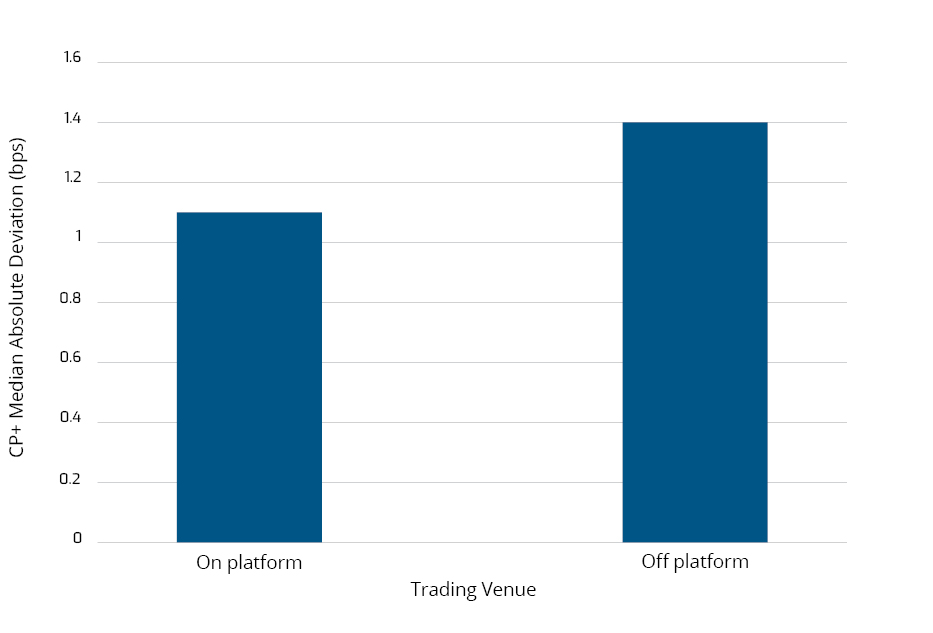
We show the value of on-platform trades by comparing the CP+ median absolute deviation (MAD) for on-platform versus off-platform trades. The MAD is a robust measure of the variance between a pricing source (CP+ in this case) and actual traded levels, with lower values indicating either better accuracy of the pricing source or less noise in the trades themselves. With CP+ as the common factor in this scenario, comparing the MAD is effectively measuring the consistency of the traded levels on and off platform.
In Q4 2023, for US IG bonds, the CP+ MAD was 1.095 bps for on-platform trades and 1.395 bps for off-platform trades. This lower MAD for on-platform trades indicates a higher degree of consistency compared to off-platform trades, making them more reliable inputs for CP+. One key factor contributing to this consistency is the centralized liquidity pool on the MarketAxess platform. In Q4 2023, 96% of US IG client initiated RFQs on the platform went to all liquidity providers via Open Trading®. This broad exposure helps to ensure that the best response back reflects the market's collective view and is less likely to be influenced by idiosyncratic factors or outliers, resulting in more reliable trade data for CP+.
CP+ Median Absolute Deviation
Examining the impact of trades and inquries on CP+
While the MAD comparison demonstrates the superior quality of on-platform trades, we can go beyond evaluating prediction accuracy and examine how CP+ adapts its pricing in response to new trade and inquiry data.
We define ‘Event Delta’ as the difference between the event level (traded level for trades or best response level for inquiries that didn't trade) and the corresponding CP+ side 15 minutes before the event, such that a positive Event Delta indicates that the event level is more competitive than the prior CP+ side from the liquidity taker's perspective. Similarly, we define 'CP+ Movement' as the change in the CP+ side from 15 minutes before the event to 15 minutes after the event such that a positive CP+ Movement signifies that the CP+ side became more competitive from the liquidity taker’s perspective after the event compared to before the event (see appendix for a more detailed explanation).
CP+'s robust learning from trade data
CP+ does not rely solely on individual trades to determine bond prices. Instead, it considers a wide range of relevant data points, even those that may be less directly related to the current prediction. By incorporating this diverse set of inputs, CP+ can generate more robust and accurate pricing estimates. As a result, when a trade occurs at a level that differs from the CP+ prediction by a certain amount (‘Event Delta’), the subsequent adjustment to the CP+ level will generally be smaller than Event Delta. This is because the algorithm weighs all available features and data points appropriately when updating its predictions, rather than overreacting to a single trade.
CP+ change after TRACE print
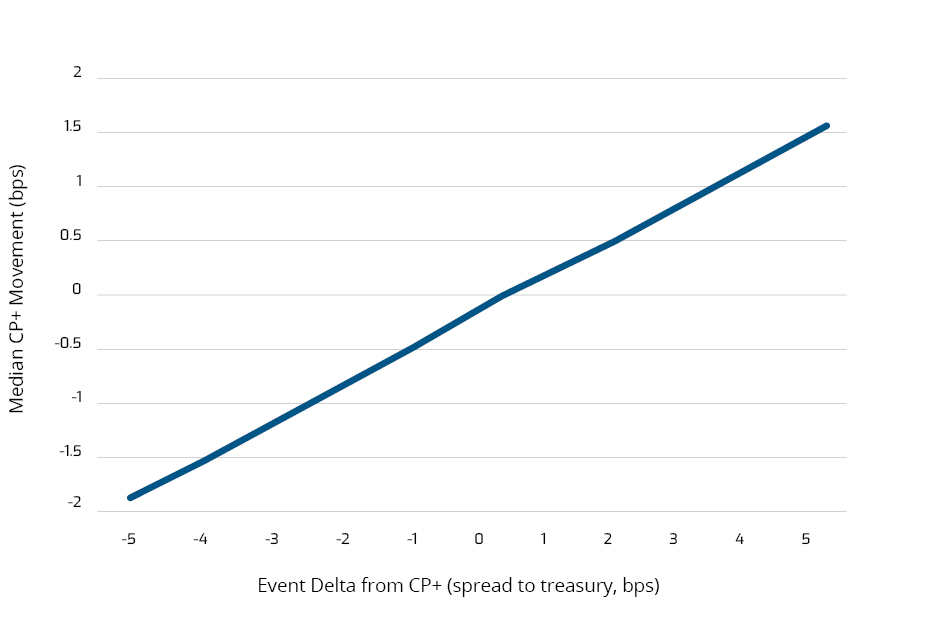
The chart above shows the CP+ Movement against the Event Delta in US IG trades. For example, a trade occurring 4bps inside CP+ side leads CP+ to tighten its prediction by 1.24bps in median terms. As expected, the slope of trendline is positive and the CP+ Movement when Event Delta is 0 is close to 0. This direction of movement reflects that CP+ aptly adjusts for market information, and the lower magnitude reflects the robustness of CP+ against overfitting.
Leveraging the value of the MarketAxess inquiry data
The unique access to MarketAxess platform data, including the stack of prices back on each inquiry, allows CP+ to gain valuable information that reflects the market's collective view, enabling it to refine pricing predictions, adapt quickly to changing market conditions, and deliver more precise pricing by leveraging the full context surrounding each request. In Q4 2023, in US IG, the MarketAxess trading platform saw more than 1.6 million firm prices back on DNTs, highlighting the vast amount of data available for CP+ to learn from, even in the absence of executed trades. To demonstrate the value of this proprietary data, we compare the impact on CP+ from three sources of trade events:
Trades executed outside the platform (TRACE off-platform).
Trades executed on the MarketAxess platform (on-platform trades).
Inquiries on the platform that did not result in a trade (DNT).
For DNT inquiries, in the below analysis, we consider the best response level as the most relevant reference point. It is important to note however that this is a simplification for illustrative purposes only and that for both trades and DNTs, CP+ has access to the entire stack of response levels back.
CP+ Impact by source
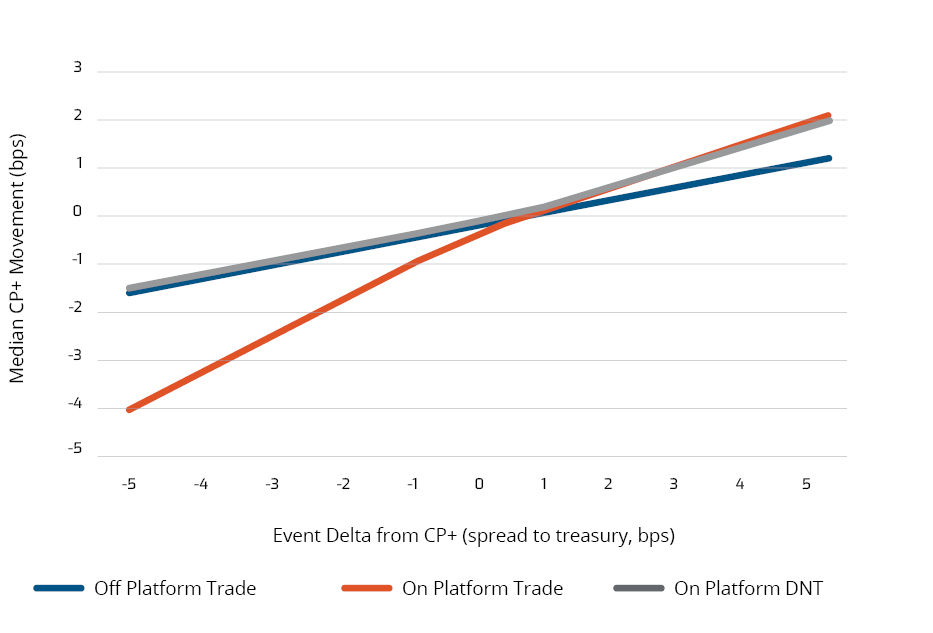
The steeper impact curve for on-platform trades in the above graph illustrates that on-platform trades have the most significant impact on CP+ Movement across all Event Delta buckets. CP+ leverages the additional context available for on-platform trades to better interpret the signal, which is particularly valuable in filtering out noise from duplicate trade reports. When CP+ predicts 2bps inside the traded level for an on-platform trade, it subsequently widens its prediction by 1.54bps in median terms. A reverse pattern is likewise observed when CP+ predicts outside the trade level.
Notably, even inquiries that do not result in a trade (DNTs) have a substantial impact on CP+ pricing. When CP+ predicts 5bps inside the best dealer level on a DNT inquiry, it widens its prediction by 1.5bps in median terms. The magnitude of this impact is comparable to that of an off-platform trade.
Conclusion
Our analysis of CP+ spread movements in response to trade and inquiry data provides valuable insights into the algorithm’s adaptive learning capabilities. It also highlights the edge of the unique data that MarketAxess provides to CP+. By knowing all the context surrounding an inquiry, whether it traded or not, CP+ can more effectively distinguish between meaningful price updates and less reliable data points. The ability to refine its predictions in response to platform-specific activity sets CP+ apart from pricing solutions that rely solely on public trade tapes.
Appendix
We define Event Delta from CP+ according to the side of the event, such that a positive number indicates the Event level is more competitive (from the liquidity taker’s perspective) than CP+ side 15 minutes before the event (so the Event level is inside CP+ bid and offer). For US High Grade in Spread Protocol, Event Delta to CP+ is defined as the following:

Additionally, we define CP+ Movement according to CP+ side before and after the event, such that a positive number indicates that CP+ 15 minutes after the event is more competitive (from the liquidity taker’s perspective) than CP+ 15 minutes before the event. For US High Grade in Spread Protocol, CP+ Movement is defined as the following:
