
Open Trading: Sourcing liquidity in times of volatility

Recent geopolitical tensions are creating a new normal of volatility in the global credit markets. During these times of volatility, established trading patterns often break down. The usual playbook goes out the window, liquidity providers can step back, and market participants scramble to locate buyers and sellers.
When liquidity becomes fragmented, and price discovery grows more challenging, certainty of execution and reliable counterparties become more difficult. This is precisely where Open Trading® delivers value.
Open Trading is our global, all-to-all electronic marketplace that delivers smarter, faster, and more efficient trading. This means enabled participants can both take and provide liquidity regardless of jurisdiction or counterparty type. They can trade with specialist dealers, alternative liquidity providers, and real money clients at the touch of a button. Responses are co-mingled with the responses of their regular dealer panel as a client or fully anonymized as a dealer. Dealers taking liquidity now make up nearly one-third of Open Trading volumes, further demonstrating the diversity of liquidity available.
One of the key differentiators of Open Trading is the breadth of its network. In calmer markets, trading relationships tend to remain stable, and clients often concentrate flow among a smaller set of preferred dealers. They use Open Trading to further prove best execution. When volatility spikes and liquidity dries up, those relationships can often not be relied upon. Dependable price discovery becomes increasingly difficult, especially in emerging markets and high yield, where automation is less prevalent, pushing many traders back to voice.
During these periods of stress when traditional price discovery mechanisms struggle, Open Trading vastly expands the available liquidity pool, increasing the likelihood of finding a match. It improves trading outcomes and lowers transaction costs — both for providers and takers of liquidity. The result is more informed decision-making and improved confidence in execution.
Open Trading price improvement (MENA)†
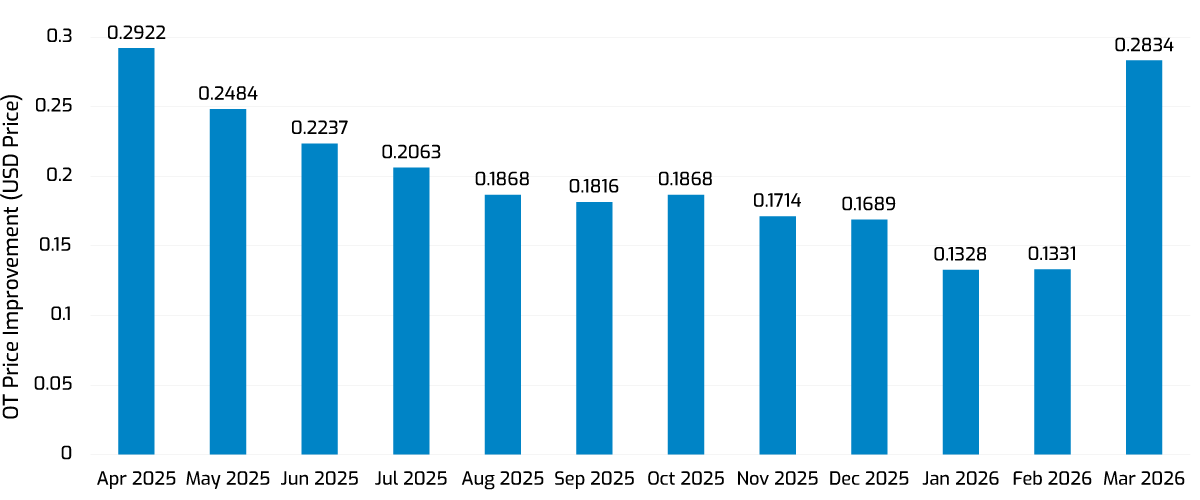
†Difference between the winning OT price and the next best disclosed price.
Algorithmic trading adds stability
Another key evolution in recent years has been the growing use of algorithms from both established dealers and new alternative liquidity providers who turn to Open Trading to scale their risk recycling and provide unprecedented levels of liquidity as a result. Today, more algorithms are pricing bonds than ever before, and in larger sizes — often quoting up to $3–5 million in single inquiry size in liquid names and in many cases much more.
These algorithms are becoming more active across all core sectors and increasingly remain switched on, even during volatile conditions. This consistency provides a stabilizing effect on prices and ensures that actionable liquidity remains visible on screen.
Historically, traders moved to voice during periods of uncertainty. But now with improved data, consistent algorithmic pricing, and the expanded reach of Open Trading, participants can confidently remain on the platform rather than reverting to phone-based execution.
This reliability is particularly valuable when sourcing liquidity in specialized names. For example, if a trader is seeking liquidity in a specific issuer, such as a regional energy company, the optimal counterparty may be limited. Open Trading’s all-to-all model increases the probability of locating domestic or onshore liquidity providers specific to that name, acting as an effective price finder when it is needed most.
A full suite designed for every trading scenario
Markets often shift toward more on-demand trading during volatility, especially voice and Request-for-Quote (RFQ) workflows. While some participants question inquiry quality in stressed environments, MarketAxess enhancements have helped improve engagement and response rates. For many clients and dealers, Open Trading has become the number one counterparty on the MarketAxess platform.
Remaining engaged with the full Open Trading network during times of market stress suits the majority of market participants, but not all. That’s why we offer a suite of protocols that lets the trader not only decide how to trade but who they trade with. We have new protocols that help bridge the gap between full disclosure and full anonymity.
Disclosed Open Trading is a hybrid functionality within Open Trading. It allows name give-up to counterparties within the Open Trading network, where participants do not have a direct relationship by settling through MarketAxess as the intermediary. This enables traders to receive the benefits of pre-trade name disclosure and relationship building. Full control of the inquiry distribution is possible as Disclosed Open Trading replicates full name give-up and can even be used to send to a single known dealer.
Disclosed Open Trading is just one way clients can utilize the Open Trading settlement facility on certain types of name-give-up trades. Crossing allows the externalization of internal fund transfers. Bridge Trading allows clients and dealers who do not have lines with each other to settle pre-agreed trades.
Voice facilitation is often not associated with electronic trading. However, as a top-tier counterparty on the platform, we recognize that we need to provide a service worthy of a top-tier dealer, and that includes replicating many of the services a trading desk at a dealer would provide. The Open Trading desk’s staff includes ex-traders and brokers who can facilitate a variety of services, including block size work-ups and reflecting targets on expired inquiries, all in confidence, on voice.
Trading with confidence: reach, data, and consistency
No single execution method fits every scenario, and traders need access to a full spectrum of tools. Open Trading expands the liquidity pool and improves execution probability. Our data tools enhance price discovery when observable markets are thin. Algorithmic liquidity adds consistency and stability. RFQ workflows support targeted engagement.
Together, the MarketAxess trading suite empowers participants to navigate all market conditions with confidence — helping them find liquidity, achieve the best price, and execute with speed and efficiency.