
Setting the scene: Fixed income in Global Emerging Markets

Emerging market (EM) bonds have continued to see broad gains over the first half of 2024, despite diverse and persistent macroeconomic headwinds.
A positive market development is the continued growth in global fixed income exchange-traded funds (ETFs). According to MarketAxess’ TraX® data, we have continued to see shifts in the global market structure, driven by the strong performance of ETFs. This performance has had an impact on fixed income markets globally, as where we have seen ETF activity increase rapidly, we have also seen trading volumes in underlying cash bond activity follow a similar trend.
Specifically, there has been a division in the liquidity of ETF-eligible bonds and non-ETF-eligible bonds. ETF-eligible bonds are trading with a much higher velocity and turnover compared to their non-ETF counterparts, driven by how banks are recycling risk.
Electronification is key to the success of ETF trading. Electronic protocols allow traders to efficiently trade a basket of bonds with an overall risk profile, that can be easily hedged through the ETF create/redeem process rather than dealing with the individual bond position or line item.
Accurate pre-trade pricing and real-time liquidity analysis has helped counterparties quote prices for high numbers of bonds and execute trades at ultra-fast speeds and with razor-thin spreads.
More broadly the two clear trends currently developing in EM when it comes to e-trading are:
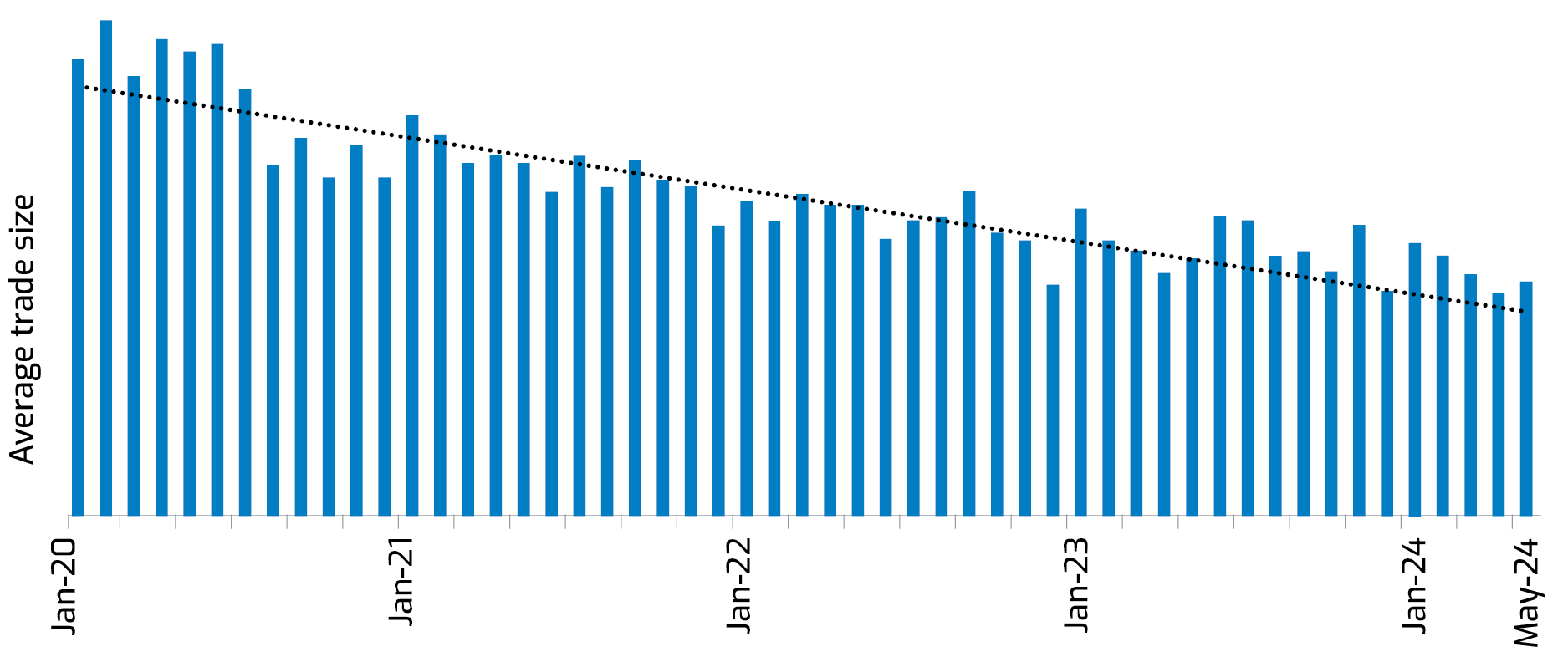
A decrease in trade size.
An increase in trading activity at month end.
Trade volume of Emerging Markets (Hard & Local Currency) on MarketAxess
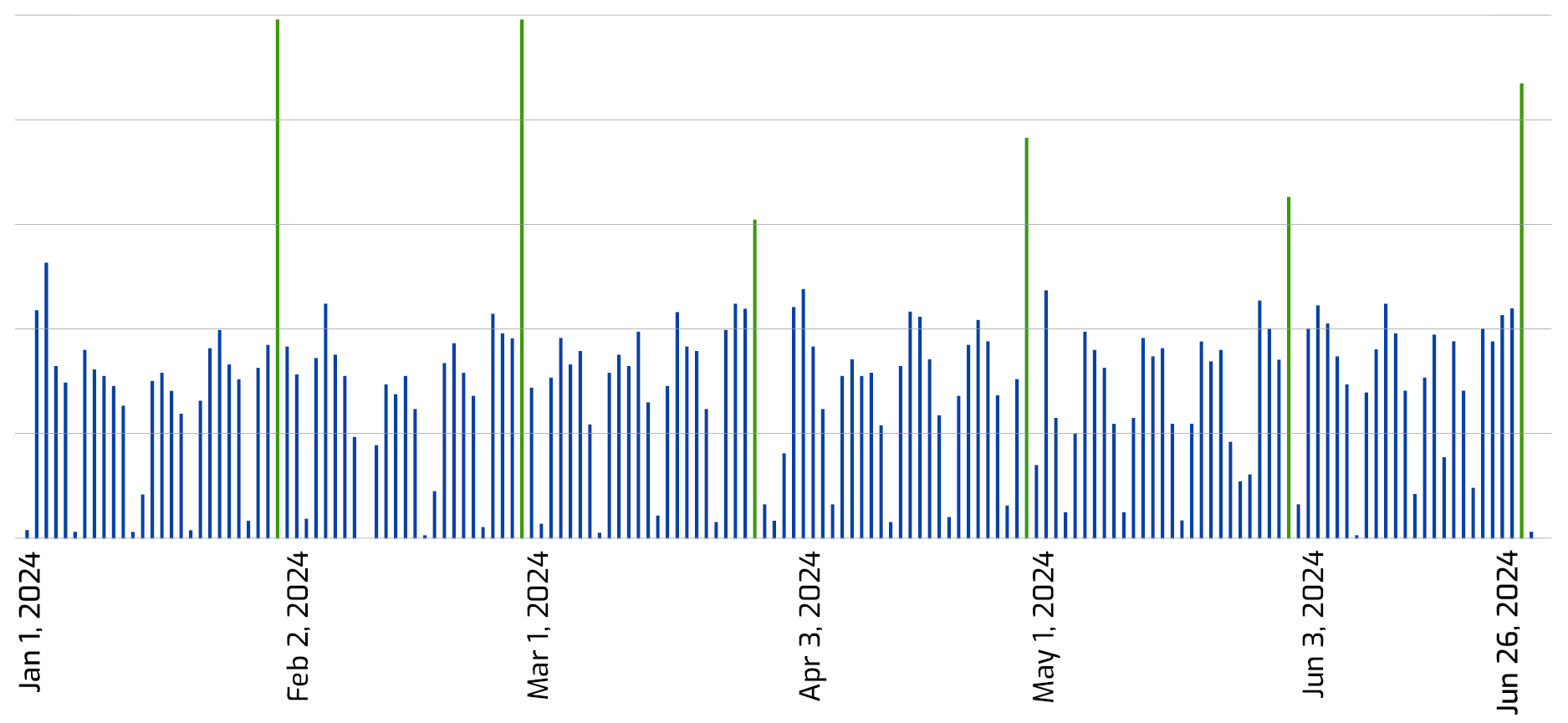
Based on platform trading data, the trend is seen across EM sovereigns which have a high correlation to most active EM ETFs—for example, iShares EMB has a 100% weighting on sovereign bonds and agency bonds. This is a trend that has not been replicated in the hard currency corporate market, creating an increased separation of liquidity.
Average trade size of EM Hard Currency Sovereign Bonds
In this constantly changing liquidity environment, it’s clear that traders need a range of protocols, data & analytics that will let them juggle between a range of different trading methods including high-touch, low-velocity and low-touch, high-velocity.
In a recent Trader’s Table event held in London, 11 buy-side clients joined us to explore these emerging trends and, particularly, the increased distinction between low- and high-touch trading flows when trading EM bonds. |
Our clients largely agreed with the above. We heard that efficiency at both ends of the spectrum is critical for them. That means developing deeper, more robust data on less liquid securities as well as offering protocols that allow for easier block trading, as well as improving the sophistication of automation and algo trading tools.
Elevating high-touch trading
To help clients mitigate the risks often associated with sending out larger inquiries, we have created new tools such as Smart Dealer Select and Request-for-Market (RFM), to allow traders to make better, data-driven decisions for these trades.
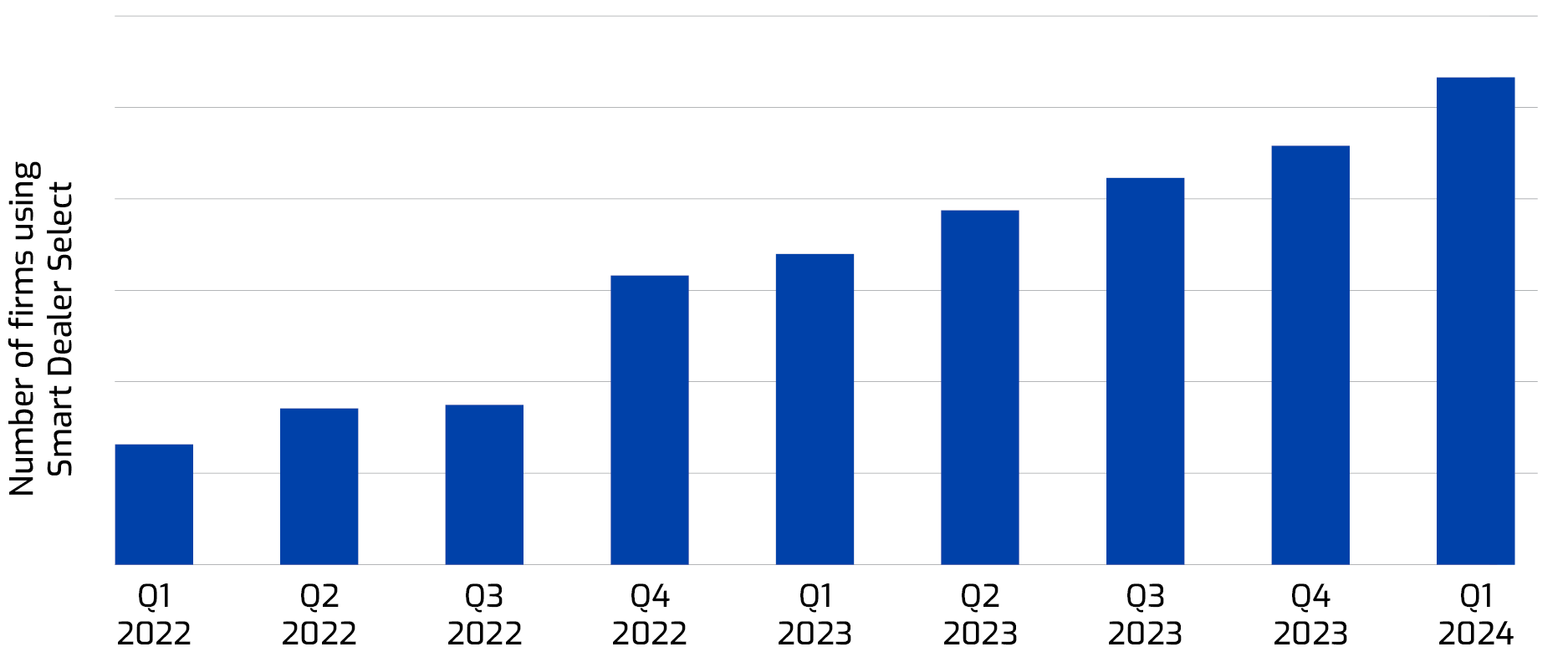
For example, Smart Dealer Select (SDS) leverages the vast pool of data we sit on to recommend the most suitable liquidity providers for a given trade, based on a rules-based model. With SDS, clients can adopt a smarter, faster and data-driven approach to obtaining the best liquidity available.
Adoption of Smart Dealer Select for Targeted Selection
Popularity of portfolio trades
We continue to see the popularity of Portfolio Trading (PT) as a unique method for maneuvering through Emerging Markets. EM trades executed by PT in the global market grew by 60% as of Q2 this year. Not only that, 70% of the participants at the Trader’s Table indicated they have used PT or are considering using PT as a method of execution.
Benefits of PT include allowing clients to trade a basket of bonds quickly when compared to trading the bonds individually. The use of PT also minimizes market impact as trading a PT can allow for quick risk movements of a basket of bonds without alerting the market, reducing the likelihood of market impact which may lead to unwanted impact on pricing. The ‘all or none’ feature is an added benefit when guaranteed execution is required.
A unique differentiator around PT that came out from the discussion was the distinctive proprietary data that MarketAxess provides, pre-trade and in-flight (TraX & CP+™), which helps traders in their decision-making. Our newest technology features present an outlier analysis, that helps optimize the execution of the PT on a basket level as well as individually.
The market is evolving and so are we. As the largest electronic marketplace for Emerging Markets, we continue to build innovative trading and data solutions that open new opportunities for our clients—we look forward to continuing our partnerships with our clients across these important markets.