
AxessPoint: Stellantis—sector pressure and issuer-specific repricing

By Aran Khaira | 6 October 2026
Text
On 10 February 2026, Moody’s downgraded Stellantis to Baa3 from Baa2, its lowest investment-grade rating, following substantial downward revisions to profitability and cash-flow expectations. Stellantis had also announced €22.2bn of charges associated with changes to its product roadmap, battery supply chain and warranty estimates. Volkswagen entered the period from a stronger rating position: S&P had affirmed its BBB+ rating in December 2025 but revised the outlook to negative amid pressure on profitability and free cash flow.
Unless otherwise stated, spreads, spread changes and bid-ask widths are expressed in basis points of yield spread. Open Trading® metrics are expressed as percentages, with changes reported in percentage points.
Stellantis’ February reset and subsequent rating actions were followed by a materially larger spread repricing than among selected auto peers. The dislocation persisted across much of its senior curve, with parts trading wider than maturity-matched BB reference benchmarks. The liquidity indicators examined were comparatively resilient: bid-ask widths narrowed after an initial widening, while Open Trading participation remained comparatively high.
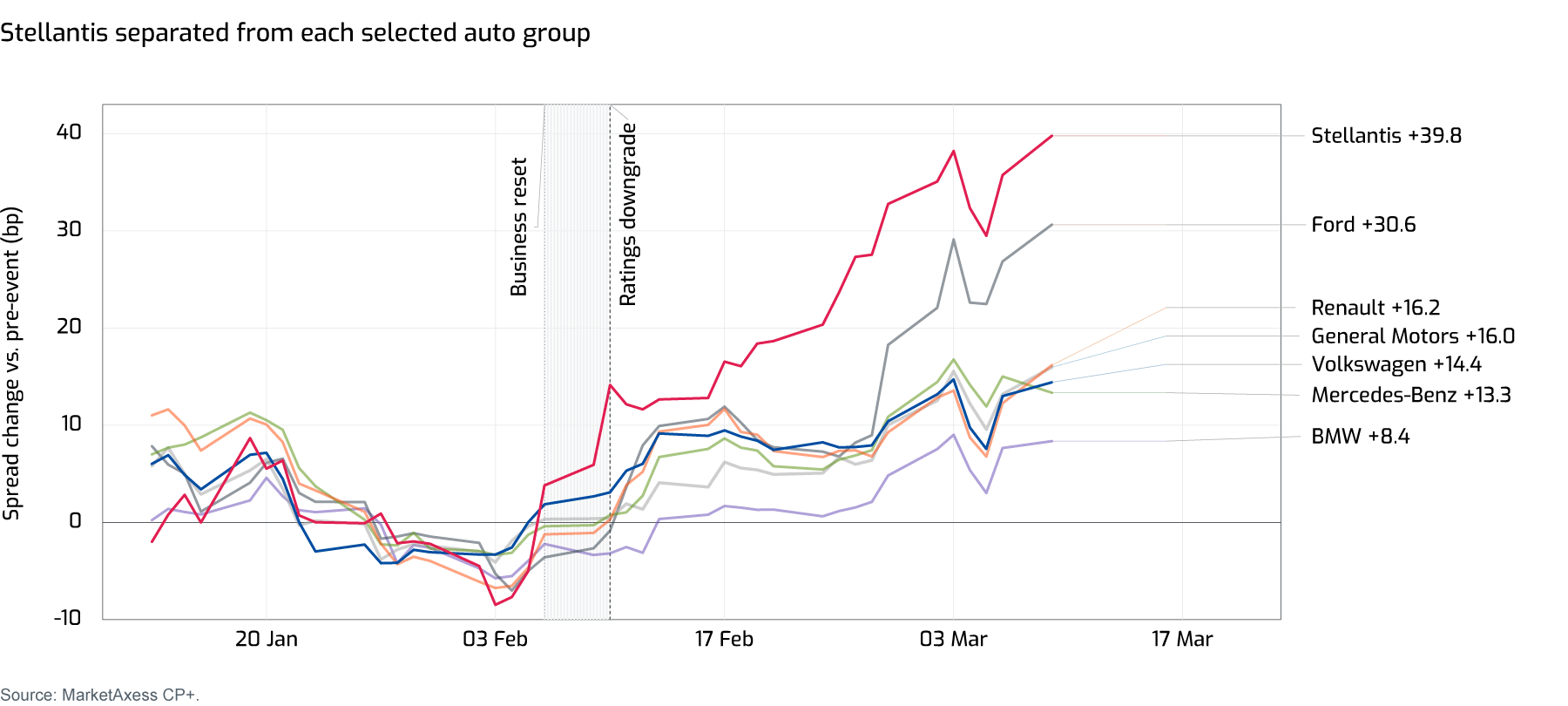
By 9 March, credit spreads were wider than their pre-event medians across the selected auto groups. Volkswagen was 14.4bp wider, while Stellantis was 39.8bp wider.
Comparing the pre- and post-event windows, median bond-level spread widening was 21.6bp for Stellantis, 5.8bp for Volkswagen and 5.0–7.7bp for the other selected auto peers. Stellantis’ spread premium to the selected auto-peer median increased by 15.9bp.
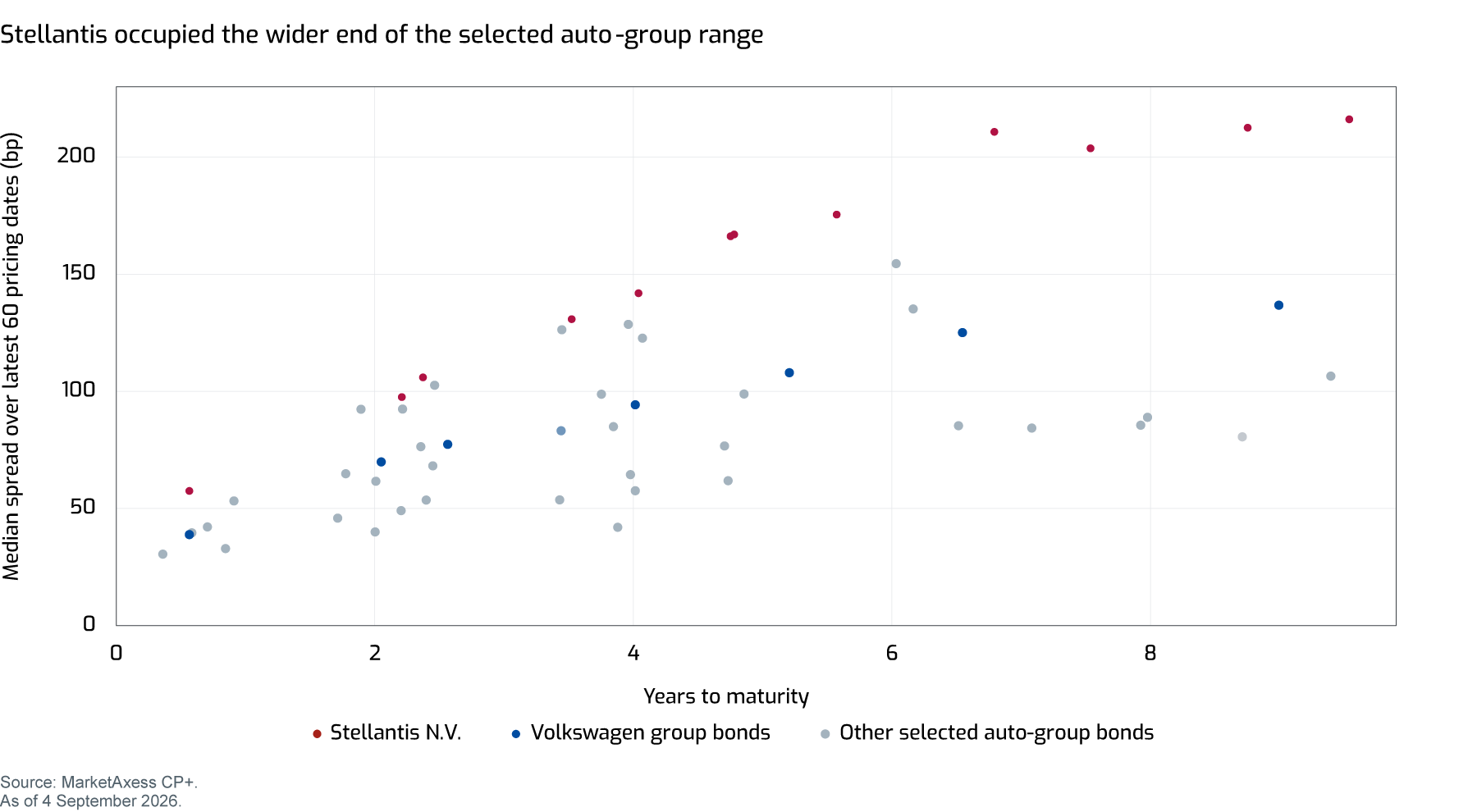
Six of the 12 sampled Stellantis senior unsecured bonds traded wider than their respective maturity-matched BB reference benchmarks on at least 60% of observed pricing days.
Methodology: Pre-event window: 13 January–9 February 2026. Post-event window: 10 February–9 March 2026. Selected auto peers: BMW, Ford, General Motors, Mercedes-Benz, Renault, and Volkswagen. The pre-event window includes the 6 February business reset, so the comparison captures the broader reset-and-downgrade sequence rather than the 10 February downgrade in isolation.
Stellantis widened more sharply than selected auto peers
The February reset coincided with sector-wide widening, but the magnitude differed sharply. By 9 March, Stellantis’ CP+™ spread was 39.8bp above its pre-event median, compared with 14.4bp for Volkswagen and smaller moves across most selected peers. The divergence was therefore consistent with a pronounced issuer-specific component rather than a uniform auto-sector repricing.
Over the 60-trading-day period ending 4 September 2026, Stellantis bonds occupied the wider end of the selected auto peer range across most comparable maturities. The separation was particularly visible further along the curve, indicating that the repricing was not confined to a single bond or narrow maturity segment. Six of the 12 sampled senior unsecured bonds traded wider than their respective maturity-matched BB reference benchmarks on at least 60% of observed pricing days.
The relative dislocation persisted across much of the curve
Bid-ask widths partly normalised after the initial deterioration
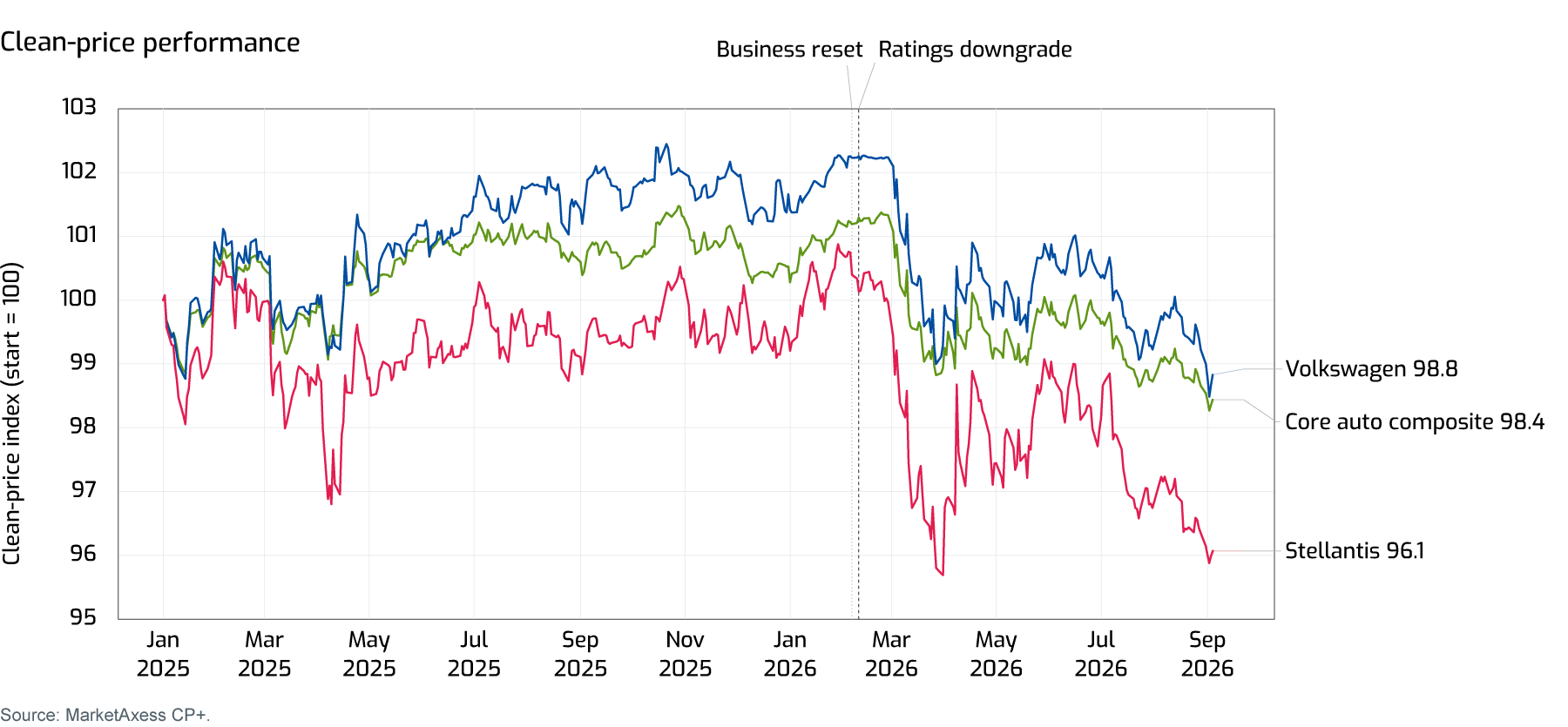
For a fixed set of seasoned bonds, MarketAxess CP+ shows daily clean-price performance, indexed to 100 at the start of the period, and monthly median bid-ask width. Stellantis prices declined further than those of Volkswagen and the core-auto composite, although clean-price performance also reflects duration and rates exposure. Spread measures therefore remain the cleaner indicator of relative credit repricing.
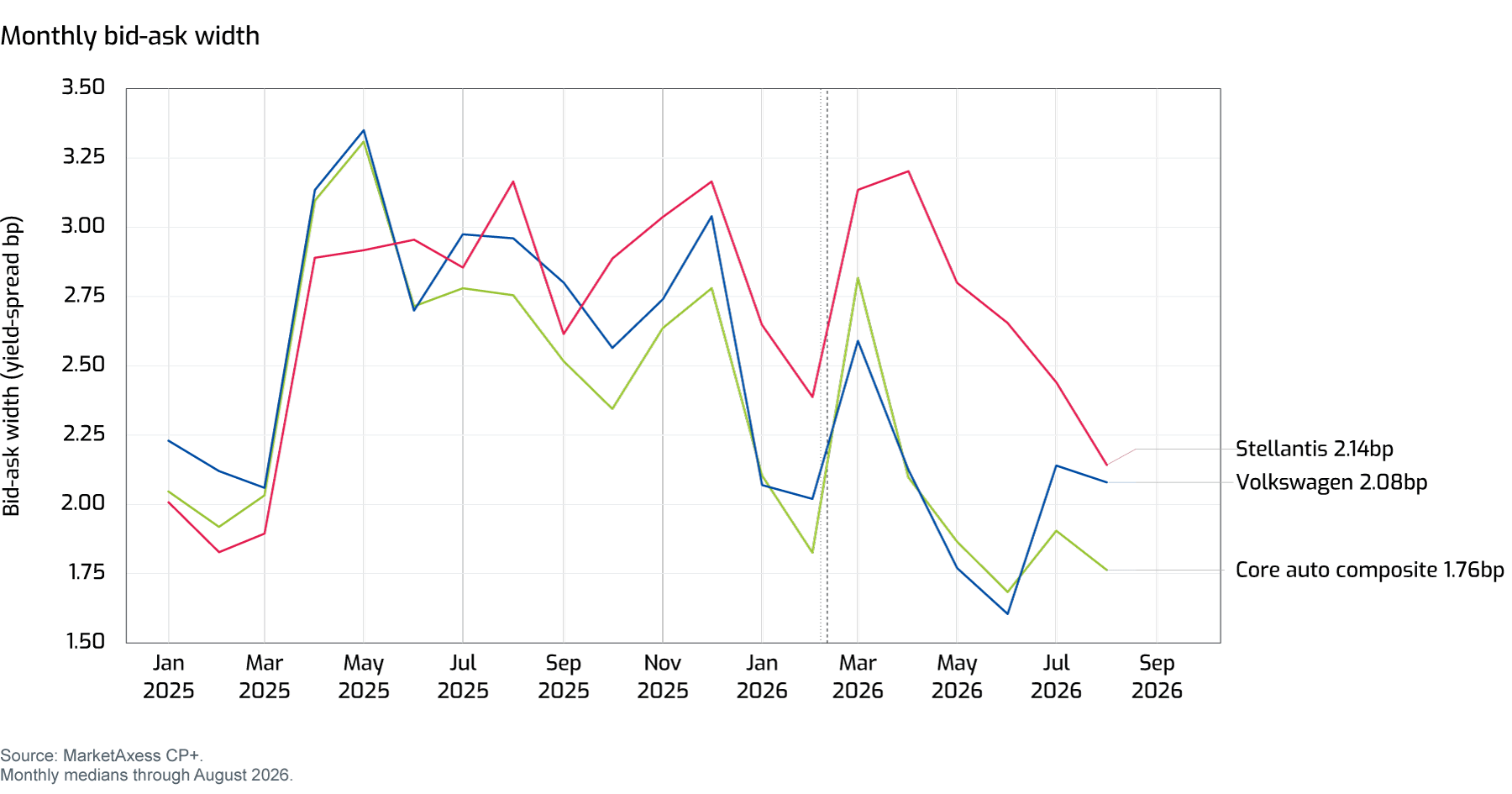
Stellantis’ monthly median CP+ bid-ask width rose from 2.39bp in February to 3.20bp in April, before narrowing to 2.14bp in August. By August, it was close to Volkswagen’s 2.08bp, although it remained above the 1.76bp core-auto composite.
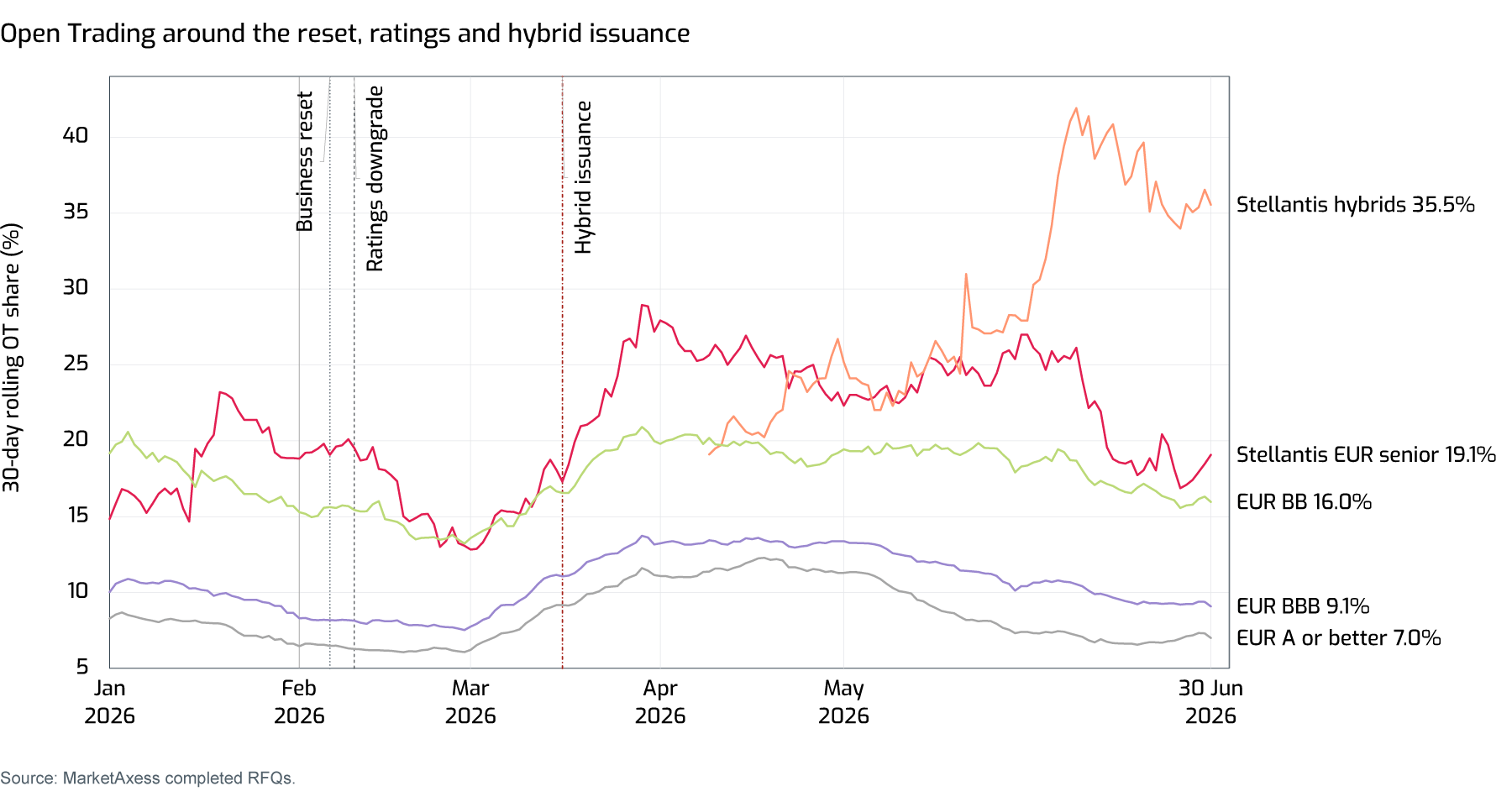
Open Trading diverged between seasoned senior bonds and new hybrids
Open Trading evidence was mixed. The rolling share for seasoned Stellantis senior bonds fell by 6.0 percentage points during the reset-and-downgrade window, from 19.1% to 13.1%; its median over the window was 17.3%. That median remained above the EUR BB, BBB, and A-or-better reference cohorts shown.
By contrast, the rolling Open Trading share increased by 11.2 percentage points between 9 April and 1 June across the three hybrids issued in March, pooled by completed RFQ count. Because these were new bonds, the increase should not be read as evidence of improving liquidity in the seasoned senior curve. Open Trading rose in newly issued hybrids, not in seasoned senior bonds.
Conclusion
Stellantis’ February credit reset marked more than a temporary sector-wide reaction. Its senior curve repriced materially against selected auto peers, with parts trading at spreads wider than their maturity-matched BB reference benchmarks. Yet the liquidity evidence was differentiated rather than uniformly weaker: bid-ask widths narrowed after the March–April increase, seasoned senior Open Trading participation remained above the reference cohorts shown, and the strongest later Open Trading increase was concentrated in newly issued hybrids. The evidence therefore points to a higher embedded credit premium without a comparable, sustained deterioration in the liquidity indicators examined here.