
AxessPoint: Speed of trading, algos and velocity

Highlights
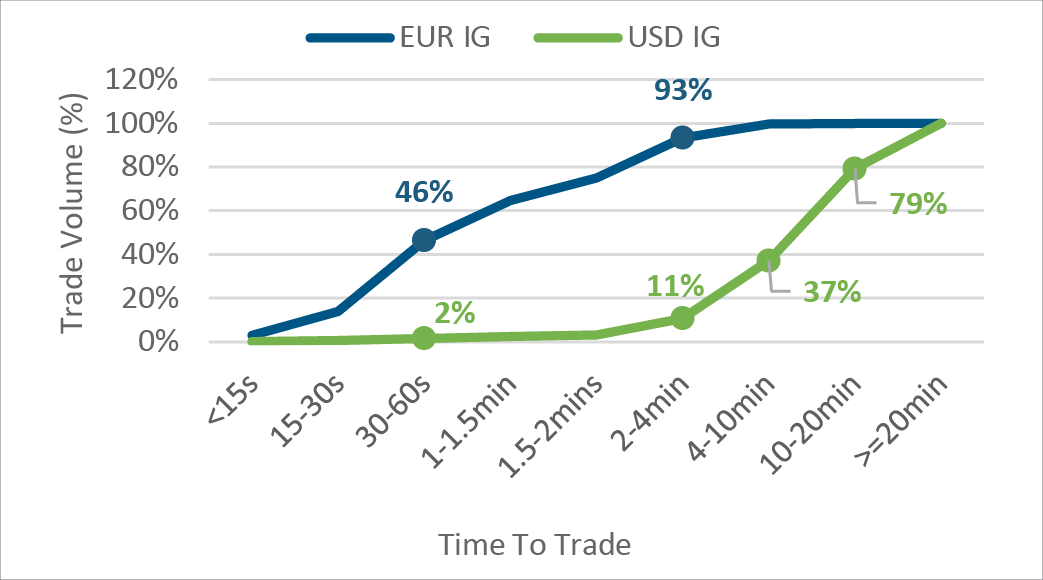
- Time to trade is on average 13 times faster in the EU markets than in the US: the median time to trade is 43 seconds in EUR IG vs 10 minutes in USD IG.
- Growth of algos in both EU and US markets means that trading can be faster than it used to be.
- Submitters already calibrate their timers to size and liquidity but there is the opportunity for them to adjust them even more.
- There is little benefit to delay the timers as similar trading outcomes can be obtained with shorter timers.
- Trading is expected to continue to get faster with the adoption of automation and more data driven workflows.
Time to Trade
EU markets trade on an ASAP timer model while US markets trade on a Bin timer model. That means EU investors can view quotes back as soon as they are sent, and they can trade against them at any point. In the US markets however, participants must wait until the end of the timer for the quotes to be revealed; only then the execution decision can take place.
By the nature of these protocols, trading speed varies considerably between the two markets - EU markets are much faster compared to US ones. US participants tend to use long timers: the median Bin timer in USD IG is 10 minutes. Time to trade – which is defined as the delta between submission time and trade time – can thus only be longer than 10 minutes on 50% of the trades. It explains why speed of trading is slower in US markets.
When looking at request for quote (RFQ) activity on MarketAxess in Q1 2023, we saw that 46% of the EUR IG volume was executed in less than one minute while only 2% of the USD IG volume was done in less than one minute. In EUR IG, 93% of the volume was traded in less than four minutes vs 11% of the USD IG volume. 21% of the USD IG volume had a time to trade of more than 20 minutes.
Cumulative Distribution of Trade Volume
Algos Growth
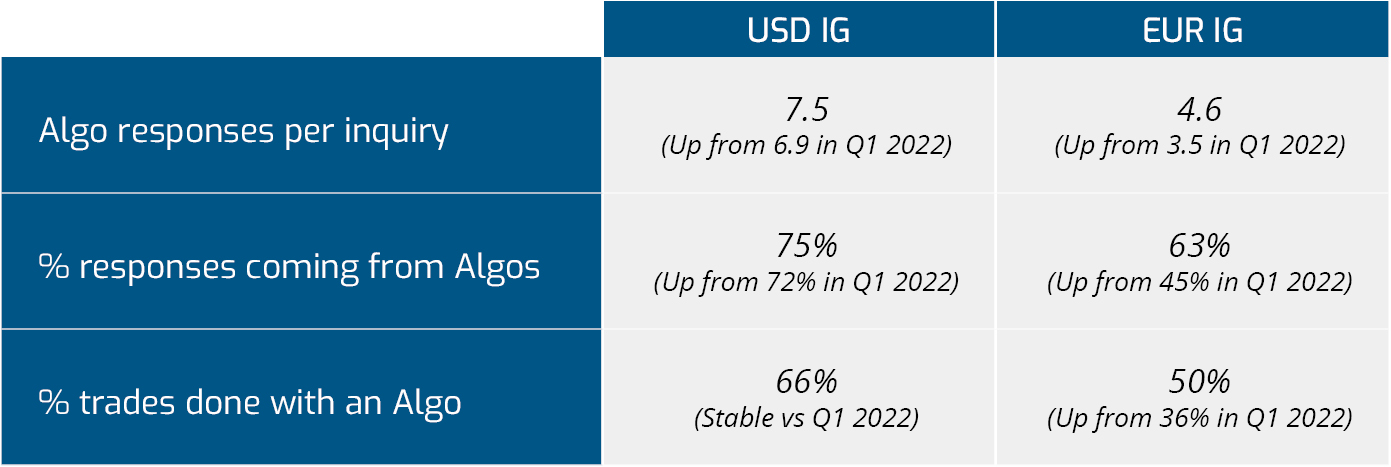
Increasingly liquidity providers quote prices via fully automated algorithms. Through their algos, providers can respond faster and across an expanded coverage leading to an improved depth of liquidity on the platform. Responsiveness and quality of responses is improved. We see that both the proportion of responses coming from algos, and proportion of trades executed with an algo increased.
In USD IG, 75% of prices came back from algos and two thirds of trades were won by an algo-generated price in Q1 2023. In EUR IG, 63% of responses came from algos in Q1 2023 and half of the trades were executed facing an algo.
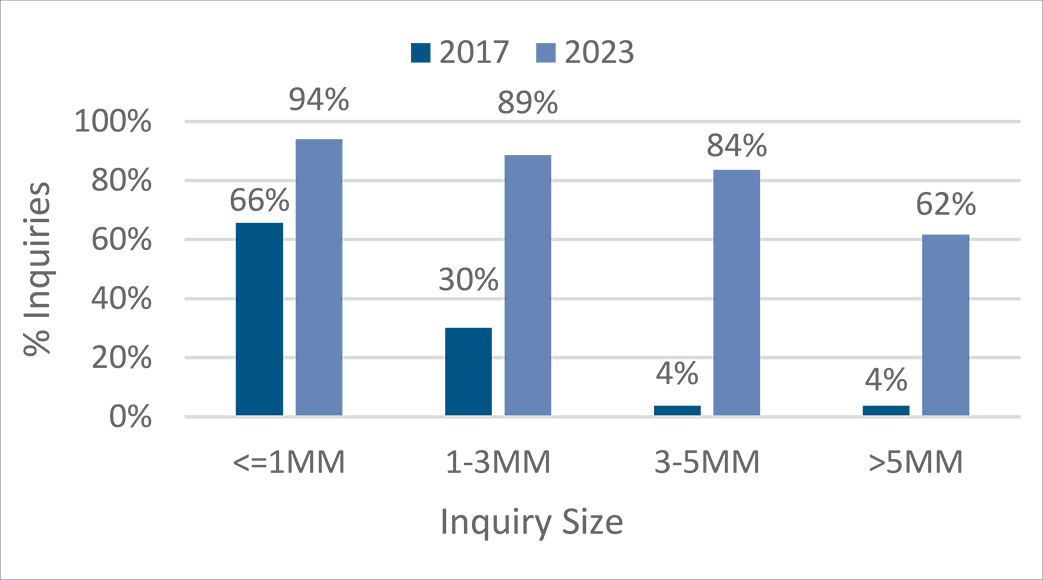
There has been a massive growth of algos for the past six years, with providers expanding their universes in terms of number of bonds covered and quote size.
The bond universe itself grew by 79% from 2017 to 2023: we saw algo responses on ~9,500 unique bonds in USD IG in Q1 2023, up from ~5,300 bonds in Q1 2017. There is also an increase of ticket size that algos are quoting. Despite being initially active only in smaller tickets, algos are now willing to quote larger sizes. In Q1 2017, 66% of <=1MM inquiries received at least one algo response while only 4% of blocks (>5MM) did in USD IG. In Q1 2023, 94% of <=1MM inquiries received at least one algo response and 62% of block inquiries benefited from algo liquidity.
% Inquiries with 1+ Algo Response - USD IG
While long timers are being used in USD IG, the market is efficient. The presence of algos means participants can quote within a few seconds and the market is thus forming prices instantaneously.
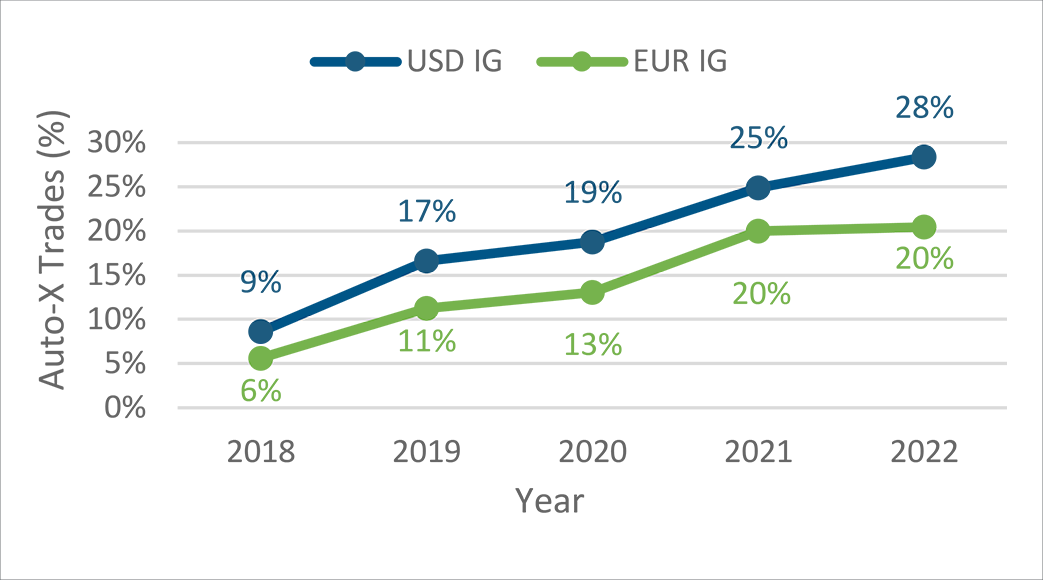
Automation is also growing on the submitter side. On the MarketAxess platform, Auto-X RFQ allows clients to automate inquiry orders based on pre-defined tolerance settings. These settings include the inquiry’s size, liquidity, and quality of responses. If all limits are met, then a trade will automatically occur.
In USD IG, more than one out of four trades were automated in 2022 and in EUR IG we saw one out of five trades automated.
Auto-X % of RFQ Trades
Velocity
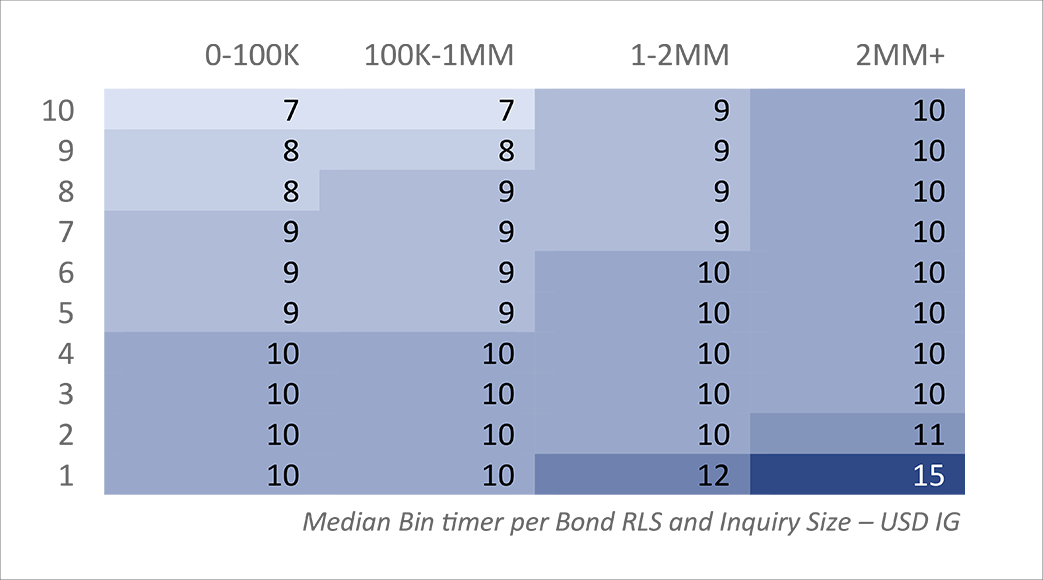
In USD IG, we see that submitters naturally adjust their Bin timers with size and liquidity. Bin timers tend to be longer when the size of the inquiry increases and when the Relative Liquidity Score (RLS) of the bond decreases. While the median timer for an <=100K inquiry with a RLS of 10 is seven minutes, it almost doubles (15 minutes) for an inquiry of 2MM+ with a RLS of 1.
Given the automation trends, could submitters adjust the timers even more and develop further the use of data within their execution workflow?
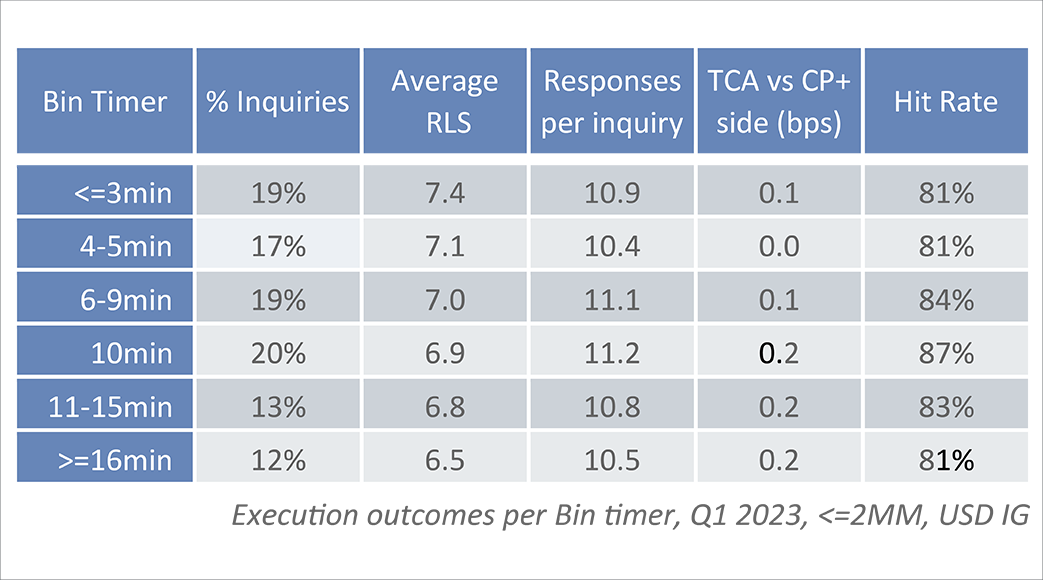
When looking at the inquiries sent in Q1 2023 in USD IG, we can see that submitters obtain similar trading outcomes regardless of the Bin timer that they set. This is true across several metrics.
First, we control that the universe is similar and that inquiries have comparable liquidity profiles. We can see that the average Relative Liquidity Score (RLS) is close to seven, regardless of the timer.
The depth of the stack – measured with the number of prices back per inquiry – is greater than 10 across timers. Most of the liquidity is coming from algos and highly automated providers.
The liquidity quantity is constant and the quality of execution is similar. Looking at the success rate or hit rate – defined as the number of trades divided by the number of inquiries - the hit rate is above 80% no matter how the timer is set.
We also measure the execution quality through Transaction Cost Analysis (TCA) vs CP+™ side: we compute the delta between the traded level and CP+ of the same side. Here as well, we can see that the execution occurs very close to CP+ side across Bin timers. Traded levels are within two tenths of a basis point of CP+ side, a small range compared to the full CP+ Bid-Ask Spread - which was 3.7bps for Q1 in USD IG.
Depth of liquidity and execution outcomes are positive for submitters regardless of the timer. Shortening timers appears to be a viable solution to gain even more efficiency in the market.
Trading workflow can thus be tailored depending on the size of the inquiry and liquidity of the bonds traded. Data-driven approaches are key to mastering and optimizing trading outcomes. Time to trade is expected to reduce further as more automation tools and data driven insights are adopted.
CP+™ is MarketAxess’ proprietary AI powered pricing engine for corporate bonds. It produces an unbiased, two-sided market for more than 33,000 instruments globally. Updated every 15 to 60 seconds, the engine generates nearly 30 million levels per day covering 90-95% of trading activity in its markets.
Relative Liquidity Score (RLS) provides a defined measurement of the current liquidity for individual bonds and highlights the potential ease that a trader can expect to transact in that instrument. It covers nearly 36,000 bonds daily, with scores ranging from 10 - the highest level of liquidity - down to 1.
Transaction Cost Analysis (TCA) is defined relative to CP+ and is computed as the difference between the trade price and the CP+ price on the corresponding side, at inquiry time. A positive value means the trade occurred inside (more competitive than) CP+ bid or offer, while a negative value means the trade occurred outside (less competitive than) the CP+ bid or offer.