
Enhancing data usability and market visibility under new regulatory changes

Europe’s transparency reforms promised consolidation; instead, they are delivering choice. As the UK (FCA) and EU (ESMA) shorten deferral periods and two different bond CTPs (Consolidated Tape Providers) enter the market at different times, firms are navigating a more complex landscape of transparency data — where usability, not availability, is the real differentiator.
The question is no longer whether data is available, but whether it can be trusted enough and used to make good trading decisions.
Why this matters now
Recent FCA and ESMA transparency reforms have increased the real-time publication of corporate bond prices to an estimated 80–90% of all transactions, up from around 30% previously, according to MarketAxess TraX®, our executed global fixed income data. While this marks a significant step forward for market transparency, several structural challenges remain.
Deferral frameworks are complex.
The two regimes apply different deferral frameworks, resulting in 68 distinct deferral scenarios across corporate and sovereign bonds. That number will increase from 4th May, when ESMA’s supplementary sovereign bond deferrals come into force, adding additional volume‑masking rules for liquid sovereign instruments. Our analysis suggests that around 15% of investment-grade corporate bond volume will still be subject to the longest deferral in reporting — three months under FCA rules and four weeks under ESMA.
This means the timing of trade publication will vary materially depending on the reporting regime, trade size, and instrument— adding complexity for firms attempting to interpret transparency data across both regimes.
Deferred volumes hide meaningful volume.
The practical impact of these deferrals became clear when the FCA transparency regime changes took effect in December 2025. While APA’s (Approved Publication Arrangements) delayed publication of approximately 75% of volumes, TraX captured the underlying trades in real time, allowing us to quantify exactly how much market activity was missing from the public view.
Impacts of the FCA deferral regime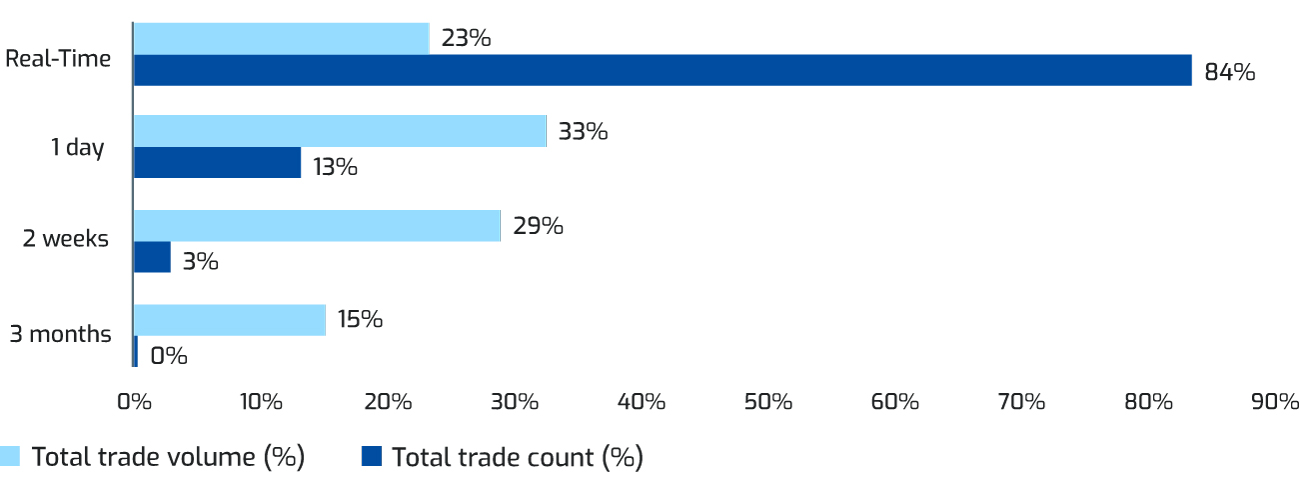
By the close of trading each day during the first week of December 2025, TraX revealed approximately €80bn of clean, visible investment-grade corporate bond volume — compared with an estimated €32bn that would have been observable through combined FCA and ESMA public reporting alone.
Total clean volume published in Corp-IG at deferral period
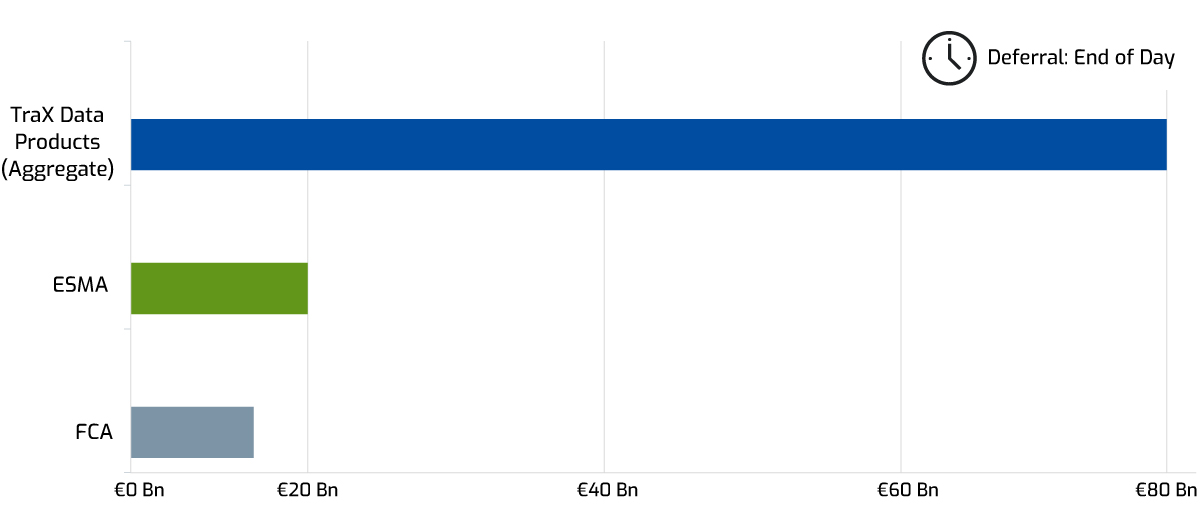
TraX was able to reveal volumes much closer to true market size, delivered via our curated TraX Volume service. TraX Volume aggregates trading data from a network of more than 50 dealers and clients, applying carefully agreed size thresholds and caps to balance transparency with market protection. Participants contribute their data as subscribers to our services, and in exchange for access to TraX and our market data products.Data usability
Alongside completeness, usability and reliability of pricing remain key concerns. Our analysis from July 2025 – see here, shows that nearly 40% of published trades from the top 10 APAs are not immediately usable, most commonly due to duplication, and require additional processing.
Percentage of clean trades in the top 10 APAs†
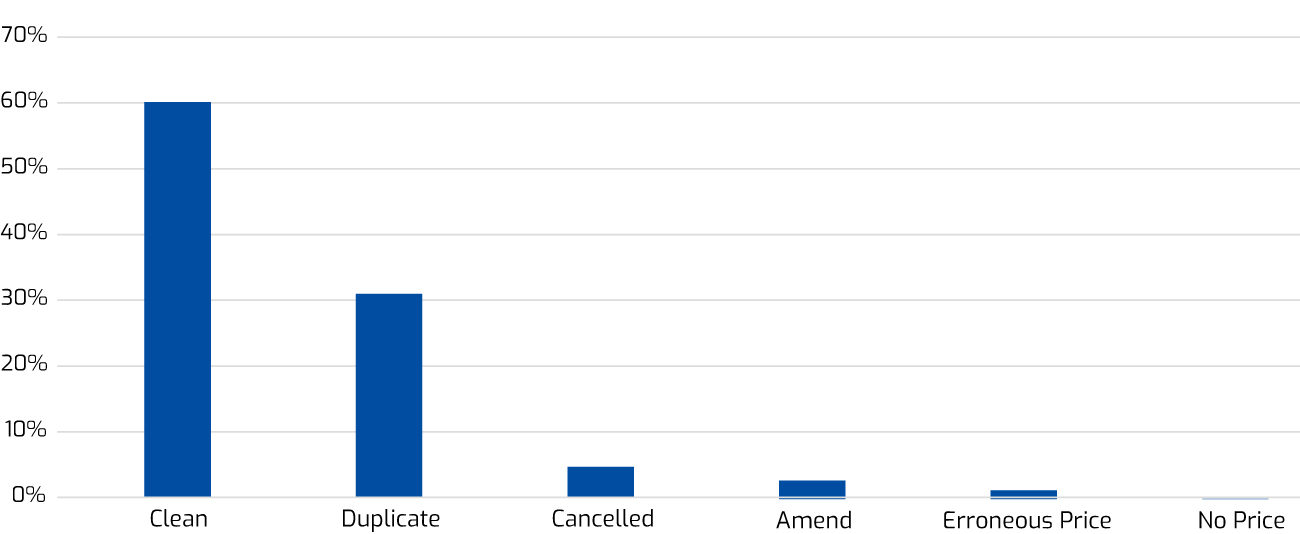
†Output from TraX proprietary data-cleansing algorithms on trade data published by the top 10 APAs, covering all fixed income market activity in Q1 2025.
For firms, this means transparency often comes with a hidden cost: cleansing and normalising data before it can support accurate pricing, liquidity assessment, trading decisions, or analysis.
A different way to approach transparency
Transparency is not just a question of how much data is published, but whether that data presents a clear, clean and representative picture of market activity.
If you can consolidate data early, de-duplicate it at source, and enrich it with context, you can deliver a more usable “tape” than stitching together raw public outputs.
Introducing: TraX Tape
TraX Tape is designed to be a single, consolidated data feed that provides a clean, standardised view of all global bond market activity.
The aim is simple: provide decision-grade data so trading desks can interpret true market activity faster, with less internal data processing, and with more context than raw inputs alone can provide.
It applies UK and EU transparency rules to TraX, supplemented by additional real-time transparency for small and medium-sized trades, as agreed following consultation with our contributor community. Trades are processed through our proprietary cleansing algorithm, refined for over 20 years, and enriched with proprietary insights — including trade direction and our award-winning pricing engine CP+™.
That means clients can see whether moves are being driven by client buying, client selling, or inter-dealer activity, and assess pricing and execution quality with a far richer context than a plain trade print. The result is a more complete and reliable representation of market activity than standalone APA feeds, or future CTP outputs, can provide on their own — without forcing firms to build and maintain the same cleansing and normalisation stack internally.
How it will work
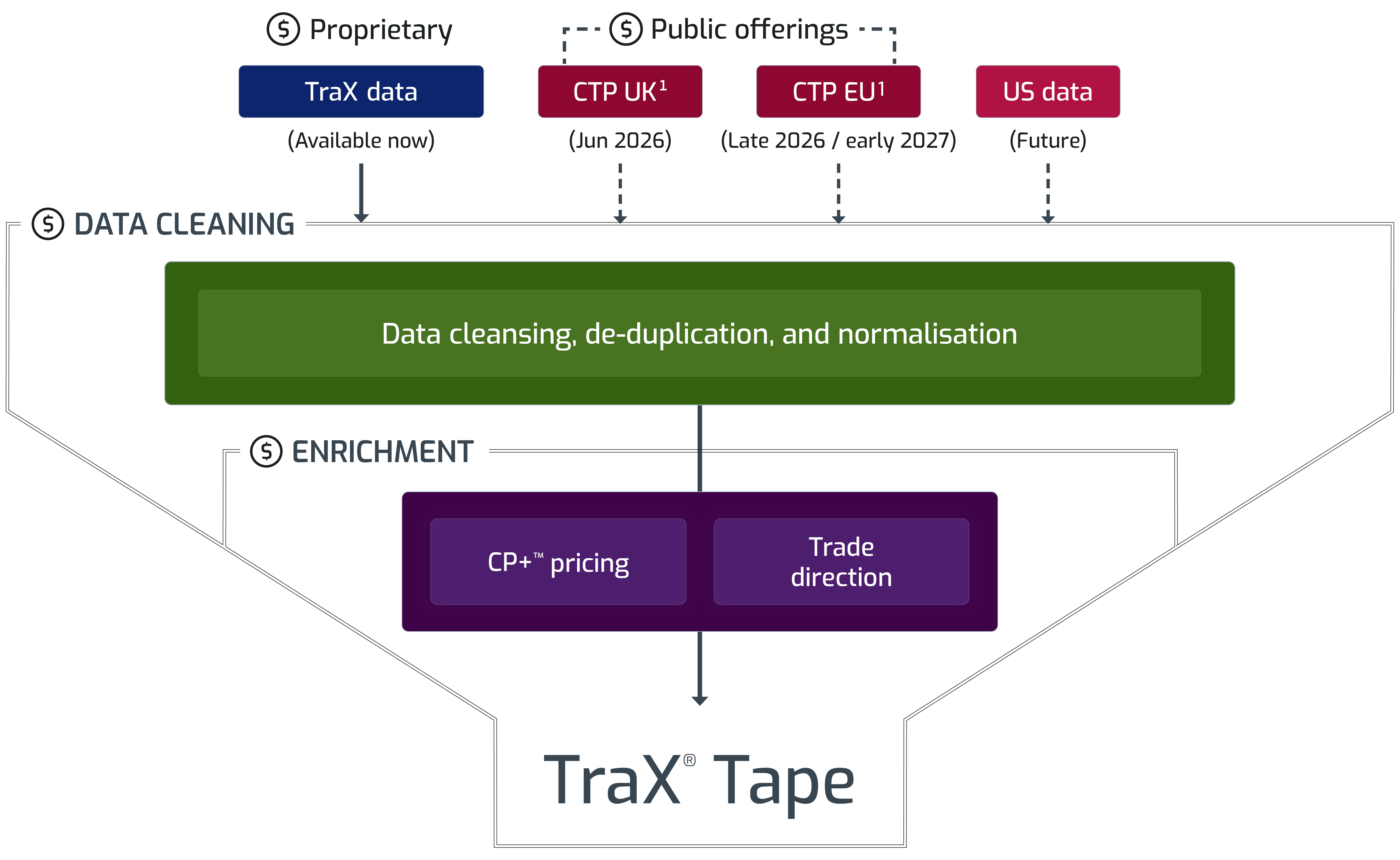
Why TraX Tape is different
Directional clarity: client-buy, client-sell and inter-dealer indicators on every trade print, making it easier to distinguish genuine market momentum from noise.
Cleaner data: a holistic view of all trading activity enables superior de-duplication and cleansing, reducing the hidden cost of reconciling, normalising, and validating fragmented public outputs.
Broader coverage: In January 2026, TraX captured and published 233,342 unique trades that would not have been published under ESMA or FCA transparency regimes, driven by unique contributions from global EM markets and non-European activity — helping firms build a more representative picture of true market liquidity and flow.
Earlier volume insight: aggregated volumes are available by end of day, ahead of public deferrals sourced from our contributor community and trading platform — so analysis is driven by what traded today, not what becomes visible weeks or months later.
Calcs: bond-level analytics applied to each trade, including yield and spread calculations supporting faster relative-value analysis and more consistent downstream analytics.
One connection: one consolidated connection providing access to all underlying data sources lowering operational complexity versus stitching together multiple feeds.
What this enables
Clear directional market sentiment in real time — so teams can see what’s actually driving moves.
Faster, more consistent price and liquidity context on each print via CP+ and analytics — supporting TCA-style insights into execution quality.
Earlier access to meaningful market activity than public deferrals alone allow — reducing reliance on delayed, stale tape data.
Outsourced data cleaning and consolidation — removing operational complexity and freeing teams to focus on decisioning and strategy.
TraX data In action
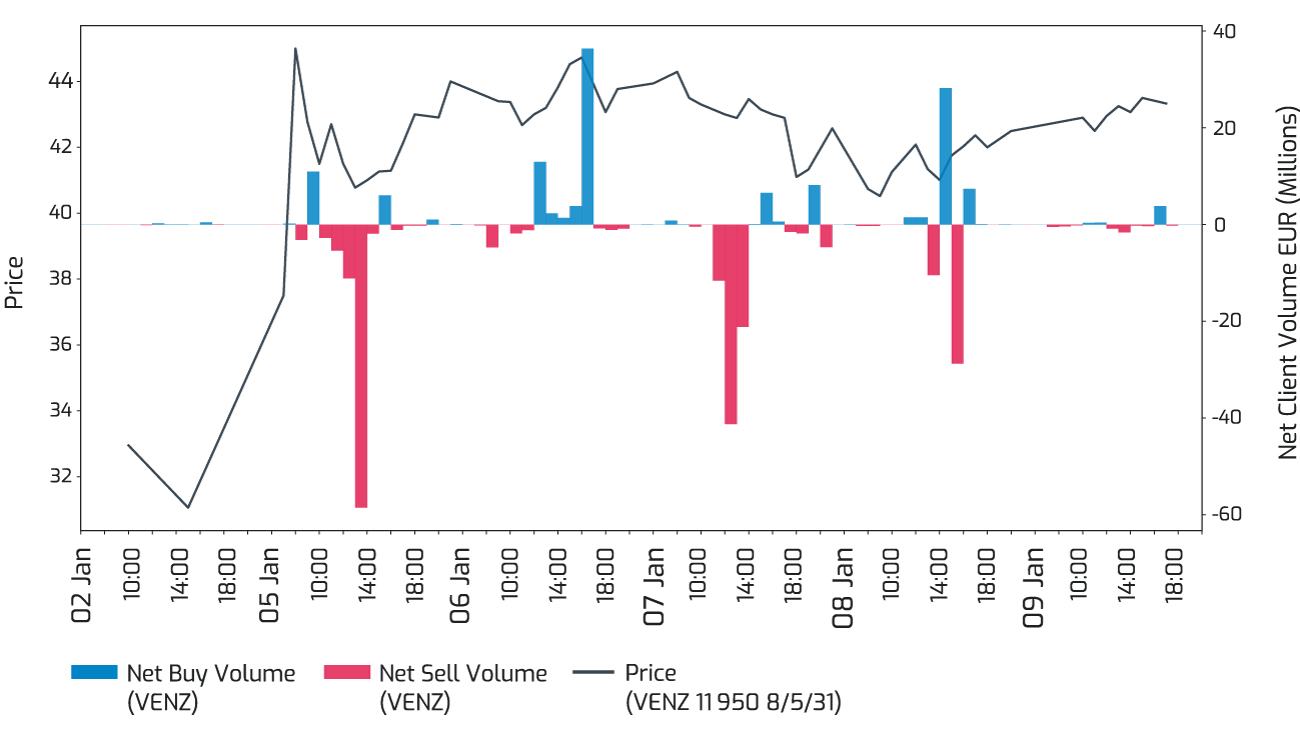
The market reaction to US intervention in Venezuela illustrates the value of enriched transparency. Using TraX data, clients were able to see trade direction on every transaction — insight that is not available under either the FCA or ESMA regimes. In the 5-year Venezuelan government bond (VENZ 11.950 8/5/31), client sell-offs on Monday afternoon were followed by renewed buying on Tuesday, closely mirroring sharp price movements as the news unfolded.
In addition, TraX captured activity that never became publicly visible, with 17% of Venezuelan bond trades unique to TraX in the week following the intervention. Crucially, this data was cleaned and de-duplicated in real time, allowing users to observe true market behaviour as it happened, rather than reconstruct it after the fact.
How the market reacted to the 2026 US intervention in Venezuela
What comes next
TraX Tape1 is currently being tested with our largest clients and contributors, reflecting our long-standing approach of building products in close partnership with the market. The roadmap is clear: delivery via CSV and API, followed by a graphical interface shortly thereafter. But this is just the starting point: because TraX Tape is built on proprietary data and analytics, we can continue to enhance fields, calculations, and datasets on a commercial cadence as client needs evolve.
Our ambition is to evolve TraX Tape into a truly global data source by incorporating public CTP data1 and US data sources to deliver a consistent, enriched single view of market activity across all regions. In parallel, we expect to make longer-run historical time series available, enabling back-testing and more advanced quantitative research against a dataset that extends beyond what new public tapes can offer. As firms seek usable transparency now, rather than fragmented data or uncertain future solutions, we continue to work closely with clients to help shape the next phase of transparency.
The direction of travel: an enriched public bond tape
The EU & the UK are moving towards public consolidated bond tapes — but experience from the US shows the end state is rarely “raw tape only”. Since the introduction of TRACE, the most sophisticated firms have increasingly relied on enriched TRACE products to improve usability, provide better context, and reduce internal processing.
The same landscape is emerging in Europe: two baseline public bond tapes, and a growing requirement for consolidated, cleaned, and enriched data that trading desks can actually use. TraX Tape is built for that end state — delivering the benefits of consolidation while adding the quality, coverage, and context that institutions need. We have used this model with TraX for over 20 years: with contributor-led inputs, designed around market needs, and continuously refined as usage patterns evolve.
1Our intent is to include CTP data from both the EU and UK CTPs; however, this is subject to the final terms and conditions imposed by each CTP.